

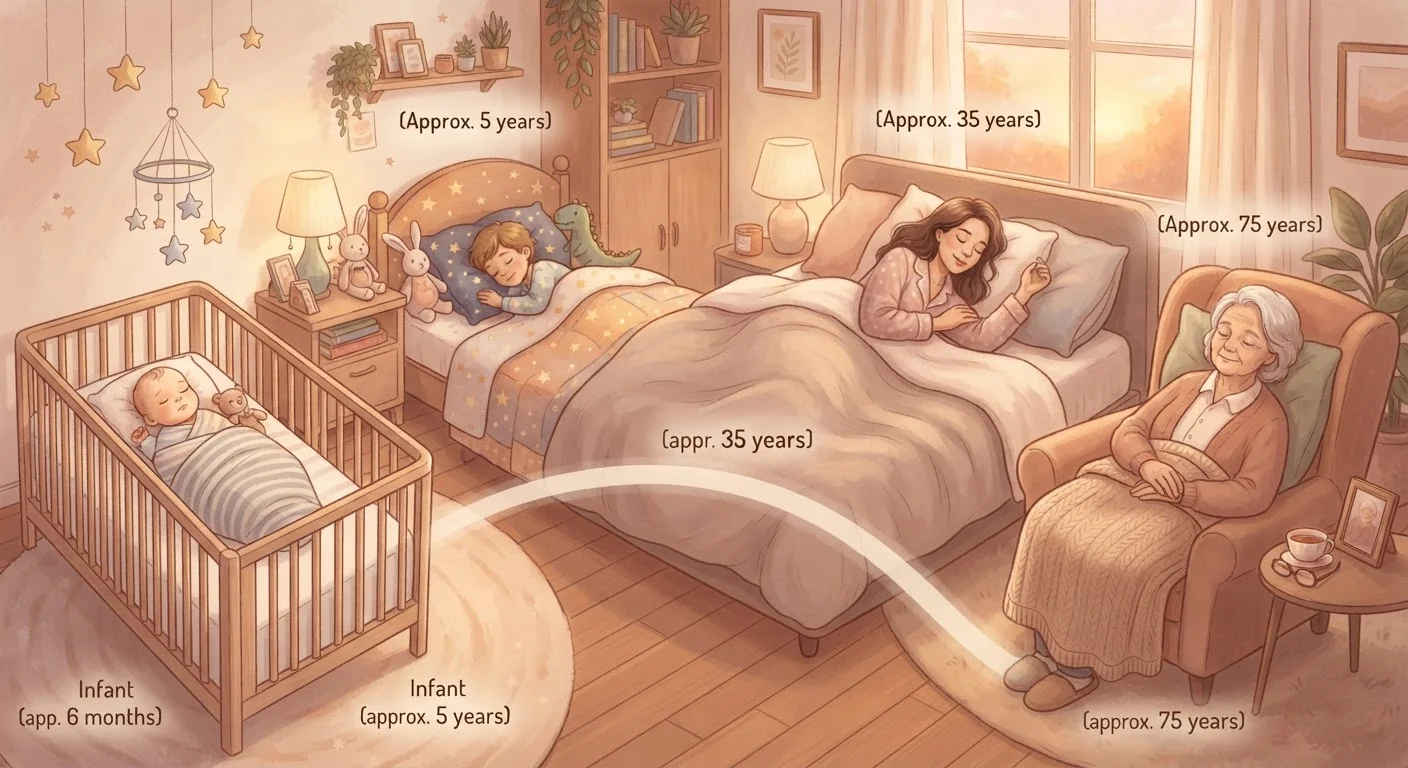
Why Sleep Architecture Changes Over Time
Sleep is not a fixed, uniform state - it is a dynamic biological process whose structure, timing, and duration shift continuously across the human lifespan. These changes are driven by shifts in brain maturation, hormonal output, circadian rhythm calibration, and accumulated neurological wear. Understanding them is foundational to making sense of why a teenager seems impossible to wake before noon, why a new parent is perpetually exhausted, or why an older adult wakes at 4 a.m. despite going to bed early.
At the core of these changes is sleep architecture - the cycling pattern of sleep stages that repeats throughout the night. To understand how this architecture evolves, it helps to first understand the stages themselves. Our deep dive into REM, light, and deep sleep explains each stage and why disrupting them impairs recovery. In brief: sleep oscillates between non-REM stages (light and deep) and REM (rapid eye movement) sleep, with each full cycle lasting roughly 90 minutes. The proportions of these stages change dramatically from birth onward.
50%
REM sleep proportion in newborns
Newborns spend roughly half their sleep in REM, reflecting the brain's intensive early development phase.
14-17 hrs
Daily sleep needed by newborns
According to the American Academy of Sleep Medicine, newborns require substantially more sleep than any other age group.
1-3 hrs
Adolescent circadian phase delay
Research shows puberty shifts melatonin release timing by up to three hours, biologically driving later sleep onset in teens.
50%+
Decline in deep sleep by older adulthood
Slow-wave sleep can decrease by more than half between young adulthood and older age, making sleep lighter and more fragmented.
Infants and Toddlers: Sleep as a Developmental Engine
Newborns sleep between 14 and 17 hours per day, according to guidance from the American Academy of Sleep Medicine (AASM). But this sleep looks nothing like adult sleep. Infants spend roughly 50% of their total sleep time in REM - compared to about 20-25% in healthy adults - because REM is a primary driver of synaptic development and memory consolidation in the rapidly maturing brain.
Infant sleep cycles are also much shorter (approximately 50-60 minutes) and their transitions between sleep states are more abrupt, which explains frequent nighttime awakenings. By age one, most children consolidate sleep into longer overnight stretches plus one or two daytime naps. Toddlers (ages 1-2) need 11-14 hours, while preschoolers (ages 3-5) require 10-13 hours, including naps that phase out gradually as the homeostatic sleep drive matures.
For infants, prioritize consistency in the sleep environment - darkness, white noise, and a predictable pre-sleep routine - rather than trying to force a specific schedule too early. The circadian system needs several months to fully mature.
Infant circadian rhythms are not fully established until around 3-4 months of age; consistent environmental cues help accelerate this entrainment process.
If you have a teenager who cannot fall asleep before 11 p.m., reducing bright light and screen exposure after sunset is more effective than earlier bedtimes alone - the circadian delay must be addressed at its biological root.
Blue-spectrum light exposure in the evening suppresses melatonin and compounds the natural adolescent phase delay, making behavioral light management one of the highest-leverage interventions available.
This article provides general health information only. Consult a pediatrician for guidance specific to your child's sleep patterns or concerns.
School-Age Children and Adolescents: Shifting Clocks
Children between ages 6 and 12 need 9-12 hours of sleep. During this period, sleep architecture stabilizes closer to adult patterns, with deeper slow-wave (deep NREM) sleep occurring in greater abundance than at any other life stage - a reflection of the intense synaptic pruning and learning consolidation underway. Insufficient sleep in this age group is associated with attention difficulties, emotional dysregulation, and impaired academic performance.
Adolescence introduces one of the most consequential biological sleep shifts: a circadian phase delay. Around puberty, the timing of melatonin secretion shifts by 1-3 hours, causing teenagers to feel genuinely alert later in the evening and to struggle with early morning waking. This is not laziness - it is a hormonally mediated change. Chronotype research confirms that biological timing preferences are real and developmentally patterned. Despite needing 8-10 hours, many teens accumulate significant sleep debt due to early school start times - a concern major pediatric and sleep medicine organizations have formally raised.
Teen Sleep Debt Has Real Consequences
Chronic sleep deprivation in adolescents is associated with increased risk of mood disorders, impaired academic performance, and higher rates of accidents. Treating a teenager's struggle to wake early as a discipline issue rather than a biological one can lead to unnecessary conflict and missed opportunities for genuine support. If sleep difficulties are severe or persistent, consult a pediatric sleep specialist.
Adults: The Maintenance Window
Healthy adults generally need 7-9 hours of sleep per night. By the mid-twenties, sleep architecture has largely stabilized, though slow-wave sleep begins a gradual, decades-long decline starting around age 30. REM sleep remains roughly constant through middle age. Adults are also more susceptible than younger people to circadian disruption from shift work, travel across time zones, and - critically - habitual behavioral choices made in the hours before bed.
Pre-sleep habits such as screen exposure, alcohol use, and irregular sleep timing can meaningfully erode sleep quality even when total hours appear adequate. Adults also experience stronger links between sleep and emotional health: research consistently shows that chronic short sleep amplifies emotional reactivity and stress response. For a closer look at this connection, see how sleep affects emotional regulation.
Older Adults: Why Sleep Becomes Lighter and Earlier
A common misconception is that older adults simply need less sleep. The evidence suggests otherwise: most sleep researchers consider 7-8 hours still appropriate for adults over 65. What changes substantially is sleep architecture and timing. Slow-wave (deep) sleep decreases markedly - sometimes by more than 50% compared to young adulthood - making sleep lighter and more vulnerable to interruption. Sleep efficiency (the proportion of time in bed actually spent asleep) also declines.
Circadian timing shifts earlier in older age - an advance rather than a delay - causing many older adults to feel sleepy by early evening and to wake before dawn. This is partly driven by reduced light sensitivity in the aging eye, which impairs the light-based signals that anchor the circadian clock. Conditions that fragment sleep, including sleep apnea, restless legs syndrome, and nocturia, also become more prevalent with age.
Sleep Changes ≠ Sleep Disorders
Not every age-related shift in sleep is a medical problem. Lighter sleep, earlier wake times, and reduced deep sleep are normal features of healthy aging. However, symptoms like loud snoring, gasping during sleep, or excessive daytime sleepiness at any age warrant evaluation by a healthcare provider, as they may signal treatable conditions rather than normal aging.
Optimizing the sleep environment remains one of the most practical and evidence-supported interventions at this life stage. Bedroom environment adjustments - managing light, temperature, and noise - can have measurable effects on sleep continuity for older adults.
Practical Strategies for Every Life Stage
While sleep needs and patterns differ across life stages, several evidence-based principles apply broadly. Consistency in sleep and wake times - even on weekends - anchors the circadian clock at every age. Protecting the sleep environment from disruptive light and noise is equally valuable whether you are settling a toddler or managing your own insomnia.
- Infants and toddlers: Follow age-appropriate sleep schedules; prioritize darkness and quiet during nighttime sleep to reinforce circadian cues.
- School-age children: Limit screens in the hour before bed; maintain consistent bedtimes even during school breaks.
- Adolescents: Advocate for later school start times where possible; reduce evening light exposure to avoid further delaying the circadian clock.
- Adults: Audit evening habits systematically - alcohol, caffeine timing, and late-night screen use are the most common culprits in self-reported sleep difficulties.
- Older adults: Maximize daytime light exposure to anchor the circadian rhythm; discuss sleep fragmentation with a healthcare provider, as treatable conditions like sleep apnea are frequently under-diagnosed in this group.
Sleep is one of the most modifiable factors in long-term health. Understanding how it changes across life - rather than treating any single pattern as the norm - is the first step toward protecting it at every stage.
This article is for general informational purposes only and does not constitute medical advice. Always consult a qualified healthcare professional for concerns about your sleep or that of a child or older adult in your care.
The content on this site is for informational purposes only and is not a substitute for professional advice. Always consult a qualified professional for guidance specific to your situation.