

Why Your Bedroom Environment Matters More Than You Think
Many people focus exclusively on sleep habits - consistent bedtimes, limiting screens - while overlooking the physical space where sleep actually happens. Yet research in sleep medicine consistently finds that environmental factors directly influence how quickly you fall asleep, how deeply you sleep, and how often you wake during the night.
Your brain does not simply switch off at bedtime. It monitors the environment throughout the night, and sensory signals - a temperature that's too warm, a sudden noise, or light filtering through a window - can fragment sleep architecture even when they don't fully wake you. Understanding the three primary environmental levers gives you a practical framework for redesigning your bedroom around sleep physiology rather than aesthetics alone.
For a broader look at how nighttime habits interact with your environment, see our guide to evening habits that support sleep quality.
“The bedroom environment - its temperature, light, and noise levels - is not just background context. It actively participates in sleep physiology. Small, deliberate changes to that environment can meaningfully shift sleep quality for many people.”
— Matthew Walker, Professor of Neuroscience and Psychology, University of California, Berkeley; author of research on sleep and brain health
Temperature: The Most Underrated Sleep Variable
Core body temperature naturally drops by 1-2°F in the hours before sleep - a process that signals the brain to initiate rest. A bedroom that is too warm interferes with this thermoregulatory process, increasing the time it takes to fall asleep and reducing the proportion of slow-wave (deep) sleep.
Research cited by the American Academy of Sleep Medicine suggests that most adults sleep best in rooms between approximately 65-68°F (18-20°C), though individual comfort varies. Children and older adults may have different thermoregulatory needs - if you're considering adjustments for family members outside the typical adult range, consult a healthcare provider for guidance appropriate to their life stage. Our article on sleep across the lifespan covers how these needs shift with age.
65-68°F
Optimal sleep room temperature range
Research cited by the American Academy of Sleep Medicine identifies this range as supportive of sleep onset and deep-sleep maintenance for most adults.
40-50 dB
Noise threshold for sleep micro-arousals
Polysomnographic studies have found that sounds at this level can interrupt sleep stages even without fully waking the sleeper.
Practical options include setting a programmable thermostat to drop temperature before your target bedtime, using breathable natural-fiber bedding, or - if air conditioning is unavailable - cooling the room with fans before bed rather than during sleep, since fan noise can itself be disruptive for some people.
Noise: Managing Sound for Uninterrupted Sleep
The sleeping brain remains responsive to sound. Research using polysomnography (a multi-sensor sleep study technique) shows that auditory stimuli at levels as low as 40-50 decibels can cause measurable micro-arousals - brief interruptions to sleep stages that reduce restorative value without fully waking the sleeper.
The goal is not necessarily silence. In fact, complete silence can itself make transient sounds more jarring by contrast. Many sleep researchers recommend continuous, low-level background noise - sometimes called masking noise - to reduce the contrast between quiet periods and sudden sounds.
White Noise vs. Pink Noise: What to Know
White noise contains all frequencies at equal intensity and is well-established as a sleep masking tool. Pink noise emphasizes lower frequencies and sounds more like falling rain; some small studies suggest it may support deeper sleep, but the evidence is preliminary. Either can be worth trying - consistency of use matters more than which type you choose.
White noise machines, fans, and similar devices generate broadband sound that effectively masks common disturbances like traffic, neighbors, or household activity. For those who find white noise tonally harsh, pink noise (which emphasizes lower frequencies) has shown some promise in preliminary research as a sleep aid, though the evidence base is less established than for white noise. Earplugs are another low-cost option, with a noise reduction rating (NRR) printed on the packaging indicating their effectiveness.
If noise disturbance is severe - for example, living near a highway or construction zone - structural solutions like double-pane windows or door draft seals may offer more durable relief. These fall under general home maintenance improvements that have both sleep and quality-of-life benefits.
Light: Protecting Your Circadian Signal After Dark
Light is the primary cue your internal clock (circadian rhythm) uses to calibrate timing. The retina contains specialized photoreceptors called intrinsically photosensitive retinal ganglion cells (ipRGCs) that are particularly sensitive to blue-wavelength light - the kind emitted by LED screens, overhead lighting, and early morning sunlight. When these cells detect light after dark, they suppress melatonin production and signal the brain to remain alert.
Even low-level light exposure during sleep - from a streetlamp, a standby LED, or a phone screen - can reduce melatonin and shift sleep timing. Our in-depth article on how light exposure shapes your circadian rhythm explores this mechanism in detail.
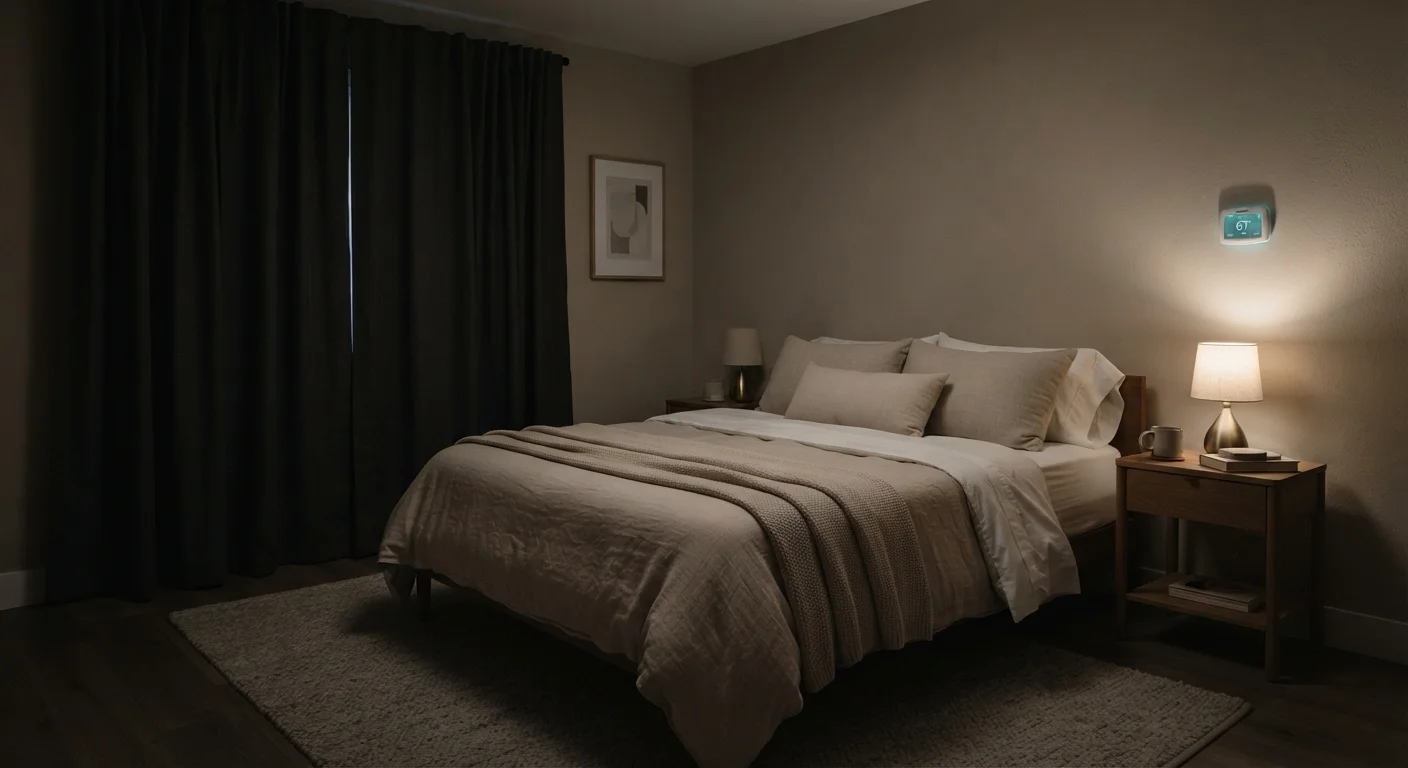
Set your thermostat to cool the room before bedtime, targeting approximately 65-68°F (18-20°C).
Core body temperature must drop to initiate deep sleep. A warm room counteracts this natural process, increasing sleep latency and reducing slow-wave sleep. Programming a thermostat to lower temperature 30-60 minutes before bed aligns the environment with the body's own timing.
Use blackout curtains or a sleep mask to eliminate light intrusion during sleep hours.
Even ambient low-level light suppresses melatonin and can fragment sleep through micro-arousals. Blackout window treatments remove the most common source of nighttime light exposure - outdoor streetlamps, car headlights, and early morning sunlight.
Introduce a consistent background masking noise, such as a white noise machine or fan.
Continuous low-level background sound reduces the acoustic contrast that makes sudden noises disruptive. This masking effect prevents the brain from reacting sharply to transient sounds like traffic or household activity.
Cover or remove all blue-spectrum indicator lights and standby LEDs from the sleep environment.
Small standby lights - on chargers, televisions, or smart devices - emit blue-spectrum light that the circadian system detects. Eliminating or covering these sources reduces cumulative light exposure during the night.
Choose breathable, natural-fiber bedding to support temperature regulation throughout the night.
Body heat accumulates under bedding during sleep. Natural fibers like cotton or linen wick moisture and allow airflow, helping maintain the cooler microclimate that promotes sustained deep sleep.
The most effective single intervention for light control is blackout curtains or blackout blinds, which block outdoor light sources entirely. Supplementing with a sleep mask is a lower-cost alternative. Inside the room, covering or removing devices with standby indicator lights - or using red-spectrum nightlights for any necessary navigation lighting - reduces the blue-light burden during the sleep period.
For readers dealing with sleep-onset difficulties, it is worth noting that alcohol and caffeine also affect light's impact on sleep architecture. Our article on caffeine, alcohol, and sleep covers how these substances interact with circadian timing.
Putting It Together: Your Quick-Start Sleep Environment Plan
Improving your sleep environment does not require significant expense. The most evidence-supported changes - adjusting thermostat settings, adding a white noise source, and installing blackout curtains - are each available at modest cost and can be tested independently to see which yields the greatest benefit for your situation.
Pair these environmental changes with a consistent wind-down routine for compounding effect. If you continue experiencing persistent difficulty sleeping despite environmental optimization, consult a healthcare professional - some sleep difficulties reflect underlying conditions such as those described in our overview of common sleep disorders.
This article is for general informational and educational purposes only and is not a substitute for professional medical advice. If you have concerns about your sleep or health, please consult a qualified healthcare provider.
The content on this site is for informational purposes only and is not a substitute for professional advice. Always consult a qualified professional for guidance specific to your situation.