

Start here
What Is a Chronotype?
Understand the science
The Biology Behind Your Sleep Timing
See how it changes
How Chronotypes Shift Across Your Lifetime
Spot the conflict
Social Jet Lag: When Your Schedule Fights Your Biology
Apply it
Working With Your Chronotype
What Is a Chronotype?
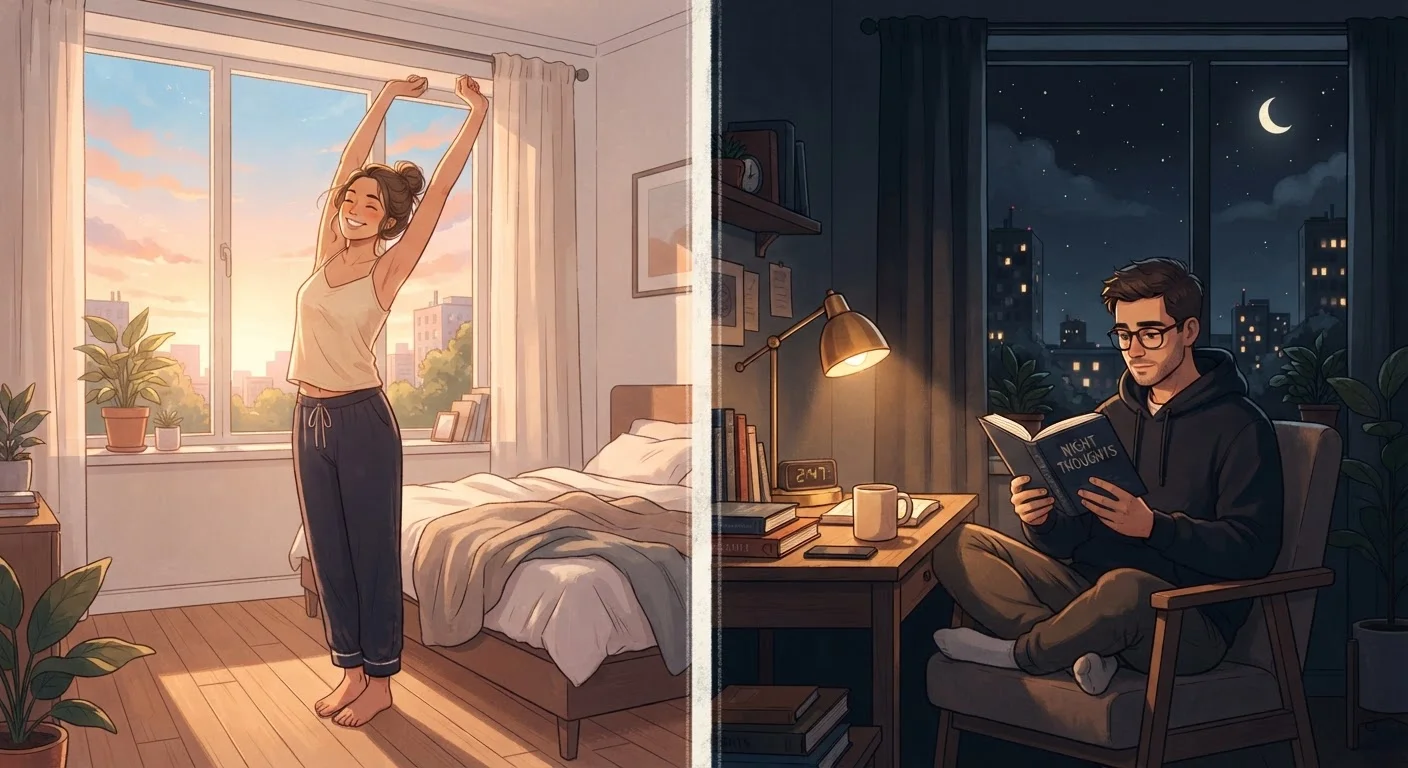
A chronotype is your body's natural preference for when to sleep, wake, and be most alert during a 24-hour period. You may know it by its popular labels: early bird (morning type) or night owl (evening type). But chronotype is not a personality quirk or a lifestyle choice - it is a measurable biological trait that shapes your daily rhythms in real, documented ways.
Researchers typically describe chronotypes on a spectrum. At one end are strong morning types who feel sharp at dawn and fade early in the evening. At the other end are strong evening types who hit their cognitive stride late in the day and struggle to fall asleep before midnight. The majority of people sit somewhere in between as intermediate types.
Chronotype
Your genetically influenced preference for the timing of sleep, wakefulness, and peak alertness within a 24-hour day. It exists on a spectrum from strongly morning-oriented to strongly evening-oriented.
Circadian rhythm
An internal biological cycle running on roughly a 24-hour loop that regulates sleep, hormone release, body temperature, and many other bodily functions. It is set primarily by light exposure.
Melatonin
A hormone produced by the brain's pineal gland that signals darkness and promotes sleepiness. Its timing differs between chronotypes - rising earlier in morning types and later in evening types.
Social jet lag
The health-relevant mismatch between your body's preferred sleep timing and the sleep schedule imposed by work, school, or social commitments. Measured in hours of difference between the two.
Sleep homeostatic drive
The biological pressure for sleep that builds the longer you stay awake and dissipates during sleep. It works alongside your circadian rhythm to determine when you feel sleepy.
Circadian phase
The position of your internal body clock in its 24-hour cycle - essentially, whether your clock is set earlier or later than average, which determines your chronotype.
Understanding your chronotype matters because it influences not just when you feel sleepy, but also when your body temperature peaks, when hormones like cortisol and melatonin rise and fall, and when your cognitive performance is strongest. Ignoring these signals does not make them disappear - it simply means you are working against them.
The Biology Behind Your Sleep Timing
Your chronotype is anchored to two interacting biological systems: the circadian clock and the sleep-wake homeostatic drive. The circadian clock is a roughly 24-hour internal timer regulated primarily by light, running in nearly every cell of your body. The homeostatic drive tracks how long you have been awake and builds pressure for sleep the longer you stay up.
Genetics play a substantial role in setting your clock's phase - meaning whether it runs slightly fast (favoring mornings) or slightly slow (favoring evenings). Studies of gene variants including PER3 and CLOCK have identified links to chronotype preferences. A large-scale 2019 genome-wide association study published in Nature Communications identified hundreds of genetic loci associated with morning or evening preference, underscoring just how deeply rooted chronotype is in human biology.
Light exposure also acts as a powerful external regulator. Morning sunlight suppresses melatonin and anchors your clock to an earlier phase, while evening light - including screens - can delay it. How light exposure shapes your circadian rhythm explains in detail how these signals interact with your internal clock day to day.
Try the free-day sleep test
To get a rough sense of your natural chronotype, pay attention to your sleep and wake times on several consecutive days when you have no obligations and no alarm set. The midpoint of your sleep window on those days (e.g., falling asleep at midnight and waking at 8 a.m. gives a midpoint of 4 a.m.) is used by researchers as a simple chronotype indicator. Consistency across free days strengthens the estimate.
How Chronotypes Shift Across Your Lifetime
Chronotype is not fixed forever. It follows a predictable developmental arc that researchers have documented across large populations. Young children tend to be strong morning types. Through puberty and adolescence, the circadian clock shifts progressively later - a biological change driven partly by hormonal shifts and changes in the brain's sensitivity to light. Peak evening preference typically occurs in the late teens and early twenties.
After early adulthood, chronotypes gradually shift back toward earlier timing, a trend that continues through middle age and into older adulthood, when many people return to earlier sleep and wake times. This lifespan pattern is well established in sleep science and is why the same teenager who cannot get out of bed at 7 a.m. may eventually become someone who wakes naturally at 6 a.m. decades later.
For a broader picture of how sleep architecture and needs evolve at every life stage, see Sleep across the lifespan.
Social Jet Lag: When Your Schedule Fights Your Biology
Social jet lag describes the misalignment between your biological sleep timing and the timing imposed by work, school, or social obligations. The term was coined by sleep researcher Till Roenneberg and refers to the gap - measured in hours - between when your body wants to sleep and when your schedule forces you to sleep.
For a strong evening chronotype required to be at work by 8 a.m., that gap can easily be two to three hours. Over time, this chronic misalignment accumulates like travel jet lag: impaired concentration, mood disruption, metabolic stress, and increased reliance on caffeine to function. Research has linked high degrees of social jet lag to elevated risk of metabolic syndrome, obesity, and cardiovascular markers, independent of total sleep duration.
Chronic sleep deprivation is not a minor inconvenience
Persistently sleeping less than your body requires - whether caused by social jet lag or other factors - is associated with impaired immune function, cognitive decline, metabolic disruption, and increased accident risk. Normalizing insufficient sleep as a productivity strategy is not supported by evidence. If you regularly rely on caffeine to function or feel unrefreshed most mornings, speaking with a healthcare provider about your sleep is worthwhile.
Evening habits play a meaningful role in how much social jet lag compounds. Reviewing your evening routine for sleep quality is a practical first step in reducing the gap where schedule flexibility is limited.
Working With Your Chronotype
You may not be able to change your job's start time, but there are evidence-informed strategies for reducing the friction between your biology and your daily schedule.
- Identify your natural timing: Track when you fall asleep and wake up on free days without an alarm over at least a week. This gives you a baseline chronotype estimate free from schedule pressure.
- Use light strategically: Morning light exposure - even a short walk outdoors - can gradually anchor an evening chronotype to an earlier phase. Dimming screens and lights in the hour before bed helps signal sleep onset.
- Schedule cognitively demanding tasks wisely: Morning types typically peak in focus and working memory in the late morning; evening types often hit their cognitive stride in the afternoon or early evening. Aligning complex tasks with your peak alertness window can improve output and reduce mental fatigue.
- Be thoughtful about naps: Short naps timed carefully can help offset the alertness deficits of social jet lag without displacing nighttime sleep. When napping helps or hurts covers the evidence on timing and duration.
- Maintain consistency on weekends: Sleeping in dramatically on weekends worsens social jet lag rather than relieving it by shifting your clock later again just before the workweek restarts.
This article is for general informational and educational purposes only and is not a substitute for professional medical advice. If you have concerns about your sleep patterns, health, or well-being, consult a qualified healthcare professional.
Frequently Asked Questions
Chronotypes are largely genetic and cannot be fundamentally changed by willpower alone. You can nudge your sleep timing modestly using light exposure and consistent schedules, but forcing a strong night owl into an early-bird pattern long-term is working against biology, not building a habit.
Research does suggest evening chronotypes face higher rates of metabolic and mental health challenges, but this is largely because modern schedules are misaligned with their biology. The health gap narrows significantly when evening types get enough sleep at their preferred times.
One widely used research tool is the Munich Chronotype Questionnaire (MCTQ), which estimates chronotype from your sleep timing on work-free days. A simpler approach: note when you naturally fall asleep and wake without an alarm over several consecutive free days.
Research is clear: adolescence produces a genuine biological shift toward later sleep timing driven by hormonal and circadian changes. This is not a behavioral choice. Many health and education bodies now advocate for later school start times based on this evidence.
Evening chronotypes show higher statistical associations with depression, anxiety, and mood disorders in research studies. However, the relationship is complex and partly explained by chronic sleep deprivation from social jet lag rather than chronotype itself being a direct cause.
Yes - most people fall somewhere in the middle and are called intermediate chronotypes. The early-bird/night-owl framing represents the ends of a continuous spectrum, and intermediate types have the most flexibility in adjusting their schedules.
The content on this site is for informational purposes only and is not a substitute for professional advice. Always consult a qualified professional for guidance specific to your situation.