

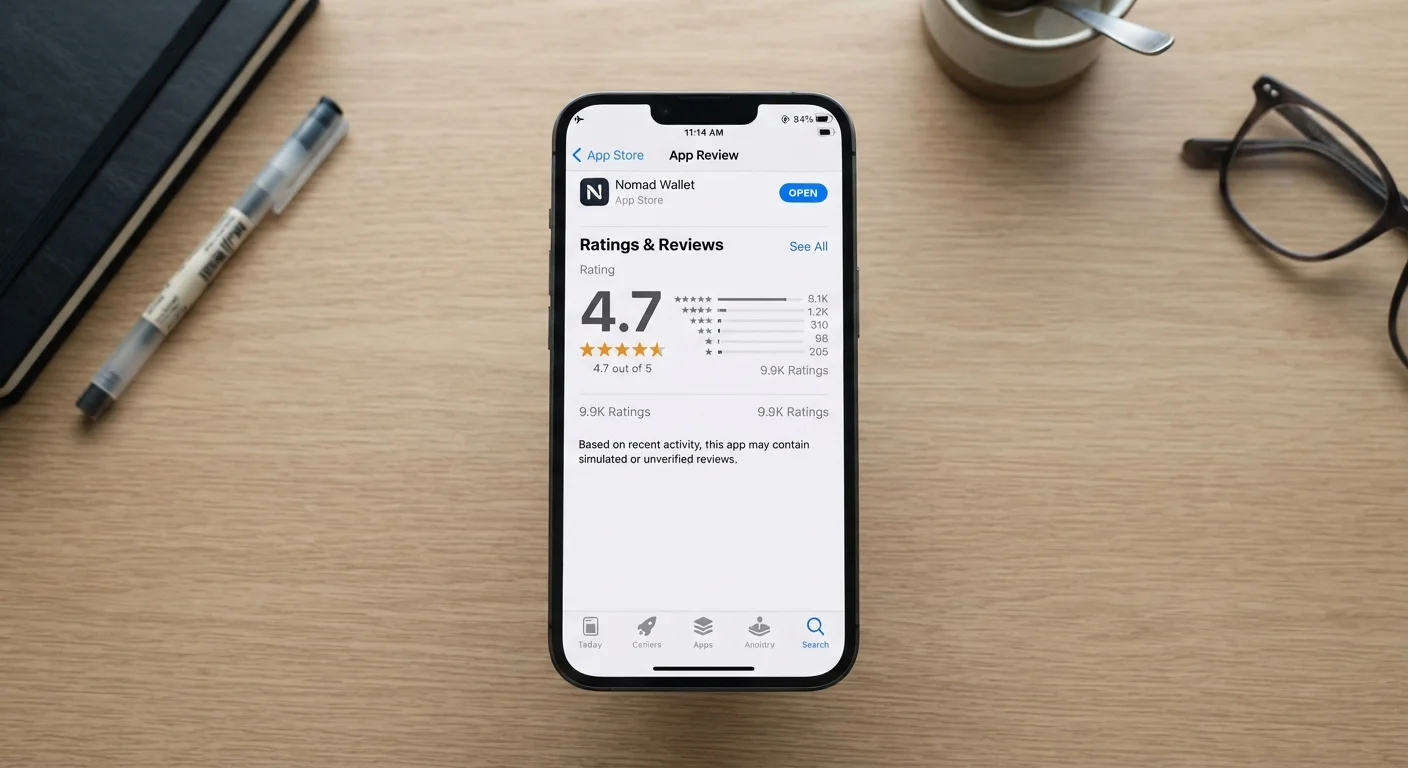
Why Star Ratings Feel More Reliable Than They Are
When you're deciding whether to install an app, a 4.7-star rating from tens of thousands of reviewers seems like solid social proof. It feels democratic — a collective verdict from real users. The problem is that the mechanisms behind those ratings are far less neutral than they appear.
App ratings are shaped by prompts, timing, platform policies, and developer strategy. Understanding those forces doesn't mean every highly rated app is bad — it means you'll be better equipped to judge which ratings actually reflect user experience and which ones are statistical noise or the result of deliberate engineering.
Myth
A high star rating means most users are happy with the app.
Fact
Ratings disproportionately reflect users who were specifically prompted to review at a moment of satisfaction — not a representative cross-section of all users.
Developers can trigger an in-app review prompt at strategically chosen moments: right after a user completes a task successfully, finishes a level, or achieves a goal. Users who encounter bugs, confusing interfaces, or billing problems are far less likely to be shown a prompt — and less likely to seek out the review screen on their own. The result is a systematic tilt toward positive reviews that the star average can't correct for.
Myth
More reviews means the rating is more accurate and trustworthy.
Fact
Volume reduces some randomness, but it doesn't eliminate the underlying prompt bias or account for changes in app quality over time.
A large review count does reduce the impact of outliers, but it also accumulates the same directional bias at scale. If an app has prompted reviews at positive moments for three years, its 80,000-review average still reflects that skew — just with more data points reinforcing it. Volume is a weak proxy for reliability.
Myth
Incentivized reviews are prohibited, so they don't really happen.
Fact
Both major app stores prohibit incentivized reviews, but enforcement is imperfect and indirect incentives are common.
Apple and Google both have policies against developers offering rewards in exchange for reviews. However, enforcement relies largely on detection after the fact. More commonly, developers use indirect approaches: prompting users who have just received a discount, a free premium feature, or a gift to leave feedback. These tactics occupy a gray area that platform policies don't always catch cleanly.
Myth
One-star reviews are usually from unreasonable or extreme users.
Fact
One-star reviews frequently contain the most specific and actionable information about real product problems.
Users who take the time to write a negative review despite no prompt to do so are often motivated by a genuine and frustrating experience. While some low-rated reviews reflect misunderstandings or user error, patterns across multiple one-star reviews — the same complaint appearing repeatedly from different accounts — are a reliable signal of a real issue. Dismissing them as fringe feedback is a mistake.
Myth
The rating you see reflects the app's full history.
Fact
Developers can request a rating reset on major version updates, so the displayed rating may only cover recent releases.
When an app ships a significant update, both Apple and Google permit the developer to reset the rating counter so that the displayed score reflects only the new version. This is sometimes legitimate — a developer who fixed longstanding problems deserves a fresh start — but it also means you may have no visibility into years of prior user experience. Always check the version history and update notes alongside the rating.
What the Numbers Don't Show You
Even a legitimate, unmanipulated rating has real limitations. The star average is calculated across all reviews ever submitted — which means a painful period two years ago when an update broke core features may be buried under hundreds of satisfied reviews posted since.
~77%
Apps that use in-app review prompts
Research from mobile analytics firms has consistently found that the majority of top-charting apps use OS-level review prompt APIs to solicit ratings at developer-chosen moments.
3–5×
Review rate difference between prompted and unprompted users
Studies on mobile feedback behavior suggest prompted users leave reviews at dramatically higher rates than those who seek out the review screen independently, skewing the overall distribution.
Both Apple's App Store and Google Play allow developers to request a version-specific rating reset when a major update ships. This is a legitimate feature, but it means the visible rating may reflect only the most recent release — not the app's full history. If you're evaluating an app that has existed for years, that history matters.
Text reviews tell a more complete story than stars ever can. Sort by "Most Recent" and look specifically at one- and two-star reviews. Patterns in negative feedback — repeated mentions of crashes, data loss, aggressive subscription upsells, or unresponsive support — are far more actionable than any aggregate number. For a deeper look at what else to evaluate before installing, see our pre-install checklist.
Don't Rely on Ratings Alone for Sensitive Apps
For apps that handle financial data, health information, or personal communications, a high star rating is especially insufficient as a trust signal. These categories warrant extra scrutiny of permissions, privacy policies, and developer transparency. Our pre-install checklist covers the specific checks that matter most for high-stakes apps.
Making Smarter App Decisions Going Forward
A better approach to evaluating apps combines the star rating as one weak signal among several stronger ones. Check when the most recent reviews were posted. Look at the developer's response history — developers who reply to critical reviews and describe fixes tend to be more accountable. Note the total review count relative to the download estimate; a 4.9-star app with only 12 reviews tells you almost nothing.
You should also consider the platform context. App store policies differ between Android and iOS in ways that affect how reviews are collected and moderated. And if an app is free, remember that its business model may involve data collection rather than a direct transaction — our article on the privacy trade-offs of free apps explains what that exchange actually looks like. Ratings rarely reflect privacy practices at all.
Finally, keep installed apps updated. A well-rated app can develop serious security gaps in older versions. Skipping updates carries real risks that a high star rating won't warn you about.
The content on this site is for informational purposes only and is not a substitute for professional advice. Always consult a qualified professional for guidance specific to your situation.