

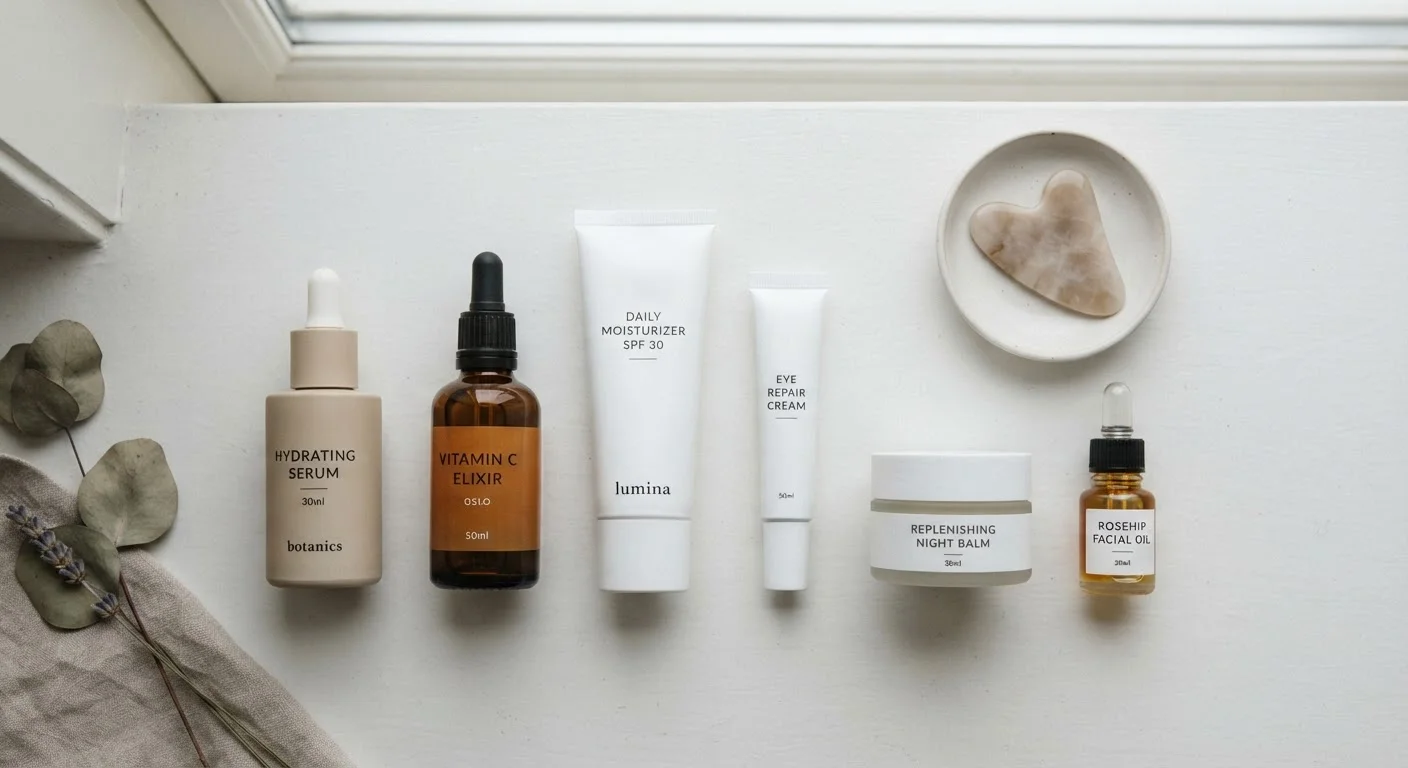
How to Read an Ingredient List
Skincare labels can look like chemistry homework, but the structure is straightforward once you know the rules. In the United States, the FDA requires cosmetic ingredients to be listed in descending order by concentration — meaning the first few ingredients make up the bulk of the formula, while those near the end are present in small amounts.
Practically speaking, if water (aqua) is first and a prized active ingredient appears near the bottom, that active is likely present at a low percentage. That's not always a bad thing — some ingredients, like retinol, work at fractions of a percent — but it helps you calibrate expectations before purchasing.
For a broader look at how ingredient lists work across personal care products beyond skincare, see our plain-language personal care glossary.
| Ingredient list order | Listed from highest to lowest concentration (FDA cosmetic labeling regulations) |
| Retinol concentration range (OTC) | Typically 0.025% – 1% (General cosmetic industry practice) |
| Hyaluronic acid capacity | Can hold up to 1,000x its weight in water (Widely cited in dermatology literature) |
| Niacinamide common range | 2% – 10% in most formulas (General cosmetic formulation data) |
| SPF ingredient regulation | Classified as OTC drugs by the FDA in the U.S. (U.S. Food and Drug Administration) |
| Vitamin C (ascorbic acid) stability | Degrades with light and air exposure; store in opaque or airtight packaging (General cosmetic chemistry) |
The Most Common Actives, Explained
These are the ingredients you'll encounter constantly. Understanding what each one does — and who it's generally suited for — goes a long way toward building a routine that actually serves your skin.
Hyaluronic Acid
A humectant naturally found in the body, hyaluronic acid pulls moisture toward the skin. It suits virtually every skin type and is typically applied to damp skin so it has water available to draw in. It adds hydration without heaviness.
Retinol
A vitamin A derivative widely studied for its role in supporting cell turnover and skin texture. It's one of the most research-backed over-the-counter actives available, but it can cause dryness and sensitivity — especially when you first start using it. Start with a lower concentration and apply at night, as it increases photosensitivity.
Niacinamide
A form of vitamin B3 that helps support the skin barrier, even skin tone, and manage excess oil. It plays well with most other ingredients, making it a versatile option for beginners. Formulas typically range from 2% to 10%.
Vitamin C (L-Ascorbic Acid)
An antioxidant that helps neutralize free radical damage and supports a brighter-looking complexion. It's notoriously unstable — light, heat, and air degrade it quickly — so packaging matters. Look for opaque or airtight containers.
AHAs and BHAs
Chemical exfoliants that remove dead skin cells without physical scrubbing. AHAs (glycolic, lactic acid) work on the surface and suit dry or dull skin; BHAs (salicylic acid) are oil-soluble and work inside pores, making them popular for acne-prone skin. Both increase sun sensitivity, so daily SPF is non-negotiable when using them.
Humectant
A substance that draws moisture from the environment or deeper skin layers to the surface. Hyaluronic acid and glycerin are classic examples. They help skin feel hydrated without adding oil.
Emollient
An ingredient that fills gaps between skin cells and softens the skin's texture. Oils, butters, and fatty acids like squalane act as emollients, leaving skin feeling smooth.
Occlusive
A heavier ingredient that forms a physical barrier on skin to prevent moisture loss. Petrolatum and certain waxes are occlusives often found at the end of an ingredient list in moisturizers.
Retinoid
A class of vitamin A derivatives used in skincare. Retinol is the most widely available over-the-counter retinoid; prescription-strength versions are stronger and require medical oversight.
AHA / BHA
Alpha hydroxy acids (AHAs) and beta hydroxy acids (BHAs) are chemical exfoliants. AHAs like glycolic acid work on the skin's surface; BHAs like salicylic acid are oil-soluble and can reach inside pores.
Occlusives
Ingredients that seal the skin surface to lock in hydration. Common examples include petrolatum, lanolin, and beeswax.
Peptides
Short chains of amino acids that signal skin cells to perform specific functions, such as supporting collagen production. They are generally considered well-tolerated by most skin types.
Comedogenic
Describes an ingredient's potential to clog pores. Products labeled 'non-comedogenic' are formulated to minimize this risk, which may be relevant for acne-prone skin.
Moisturizing Ingredients: Humectants, Emollients, and Occlusives
Not all moisturizing ingredients work the same way. Effective hydration usually involves a combination of three types working together. Humectants attract water, emollients smooth and soften, and occlusives seal everything in. A well-rounded moisturizer often layers all three.
Common humectants include glycerin and hyaluronic acid. Emollients include squalane, fatty acids, and plant-based oils. Occlusives include petrolatum and certain waxes — they're dense but highly effective at preventing moisture loss, particularly for dry or compromised skin.
If you're sorting out which products to use and in what order, our guide to moisturizers versus serums explains how each format fits into a daily routine.
This Is General Information, Not Medical Advice
Ingredient information here is educational and general in nature. Everyone's skin is different, and reactions vary based on concentration, formulation, and individual biology. If you have a skin condition, persistent irritation, or concerns about a specific ingredient, please consult a board-certified dermatologist before changing your routine.
Ingredients to Approach Thoughtfully
A few categories warrant a little extra attention — not because they're inherently dangerous, but because how and when you use them shapes whether they work well for you.
- Fragrance: Listed as 'fragrance' or 'parfum,' this catch-all term can mask dozens of individual compounds. For sensitive or reactive skin types, fragrance-free formulas are generally a lower-risk starting point.
- Alcohol: Some short-chain alcohols (like denatured alcohol) can be drying; fatty alcohols (like cetyl or cetearyl alcohol) are actually emollients. The two are very different despite sharing a name.
- Essential oils: Naturally derived but not inherently gentle. Some are well-tolerated; others are common irritants. Patch-test any new product containing them before applying widely.
For a clear-eyed comparison of how natural and synthetic ingredients actually perform, see Natural vs. Synthetic Ingredients in Personal Care Products.
Ready to put this ingredient knowledge to work? Our guide to starting a skincare routine walks you through exactly what to buy and what to skip when building your first shelf.
This article is for general informational and educational purposes only. It does not constitute medical or dermatological advice. Please consult a qualified healthcare professional for guidance specific to your skin or health needs.
The content on this site is for informational purposes only and is not a substitute for professional advice. Always consult a qualified professional for guidance specific to your situation.