

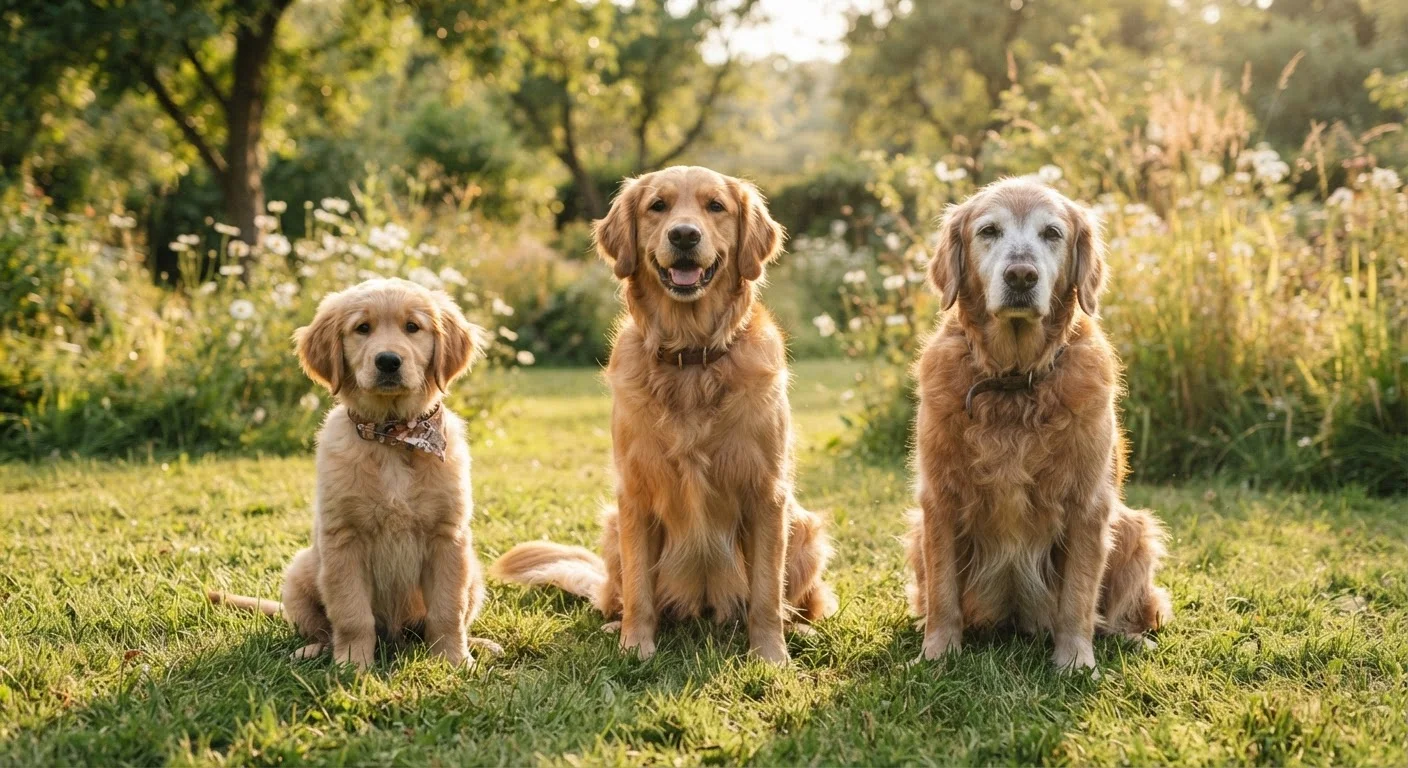
Why Age Matters in Dog Training
Dogs are lifelong learners, but the mechanisms behind their learning shift considerably as they develop. A training strategy that produces fast results in an eight-week-old puppy may frustrate both owner and dog when applied unchanged to a seven-year-old. Understanding the neuroscience and behavioral patterns behind each stage helps owners set realistic goals and choose the right tools.
Developmental biology drives these differences. Brain plasticity — the nervous system's ability to form and strengthen new connections — is highest in early puppyhood and gradually narrows with age. Hormonal surges during adolescence temporarily disrupt impulse control. Sensory decline and possible cognitive changes in older dogs affect how information is processed. None of these factors make training impossible; they simply change what works best.
3–16 weeks
Puppy socialization critical window
Veterinary behaviorists identify this developmental period as the most influential for shaping lifelong temperament.
2–3 min
Ideal session length for young puppies
Short, frequent micro-sessions align with puppy attention spans and prevent cognitive fatigue during early training.
~7 years
When dogs are generally considered senior
The threshold varies by breed and size, with larger breeds aging faster; small breeds may not reach senior status until 10–11 years.
Reading your dog's body language is equally important at any age. Our guide on reading canine body language during training explains how stress signals and engagement cues should shape every session.
Training Puppies (8 Weeks to 6 Months)
The period between roughly 3 and 16 weeks is widely recognized by veterinary behaviorists as the critical socialization window. Positive exposures to people, environments, sounds, and other animals during this time build lasting neural pathways that influence temperament for years. Missing this window isn't irreversible, but later desensitization requires far more effort.
Key training priorities at this stage include:
- Name recognition and attention: The foundation every other skill builds on.
- Basic manners: Sit, down, stay, and come — kept brief (2–3 minutes per session).
- House training: Consistent schedules and supervision, not punishment for accidents.
- Bite inhibition: Puppies learn how hard is too hard through play feedback.
Puppy brains fatigue quickly. Multiple micro-sessions spread through the day outperform a single long drill. Reward delivery must be immediate — puppies cannot bridge a delay of more than 1–2 seconds between behavior and consequence.
Maximize the Socialization Window
Aim to expose your puppy to at least 100 different people, surfaces, sounds, and situations before 16 weeks — in a controlled, positive way. Each new positive experience builds resilience rather than fear. Keep encounters brief and always let the puppy set the pace.
For a comprehensive framework covering socialization, house training, and early commands, see our complete puppy training foundation guide.
Adolescent Dogs (6 Months to 2 Years)
Adolescence is the stage where many owners feel their previously cooperative dog has become a different animal. This is not defiance — it reflects genuine neurological reality. Research in comparative psychology, including a 2020 study in Biology Letters, found that dogs show measurable reductions in obedience toward caregivers during adolescence, paralleling patterns seen in human teenagers.
Hormonal changes affect the prefrontal-equivalent cortex regions responsible for impulse control. A young dog may truly struggle to override arousal in distracting environments, even when the cue is understood in calmer settings.
During adolescence, practice 'premack principle' training — let access to the exciting thing (sniffing a bush, greeting a dog) become the reward for a brief check-in with you first.
Using environmental rewards taps into what the adolescent dog already wants, making compliance more likely than competing against arousal with a small treat.
For senior dogs beginning to show hearing loss, pair your existing verbal cues with distinct hand signals now, while the dog can still hear — the dual association makes the transition seamless.
Dogs learn by association; building the visual cue while the verbal one still works gives the dog time to transfer understanding before hearing fades completely.
Practical adjustments for adolescent training:
- Practice known behaviors in progressively more distracting environments — increase difficulty gradually.
- Use high-value reinforcers (real meat, real cheese) to compete with environmental distractions.
- Keep sessions short (5–7 minutes) and end on success.
- If reactivity or anxiety emerges, address it early rather than waiting it out.
If persistent behavioral challenges arise, choosing between group classes and private instruction can help you decide which setting best supports your adolescent dog.
Adult Dogs (2 to 7 Years)
Adult dogs bring genuine advantages to training: longer attention spans, better impulse control, and established communication patterns with their owners. The old saying that you cannot teach an old dog new tricks is simply not supported by behavioral science — adult dogs learn efficiently when sessions are well-structured.
The main challenge at this stage is that existing habits are more entrenched. An adult dog who has pulled on leash for two years has a well-reinforced motor pattern. Changing it requires consistency and patience, not more force. Extinction of an old behavior while building a new one takes longer than teaching from scratch, so owners should expect a gradual curve.
Adult dogs are also ideal candidates for more complex skill-building: loose-leash walking, reliable off-leash recalls, and behavior modification for anxiety. See our detailed breakdown on teaching loose-leash walking for a structured approach to one of training's most commonly requested skills.
“The notion that dogs stop learning after puppyhood is one of the most persistent and limiting myths in pet ownership. Adult and senior dogs are fully capable of learning new behaviors — what changes is the context and patience the owner needs to bring.”
— Dr. Karen Overall, Board-certified veterinary behaviorist and author of clinical behavioral medicine texts
Senior Dogs (7+ Years)
Senior dogs — generally considered 7 years and older, though this varies by size and breed — can absolutely continue learning. Mental engagement through training is widely considered beneficial for cognitive health in aging dogs, much as enrichment activities benefit aging brains across species.
However, owners must account for real physical and perceptual changes:
- Hearing loss: Many older dogs develop partial or complete deafness. Transitioning to hand signals before hearing loss is complete gives the dog time to learn the new cue.
- Vision changes: Reduced visual acuity affects how dogs read hand signals in low light.
- Joint pain and mobility: Asking a dog with arthritis to perform repeated sit-down-sit repetitions causes discomfort and should be avoided.
- Canine Cognitive Dysfunction (CCD): A condition in older dogs analogous to dementia in humans, affecting memory and learning. A veterinarian should evaluate any sudden or significant behavioral change.
Don't Ignore Sudden Behavioral Changes in Senior Dogs
A senior dog who suddenly stops responding to known cues, seems disoriented, or shows new anxiety may be experiencing pain, sensory loss, or early Canine Cognitive Dysfunction. These are medical concerns, not training problems. Schedule a veterinary examination before adjusting your training plan.
Short, low-impact sessions with familiar cues are the senior dog's sweet spot. This is also a meaningful time to introduce new enrichment — scent work, for example, relies on a sense that often stays strong even as other senses diminish. For broader health context, our article on aging pet health changes covers what to expect and when to seek veterinary guidance.
Principles That Hold at Every Age
Despite the meaningful differences across life stages, several training principles hold firm from puppyhood through the senior years:
- Positive reinforcement is effective at every age. Reward-based training works because it aligns with how all mammalian brains learn — behavior that produces good outcomes gets repeated.
- Clarity beats repetition. Repeating a cue multiple times when a dog doesn't respond teaches the dog to wait for the third or fourth cue. Say it once, help the dog succeed, then reward.
- Short sessions outperform long ones. Regardless of age, mental fatigue degrades performance. End before the dog disengages.
- Consistency across all household members matters. A behavior trained by one person but ignored by another will not generalize reliably.
- Health affects behavior. Pain, illness, and sensory changes alter a dog's capacity to learn. Rule out medical causes before attributing problems to attitude.
If separation-related distress appears at any age, recognize that it is a behavioral condition requiring specific strategies — our guide on separation anxiety training strategies outlines evidence-based approaches.
This article provides general educational information about dog training and is not a substitute for guidance from a certified professional trainer or veterinary behaviorist. If your dog is showing sudden behavioral changes, consult a licensed veterinarian to rule out underlying medical causes.
The content on this site is for informational purposes only and is not a substitute for professional advice. Always consult a qualified professional for guidance specific to your situation.