

Start here
Why Early Training Sets the Foundation
Next
Socialization: The Critical Window
Then
House Training Basics
When you're ready
Teaching Core Commands
Ongoing
Building Good Habits for the Long Term
Why Early Training Sets the Foundation
Puppies are not blank slates waiting for a formal start date — they are learning constantly from the moment they enter your home. Every interaction teaches them something: how humans behave, what earns rewards, and what the world feels like. Intentional training from day one channels that learning in a direction that benefits both dog and owner.
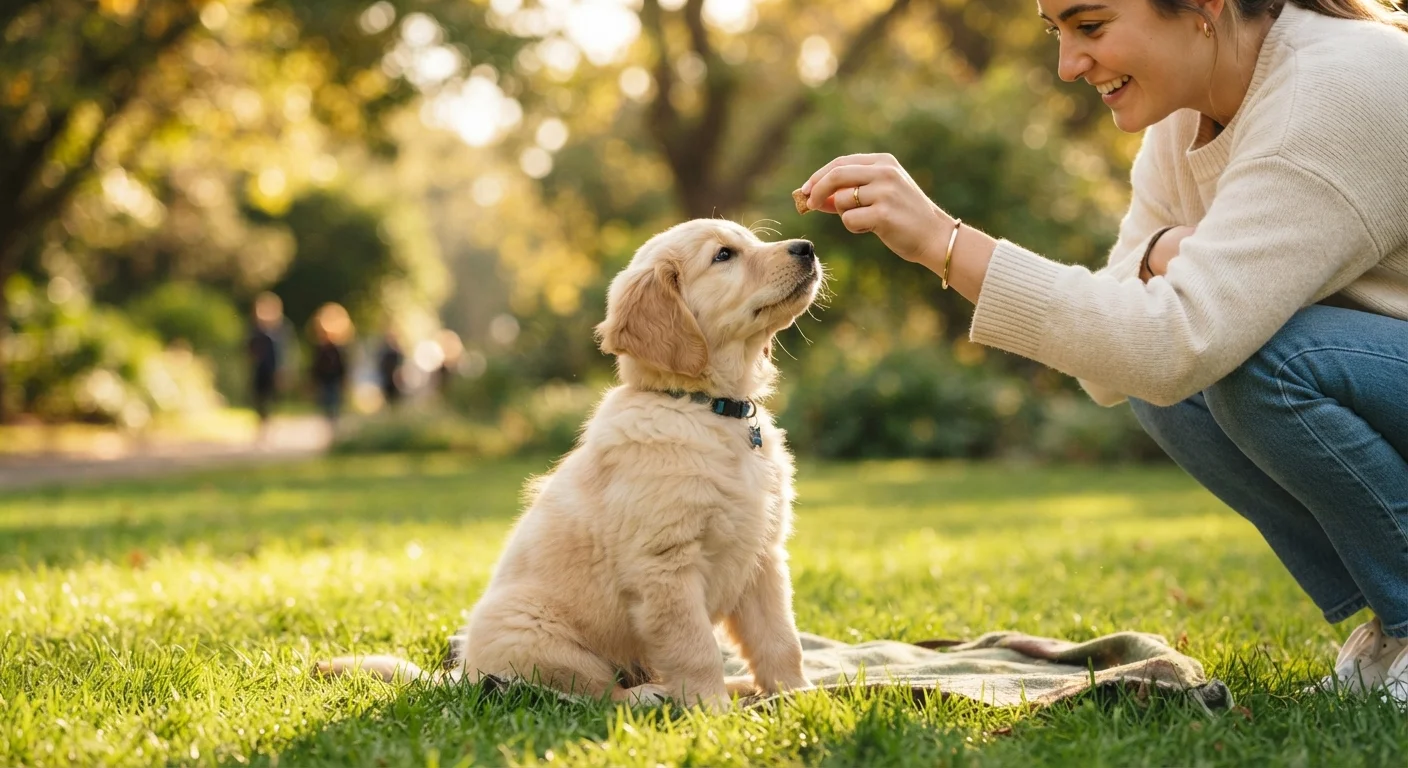
The core principle behind modern, evidence-based puppy training is positive reinforcement: rewarding the behaviors you want so they are more likely to be repeated. This approach is supported by decades of behavioral science research and is consistently recommended by veterinary behaviorists. It replaces older correction-focused methods that can damage trust and increase anxiety in young dogs.
Before your puppy arrives, make sure your home is ready. See our guide to building a safe home environment to prepare the right space, supplies, and setup before training begins.
Begin as You Mean to Go On
Whatever you allow your puppy to do in the first week, expect to allow forever. If jumping up, sleeping on furniture, or counter-sniffing will be problems later, redirect and reward the alternative behavior from the very start. It is far easier to build the right habit than to break an established one.
Socialization: The Critical Window
Between approximately 3 and 14 weeks of age, puppies go through what behavioral scientists call the sensitive period for socialization. Positive, calm exposures during this window shape how a dog responds to people, animals, sounds, and environments for the rest of its life. Missing this window doesn't make socialization impossible, but it does make it harder.
Effective socialization means exposing your puppy — at a pace that keeps them comfortable, not overwhelmed — to a wide variety of experiences: different people (children, men with beards, people in hats), other vaccinated dogs, car rides, household sounds like vacuums and doorbells, and various surfaces and environments. The goal is not just exposure but positive association. Pair new experiences with treats, calm praise, and your steady presence.
Positive reinforcement
A training method where a desired behavior is followed immediately by a reward, making that behavior more likely to happen again.
Sensitive period
A developmental phase — roughly 3 to 14 weeks in puppies — when the brain is especially receptive to learning about the social environment. Experiences during this window have lasting influence.
Socialization
The process of exposing a young puppy to a wide variety of people, animals, sounds, and environments in a safe, positive way so they become comfortable and confident.
Luring
Using a treat held in your hand to guide a puppy's body into a desired position (such as sitting), then rewarding once the position is achieved.
Recall
The 'come' command — training your dog to return to you immediately when called. Considered one of the most important safety behaviors.
Crate training
Teaching a puppy to view a crate as a safe, comfortable resting space. It supports house training by using a dog's natural reluctance to soil their sleeping area.
Puppy classes offer structured socialization alongside basic obedience and are widely recommended by veterinary organizations. Discuss your puppy's vaccination status with your veterinarian before group classes — your vet can advise on appropriate timing and risk.
House Training Basics
House training is built on three pillars: schedule, supervision, and reward. Puppies have small bladders and limited control — most need to eliminate every 1–2 hours when awake, and immediately after waking, eating, or playing.
- Take them out consistently: First thing in the morning, after every meal, after naps, after play, and last thing at night.
- Reward immediately: Praise and a small treat the moment elimination finishes outdoors — not after you've gone back inside.
- Supervise or confine: Use a crate or a puppy-proofed area when you cannot actively watch your puppy. Dogs are instinctively reluctant to soil their sleeping space, making crate training a valuable house training tool.
Avoid Punishment-Based Corrections
Scolding, startling, or physically correcting a puppy for accidents or unwanted behavior can create fear and anxiety that undermines the trust training depends on. Behavioral science consistently shows that punishment-based methods are less effective and carry greater risk of harm than positive reinforcement. When in doubt, set the puppy up to succeed rather than waiting for mistakes to correct.
Accidents will happen. Clean them thoroughly with an enzymatic cleaner to remove odor, which otherwise draws puppies back to the same spot. Never punish after the fact — puppies cannot connect a past action to a present consequence, and punishment creates anxiety without teaching the correct behavior.
Teaching Core Commands
Starting with a small set of reliable cues gives your puppy a framework for communicating with you. Four commands form the practical foundation:
- Sit: Lure the puppy's nose upward with a treat until the hindquarters drop, then say 'sit' and reward. Repeat in short sessions.
- Stay: Ask for a sit, add a hand signal (open palm), pause one second, then reward. Gradually extend duration before adding distance.
- Come (recall): The most important safety cue. Say the puppy's name followed by 'come' in a cheerful tone; reward enthusiastically every time. Never call a puppy to you for something unpleasant.
- Leave it: Teach your puppy to look away from an object on cue — a critical skill for preventing ingestion of hazards.
Note that learning ability and pacing differ as dogs age. Our article on how training changes across a dog's life explains what to expect as your puppy grows.
Building Good Habits for the Long Term
Training is not a phase — it's an ongoing relationship. The habits you establish in the first weeks become the default behaviors your dog relies on for years. Consistency across all household members is essential; a cue that one person enforces and another ignores will not reliably stick.
A few practices that protect long-term success:
- Keep sessions short and positive. Three to five minutes, two or three times daily, outperforms one long session that ends in frustration.
- Generalize to new environments. Practice commands in different locations so your dog learns to respond regardless of context, not just in the living room.
- Practice 'nothing in life is free' gently. Asking your puppy to sit before meals, walks, or play reinforces that calm, cooperative behavior earns good things — without stress.
Pair training efforts with a complete daily care routine. Our guide to responsible daily pet ownership covers nutrition, mental stimulation, and health care that support a well-adjusted dog. For a broader view of your puppy's first year, the first-year health timeline connects training milestones to veterinary care checkpoints.
American Veterinary Society of Animal Behavior (AVSAB)
AVSAB publishes position statements and owner resources on puppy socialization and humane training methods, grounded in current veterinary behavioral science.
Pet Care Basics Hub
Explore everyday care topics — from feeding schedules to grooming — that work alongside your training efforts to support a healthy, happy puppy.
Frequently Asked Questions
Training can begin the day your puppy arrives home, typically around 8 weeks of age. Puppies this young learn quickly through repetition and positive reinforcement. Simple cues like 'sit' and name recognition are appropriate starting points.
Keep sessions to 3–5 minutes each, repeated two to three times per day. Puppies have short attention spans and tire quickly. Ending on a success keeps them engaged and eager for the next session.
Yes — small, soft treats used as rewards are a cornerstone of positive reinforcement training. Keep treat portions tiny to avoid overfeeding, and gradually reduce treat frequency as behaviors become reliable.
A consistent schedule is the most effective approach. Take your puppy outside immediately after waking, eating, and playing. Reward outdoor elimination with calm praise. Supervise closely indoors and limit unsupervised access until the habit is established.
Most veterinary and behavioral organizations support starting group puppy classes around 7–8 weeks of age, provided the puppy has had at least one set of vaccinations 7 days prior. Ask your veterinarian for guidance specific to your puppy's health status.
Redirect biting onto appropriate chew toys immediately when it occurs. When a puppy bites too hard during play, a calm, brief withdrawal of attention signals that the behavior ends the fun. Consistency across all family members is essential.
The content on this site is for informational purposes only and is not a substitute for professional advice. Always consult a qualified professional for guidance specific to your situation.