

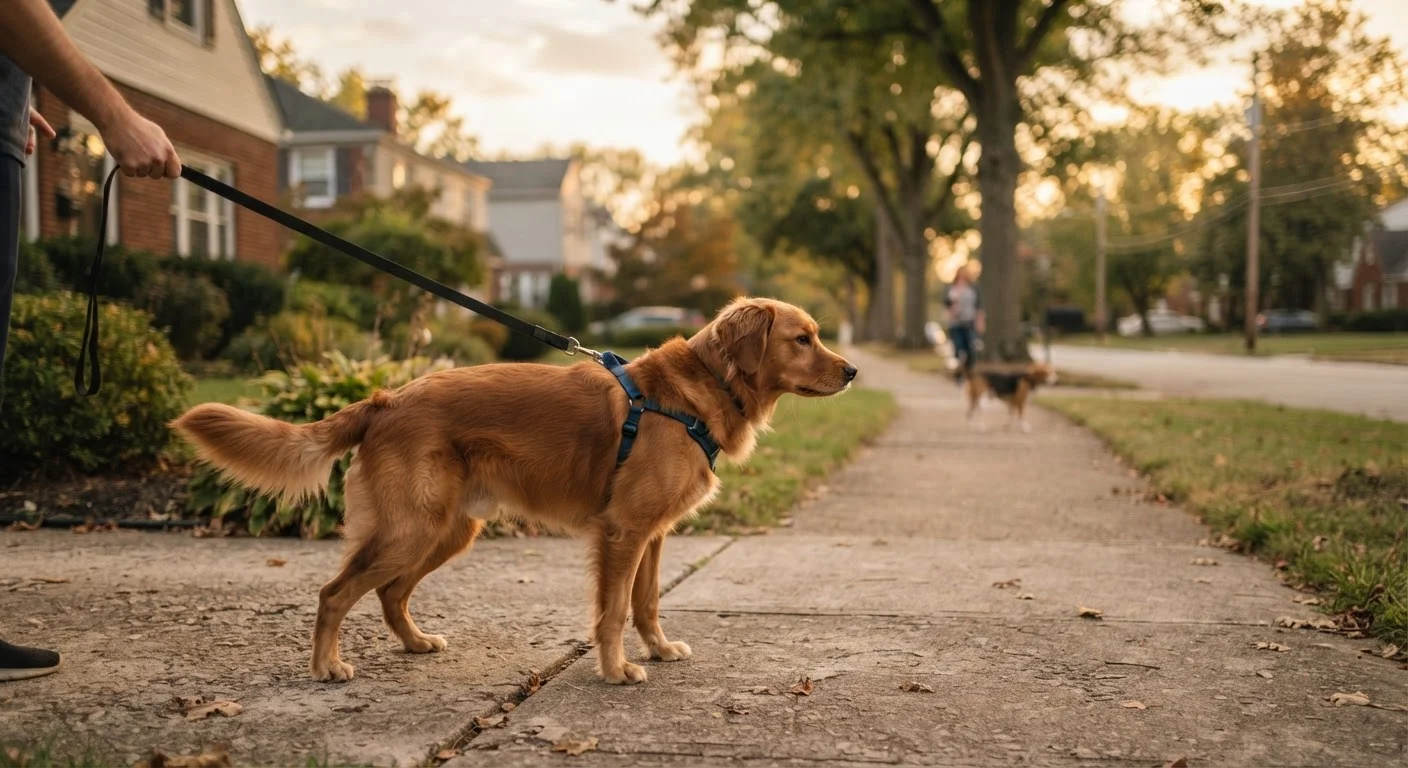
What Leash Reactivity Actually Looks Like
Owners often describe the moment their dog "loses it" on a walk — a sudden explosion of barking and lunging that seems to come from nowhere. In reality, most reactive episodes build from subtle signals that are easy to miss. Understanding canine body language can help you spot early warning signs — a stiffening body, a hard stare, ears pinned forward — before the dog crosses into full-blown reaction.
Common reactive behaviors include:
- Barking, lunging, or spinning at the end of the leash
- Growling or snapping directed toward the trigger
- Piloerection (raised hackles along the back)
- Whining or high-pitched vocalizing
- Freezing, then exploding into motion
The target of the reaction varies by dog. Some react only to other dogs. Others respond to strangers, children, skateboards, or fast-moving vehicles. A dog may have a single trigger or several, and the intensity of the reaction often correlates with how close the trigger gets.
~15%
Estimated prevalence of leash reactivity in pet dogs
Behavioral surveys and veterinary behavior literature consistently identify leash reactivity as one of the most commonly reported behavioral concerns among dog owners.
3–14 weeks
Critical socialization window in puppies
Veterinary behaviorists widely cite this developmental period as key — dogs not adequately socialized during it are at higher risk for fear-based and reactive behaviors later.
Weeks to months
Typical training timeline for improvement
Certified trainers note that meaningful progress with desensitization and counter-conditioning typically takes consistent practice over weeks to months, depending on the dog and severity.
Why Dogs Develop Leash Reactivity
Leash reactivity rarely emerges overnight. Several overlapping factors contribute to its development:
Lack of early socialization
Dogs that weren't exposed to a wide variety of people, animals, and environments during the critical socialization window — roughly 3 to 14 weeks of age — are more likely to find novel stimuli alarming later in life. A dog that never learned other dogs are safe may default to alarm when one appears.
Barrier frustration
Some reactive dogs aren't afraid at all — they're frustrated. Dogs that are highly social and eager to greet every dog they see may develop a pattern of escalating behavior when the leash prevents that greeting. Over time this frustration can look nearly identical to fear-based reactivity.
A single traumatic experience
An attack by another dog, a startling fall while leashed, or a frightening encounter during a walk can create a strong negative association that generalizes to similar future situations.
Reinforcement history
Reactive behavior is often self-reinforcing. When a dog lunges and barks, the trigger (another dog, a person) moves away — or the owner pulls the dog away. From the dog's perspective, the behavior worked. Over time, it becomes the dog's go-to strategy.
Reactivity Is Not the Same as Aggression
Reactive dogs are frequently labeled as aggressive, but the two are behaviorally distinct. Aggression involves an intent to cause harm and typically includes inhibited or uninhibited bites. Reactivity is an overaroused emotional response — loud and alarming to look at, but driven by fear or frustration rather than predatory or offensive intent. Accurate classification matters because the training approaches differ meaningfully.
Your Own Body Language Matters Too
Dogs are highly attuned to their owners' tension. When handlers anticipate a reaction and shorten the leash or tighten their grip, the dog often picks up on that stress, which can prime it to react even sooner. Practicing a relaxed grip and neutral posture on walks — easier said than done — is a meaningful part of the training picture. See our guide on why dogs tune out commands for more on how handler behavior influences dog response.
The Core Training Approach: Below-Threshold Work
The evidence-supported framework for reducing leash reactivity centers on two techniques used together: desensitization and counter-conditioning.
Desensitization means gradually and systematically exposing a dog to its trigger at a low enough intensity that it does not react — starting at the dog's threshold distance and slowly decreasing that distance over many sessions.
Counter-conditioning means pairing the trigger with something the dog loves — typically high-value food — so that the emotional association shifts from negative to positive. The goal is that the dog begins to look at you or feel calm when the trigger appears, because the trigger now predicts something good.
How to apply this in practice
- Find your dog's threshold. This is the distance at which your dog notices the trigger but doesn't react. Start every session at or beyond this distance.
- Mark and reward calm attention. When your dog notices the trigger without reacting, immediately mark (with a word like "yes" or a clicker) and reward with a high-value treat.
- Increase difficulty gradually. Only decrease the distance to the trigger when your dog is consistently relaxed at the current distance across multiple sessions.
- Manage the environment. Avoid flooding — forcing a dog past its threshold — which will set back progress and increase stress.
For dogs that struggle with loose-leash walking in general, addressing that skill in low-distraction environments first can make reactive training sessions more productive.
Use High-Value Treats During Reactive Training
Everyday kibble often isn't motivating enough to compete with a strong trigger. Reserve something special — small pieces of cooked chicken, cheese, or commercial training treats — exclusively for reactive training sessions. The higher the dog's arousal level, the more compelling the reward needs to be to capture its attention.
When to Seek Professional Help
While many owners make meaningful progress on their own, professional guidance is strongly recommended when reactivity is severe, involves any history of biting, or is not improving despite consistent effort. Look for a trainer who holds credentials from organizations such as the Certification Council for Professional Dog Trainers (CCPDT) or the International Association of Animal Behavior Consultants (IAABC), and who uses force-free or least-aversive methods grounded in behavioral science.
If your dog's reactivity appears to have an anxiety component beyond the walk itself — for example, generalized fearfulness, destructive behavior when alone, or physical symptoms of stress — a veterinary behaviorist can evaluate whether behavioral medication may support the training process. Medication alone does not teach new behavior, but it can reduce baseline anxiety enough for training to take hold.
Leash reactivity shares some surface similarities with other behavioral challenges, but it is distinct from conditions like separation anxiety or compulsive repetitive behaviors, both of which call for their own specific approaches. Accurate identification of what's driving a behavior is always the starting point for effective intervention.
This article is for general informational and educational purposes only. It is not a substitute for professional veterinary or animal behavior advice. If your dog displays severe reactive behavior, please consult a certified professional trainer or veterinary behaviorist.
Frequently Asked Questions
Not necessarily. Most reactive dogs are responding to fear or frustration rather than predatory aggression. That said, the behavior should be taken seriously and addressed with proper training, because a dog that is chronically stressed on walks has reduced quality of life — and unchecked reactivity can escalate over time.
For many dogs, reactivity can be significantly reduced so that walks become manageable and even enjoyable. Full elimination is possible for some, while others learn to tolerate triggers at a level that no longer disrupts daily life. Realistic expectations and consistent training are key.
Off leash, a dog has the option to approach, investigate, or retreat at its own pace. The leash removes those options and can create a feeling of being trapped, which raises arousal and triggers reactive behavior even in dogs that are social or calm in other contexts.
Threshold refers to the distance or intensity at which a dog first notices a trigger but can still think and respond to cues. Working below threshold — far enough away that the dog stays calm — is the foundation of desensitization training.
Punishment — including leash corrections, shock collars, or yelling — is not recommended by most certified animal behaviorists for reactive dogs. These methods can increase fear and anxiety, making the underlying emotional response worse rather than better.
There is no universal timeline. Mild cases may show improvement within a few weeks of consistent practice; severe or long-standing reactivity can take many months of work. The pace depends on the individual dog, the consistency of training, and the nature of the triggers.
The content on this site is for informational purposes only and is not a substitute for professional advice. Always consult a qualified professional for guidance specific to your situation.