

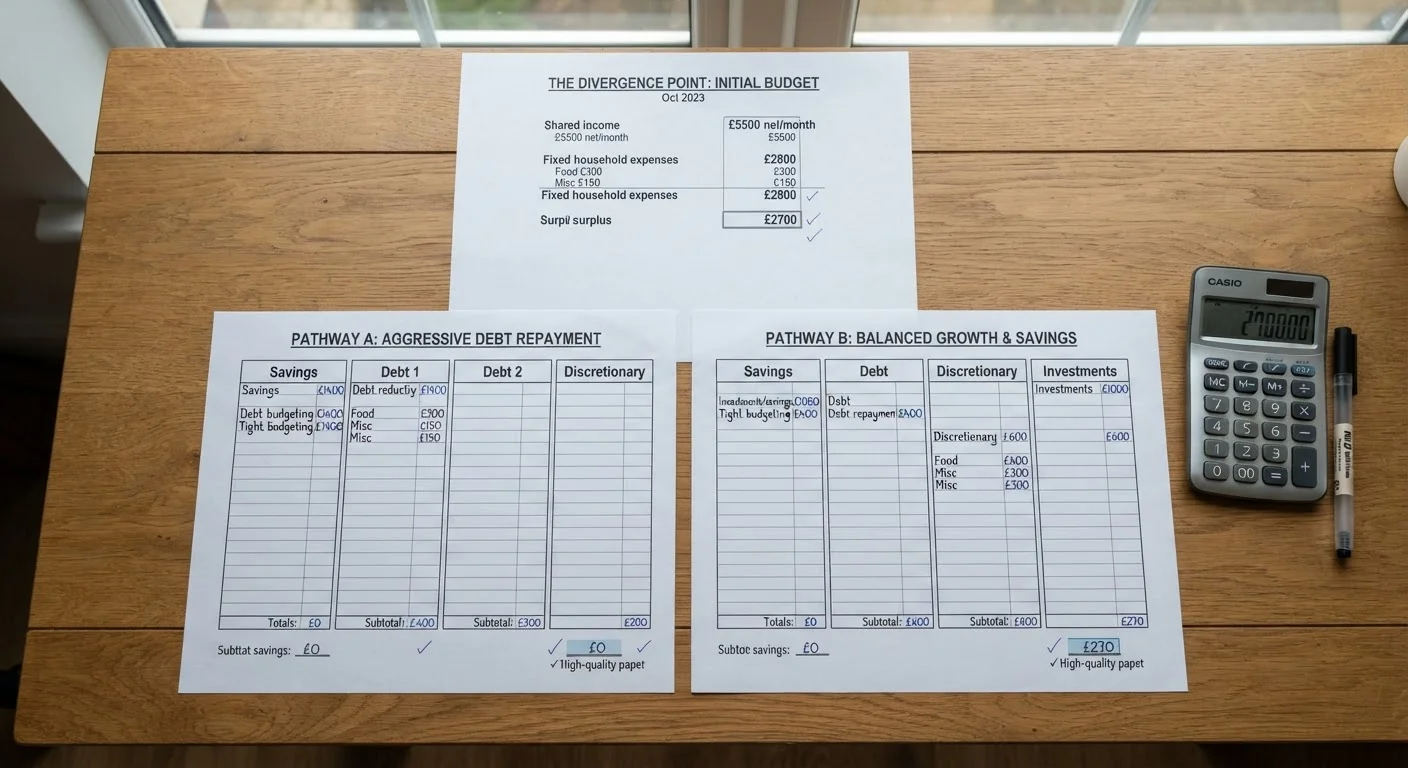
Option A
Zero-Based Budgeting
The meticulous, dollar-by-dollar approach to spending control.
Best for: People who want granular control over every dollar and are willing to invest time in monthly planning.
Option B
Percentage-Based Budgeting
The flexible, ratio-driven framework for consistent money allocation.
Best for: People who prefer a simpler structure that adjusts automatically as income changes.
How Each Method Works
The two approaches share a common goal - directing income intentionally - but they reach it through different mechanics.
Zero-based budgeting (ZBB) starts from scratch every month. You take your total expected income, then assign a specific dollar amount to every category - rent, groceries, transportation, savings, debt payments, entertainment - until the math reaches zero. Income minus allocations equals zero. No dollar is left unassigned. If circumstances shift, you revise the plan before spending, not after.
Percentage-based budgeting works from ratios instead of exact figures. A common framework is the 50/30/20 rule: roughly 50% of take-home pay toward needs, 30% toward wants, and 20% toward savings and debt repayment. You can read more about that framework in our guide on the 50/30/20 rule. The percentages stay fixed; the dollar amounts shift with your income automatically.
Understanding fixed vs. variable expenses matters for both methods, since predictable costs anchor your allocations differently than fluctuating ones.
| Criterion | Zero-Based Budgeting | Percentage-Based Budgeting |
|---|---|---|
| Core mechanic | Assign every dollar to a category | Allocate income by fixed ratios |
| Monthly setup time | High - rebuilt each cycle | Low - ratios stay constant |
| Specificity | Very high - line-item detail | Moderate - broad category buckets |
| Adapts to income changes | Yes - by design each month | Yes - dollar amounts shift with income |
| Best income type | Variable or irregular income | Stable, predictable income |
| Learning curve | Steeper - requires discipline | Gentler - quick to implement |
| Debt payoff focus | Strong - dollars directed deliberately | Moderate - depends on ratio discipline |
The Real Demands of Each Approach
Choosing a budgeting method isn't just about logic - it's about what you'll actually sustain.
Zero-based budgeting is time-intensive up front. Each new budget cycle requires reviewing last month's spending, projecting the current month's income, and re-assigning every dollar. For people with variable income - freelancers, hourly workers, commission earners - this monthly reset can be genuinely useful because it prevents overspending based on an outdated income assumption. The tradeoff is that it requires consistent engagement; skipping a month creates gaps that undermine the whole system.
Percentage-based budgeting is far lighter to maintain. Once you establish your ratios and categorize your spending buckets, the structure largely runs itself. The limitation is that percentages can mask specificity - a 30% "wants" bucket doesn't tell you whether you're overspending on dining out versus subscriptions. It sets guardrails without detailing what's inside them.
~74%
Americans living paycheck to paycheck
Survey data from multiple consumer finance studies consistently finds a large share of U.S. adults have little financial buffer between income and expenses, underscoring the value of any structured budgeting approach.
1 hour
Estimated monthly setup: percentage-based
Financial planning practitioners generally estimate that maintaining a percentage-based budget requires roughly one hour per month once initial categories are established.
Both methods benefit from a reliable tracking tool. Our comparison of spreadsheet vs. budgeting app options can help you find the right fit for whichever approach you choose.
Choosing the Right Fit - or Combining Both
The most effective budget is one you maintain, not one that looks best on paper. Neither zero-based nor percentage-based budgeting is inherently superior; each suits different financial situations and personalities.
Some people find value in a hybrid: use percentages as the top-level framework (needs, savings, discretionary), then apply zero-based logic within each category to assign exact dollar amounts. This gives you the structure of ratios without losing the specificity that makes zero-based budgeting powerful.
Combining Methods Is Legitimate
There is no rule requiring you to pick exactly one framework and apply it rigidly. Many households use percentage-based ratios to set high-level limits, then apply zero-based thinking within each bucket to ensure specific spending adds up. The goal is a system you actually use. An imperfect budget maintained consistently will outperform a theoretically optimal one that gets abandoned after two months.
If you're concerned that budgeting sounds too restrictive, our article on budgeting myths that keep people from starting addresses common misconceptions. And for a broader overview of the entire budgeting process - from calculating income to setting goals - see our complete personal budgeting framework.
This article is for general informational and educational purposes only and does not constitute personalized financial advice. Consult a qualified financial professional for guidance specific to your situation.
The content on this site is for informational purposes only and is not a substitute for professional advice. Always consult a qualified professional for guidance specific to your situation.