

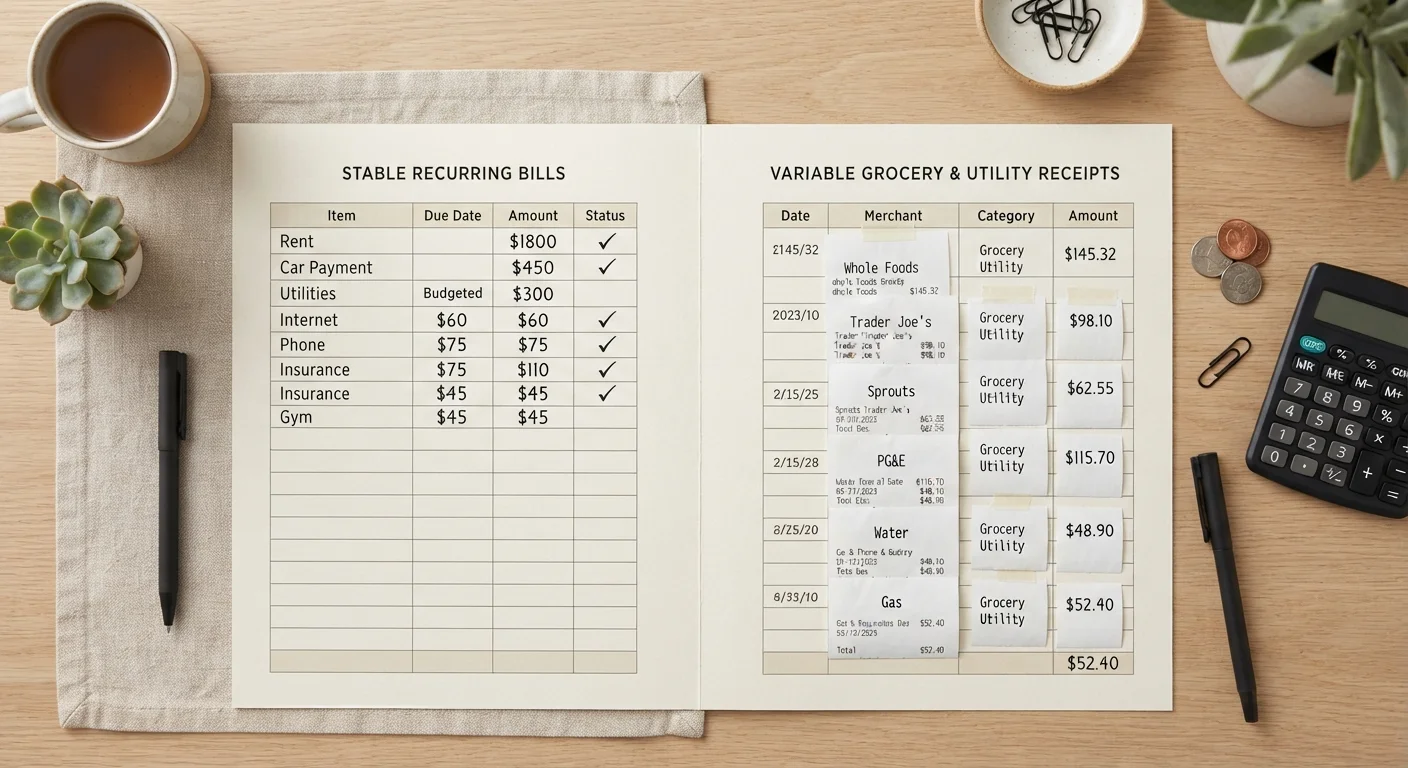
Option A
Fixed Expenses
The predictable, non-negotiable costs in your budget.
Best for: Establishing a reliable spending baseline and understanding how much income is already committed each month.
Option B
Variable Expenses
The flexible costs that fluctuate with your habits and needs.
Best for: Identifying where spending can be adjusted, reduced, or reallocated when financial priorities shift.
The Core Distinction: Predictability vs. Flexibility
At its simplest, fixed expenses are costs that don't change from month to month. Your rent or mortgage payment, auto loan installment, renter's insurance premium, and subscription services billed at a flat rate all fall into this category. You know the amount in advance, and it will be the same whether you had a great month financially or a difficult one.
Variable expenses, by contrast, shift based on behavior, usage, or circumstance. Groceries, gas, dining out, clothing, and entertainment are common examples. The total depends on decisions you make throughout the month, which means these costs can rise and fall with relatively little friction.
Understanding this distinction is foundational to building a budget that reflects reality. For a plain-language walkthrough of these and other core terms, see our Personal Budget Glossary.
| Criterion | Fixed Expenses | Variable Expenses |
|---|---|---|
| Amount each month | Stays the same | Changes based on behavior |
| Examples | Rent, loan payments, insurance | Groceries, gas, dining, clothing |
| Predictability | High - known in advance | Low to moderate - requires tracking |
| Control level | Low - usually contractual | High - responds to daily choices |
| Budget role | Defines your financial floor | Where flexibility and savings live |
| Adjustment difficulty | Requires renegotiating or restructuring | Can shift month to month |
Why the Distinction Shapes How You Budget
When you total your fixed expenses, you arrive at your financial floor - the minimum amount of money you must bring in each month before anything else. This number matters enormously. If your fixed obligations consume 70% or more of your take-home pay, you have very little room to absorb an unexpected expense or redirect money toward savings without restructuring something significant.
Variable expenses, on the other hand, are where day-to-day budget decisions actually happen. Spending $300 on groceries one month and $220 the next isn't a budget failure - it's normal variation. The goal is to track these costs consistently so you can identify patterns and set realistic spending targets rather than arbitrary limits.
~67%
Average share of income spent on housing and transportation
U.S. Bureau of Labor Statistics Consumer Expenditure data consistently shows housing and transportation - largely fixed costs - consuming roughly two-thirds of household spending.
1 in 3
Americans with no monthly budget
Surveys from the National Foundation for Credit Counseling have found that a significant share of U.S. adults do not track their monthly spending in any structured way.
A practical approach is to list all fixed expenses first and subtract them from your monthly net income. What remains is available for variable spending, savings, and debt repayment. This sequence - obligations first, then choices - prevents the common mistake of treating income as fully spendable until the bills arrive.
For a structured method of organizing both types into clear categories, our guide on categorizing everyday expenses walks through a practical spending-bucket system.
Semi-Variable Expenses and the Gray Area
Not every cost fits neatly into one column. Semi-variable expenses - sometimes called mixed costs - have both a fixed component and a usage-driven component. Electricity and natural gas bills are typical examples: there is often a base service charge regardless of usage, plus a variable rate tied to consumption. Phone plans with a fixed monthly fee but overage charges follow the same logic.
When Fixed Isn't Permanent
Fixed expenses feel immovable, but many can be renegotiated or reduced over time. Refinancing a mortgage or auto loan, switching insurance providers, or canceling unused subscriptions are all ways to lower your fixed baseline. These changes take more effort than trimming a grocery run, but their impact repeats every month thereafter - making them high-leverage moves when you need to free up cash flow.
Knowing where a semi-variable expense sits on the spectrum helps you budget more accurately. For utilities, reviewing 12 months of bills and averaging them gives a more reliable monthly estimate than using a single recent bill. For irregular income earners, this kind of smoothing is especially important - our article on budgeting with irregular income covers frameworks suited to that situation.
The goal isn't to categorize every dollar perfectly - it's to understand which costs you can influence and which you cannot. That clarity is what turns a budget from a vague intention into a workable plan. If you've ever felt that budgeting is too complicated to start, our piece on common budgeting myths addresses several beliefs that often get in the way.
This article is for general informational purposes only and does not constitute personalized financial or budgeting advice. Consider consulting a qualified financial professional for guidance specific to your situation.
The content on this site is for informational purposes only and is not a substitute for professional advice. Always consult a qualified professional for guidance specific to your situation.