

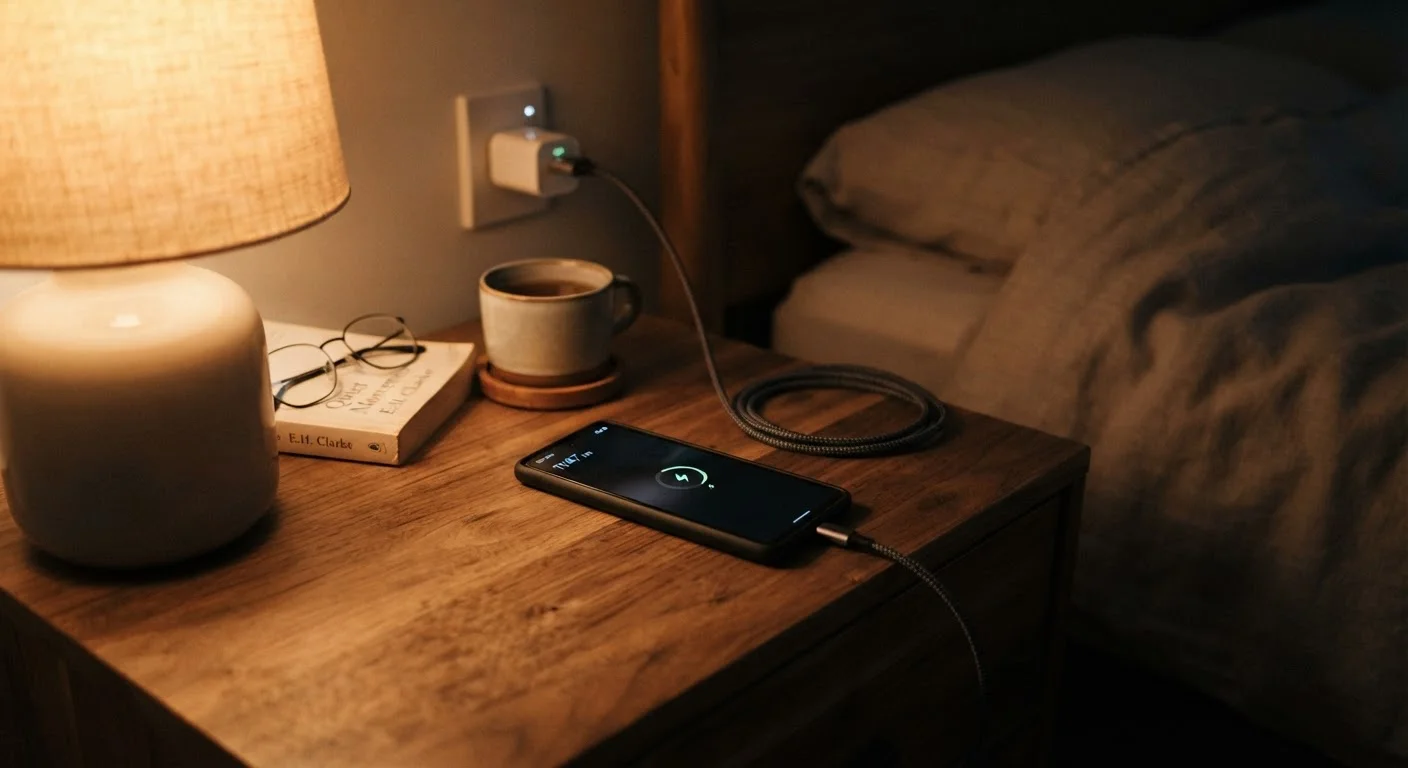
Why These Charging Myths Are So Persistent
Smartphone charging advice has been passed around so long that much of it predates the batteries actually inside modern phones. Many widely repeated rules — drain it fully, never leave it plugged in — originated with nickel-cadmium or nickel-metal hydride batteries, technologies that have not been used in consumer phones for well over a decade. Lithium-ion chemistry, which powers virtually every phone sold today, behaves very differently. Understanding that distinction is the key to separating useful habits from outdated folklore.
Just as misconceptions persist in other areas of everyday life — from credit score myths to home maintenance folklore — phone charging myths survive because they carry a kernel of historical truth. The information below reflects how current battery management technology actually works.
Myth
Leaving your phone plugged in overnight overcharges the battery and ruins it.
Fact
Modern smartphones automatically stop drawing charge once they reach 100%, so true overcharging essentially cannot happen.
Every current iPhone and Android device contains a battery management system (BMS) — a chip that monitors voltage and cuts off the charging current when the battery is full. Your phone does not keep forcing electricity into the cell after it reaches capacity. The charger essentially idles. This is why the overnight charging myth, while understandable for older nickel-cadmium batteries, does not apply to the lithium-ion technology used in phones today.
Myth
You should always drain your battery to 0% before recharging it.
Fact
Fully depleting a lithium-ion battery actually stresses it and shortens its overall lifespan.
Lithium-ion batteries have a finite number of charge cycles, and deep discharges — repeatedly running the battery to near-zero — count as harder, more damaging cycles. Battery researchers and device manufacturers generally recommend keeping charge levels between roughly 20% and 80% for day-to-day use. Full discharge calibration was relevant for older battery chemistries but is counterproductive for the technology in virtually every phone sold today. See why lithium-ion batteries lose capacity over time for a deeper look at charge cycle mechanics.
Myth
Charging your phone overnight means it sits at 100% for hours, which degrades the battery.
Fact
Optimized or adaptive charging features on most modern phones specifically address this by delaying the final charge until just before you wake up.
Apple's Optimized Battery Charging and similar features on Android phones (often called Adaptive Charging) learn your sleep schedule and intentionally pause charging at around 80% — then complete the charge to 100% shortly before your alarm goes off. This dramatically reduces the time your battery spends at maximum charge, which is when lithium-ion cells experience the most electrochemical stress. Check your phone's battery settings to confirm this feature is enabled.
Myth
Using any charger is fine as long as it fits the port.
Fact
Charger quality and compatibility directly affect how safely and efficiently power is delivered to your battery.
Not all chargers are equal. A certified charger communicates with your phone's BMS to deliver the correct voltage and current. An uncertified or counterfeit charger may push inconsistent power levels, generate excess heat, or fail to negotiate fast-charging protocols safely. Consumer safety organizations have documented cases of phone damage traced to substandard charging accessories. Stick to chargers that meet your device manufacturer's specifications.
[warning_callout]Myth
Wireless charging is much worse for your battery than wired charging.
Fact
Wireless charging is slightly less efficient and generates a little more heat, but used normally it does not meaningfully accelerate battery degradation.
Wireless (inductive) charging does produce marginally more heat than wired charging because energy transfer is less efficient — some energy is lost as heat during the induction process. Heat is the genuine stress factor for lithium-ion cells, so it is worth removing a thick case when using a wireless charger. However, the temperature difference in normal everyday use is modest. Charging your phone on a quality wireless pad is not the battery catastrophe some claim, provided you are not simultaneously running a graphics-intensive app or stacking the phone in a hot environment.
What Actually Protects Your Battery Long-Term
The biggest real-world factors in battery health are heat, deep discharge cycles, and consistent overloading. Managing those three things will do more for your battery than worrying about when to unplug your charger.
Heat Is the Real Enemy of Battery Health
Charging your phone while it sits under a pillow or in a case that traps heat is genuinely harmful to your battery. High temperatures accelerate the chemical degradation inside lithium-ion cells. If your phone feels hot while charging, remove the case and place it on a hard, flat surface to allow heat to dissipate.
A few practical habits make a meaningful difference over months of use:
- Enable optimized charging in your phone's battery settings if it is not already on.
- Avoid charging in very hot environments — a parked car on a summer day, for instance, can reach temperatures damaging to cells.
- Top off frequently rather than running to zero — partial charges are gentler than deep discharge cycles.
- Remove your case if your phone gets noticeably warm while charging.
Background app behavior is another underappreciated factor. Apps running location services, constantly refreshing content, or pushing notifications keep your processor busier than necessary, which generates heat and burns charge faster. Learn which app behaviors quietly drain your battery and how to manage them. And if you are thinking about what to do with an older phone whose battery has already declined, assessing devices you no longer use offers a practical framework for deciding what to keep, donate, or recycle.
~500
Typical lithium-ion full charge cycles before noticeable capacity loss
Battery manufacturers commonly rate lithium-ion cells at 300–500 full charge cycles to approximately 80% of original capacity, though this varies by chemistry and conditions.
25°C
Optimal temperature for lithium-ion battery storage and charging
Battery research consistently identifies temperatures around 25°C (77°F) as optimal; sustained heat above 40°C accelerates capacity fade significantly.
The content on this site is for informational purposes only and is not a substitute for professional advice. Always consult a qualified professional for guidance specific to your situation.