

Why These Three Traits Are the Foundation of Every Routine
Walk down any haircare aisle and you'll find products labeled for every curl type, frizz level, and shine goal imaginable. Yet many people spend years cycling through products that don't quite deliver. The reason is often that product selection gets based on symptoms — dryness, limpness, frizz — rather than the underlying structure causing them.
Porosity, density, and texture are the three structural characteristics that explain why hair behaves the way it does. They're independent of each other, which means understanding all three gives you far more useful information than knowing just one. Think of them as three dials that all need to be understood before you can tune your routine properly.
This framework also pairs well with understanding your scalp's specific needs, since a healthy scalp directly supports how your strands grow and behave.
Porosity: How Your Hair Handles Moisture
Porosity describes how readily your hair cuticle — the outer protective layer of each strand — opens to absorb water and moisture, and how well it seals to retain it. There are three general levels:
- Low porosity: The cuticle lies flat and tightly packed. Water and products tend to bead up or sit on the surface rather than absorb easily. Hair takes a long time to get fully wet but stays moisturized once it does.
- Medium (normal) porosity: The cuticle is slightly raised, allowing moisture in and out at a balanced rate. This is often the easiest to work with and maintain.
- High porosity: The cuticle is more open, either naturally or due to chemical processing or heat damage. Hair absorbs moisture quickly but loses it fast, leading to dryness, frizz, and brittleness.
Porosity Can Vary Across Your Head
It's entirely possible to have different porosity levels in different sections of your hair — for example, more porous ends from years of heat styling and relatively intact roots. This is especially common in longer hair. You may find that treating ends differently from roots gives better results overall.
For low-porosity hair, lightweight, water-based products applied to damp hair work better than heavy butters that sit on top. For high-porosity hair, sealing with heavier emollients or oils after moisturizing helps lock hydration in. Understanding this distinction is one of the most practical shifts you can make in a haircare routine.
Density: It's About Numbers, Not Size
Hair density refers to how many individual strands grow from your scalp per square inch — not how thick or thin each strand is. People are often surprised to learn that what they've been calling 'thick hair' is actually high density, while their strands themselves may be quite fine.
A practical way to assess density: look at your scalp in a mirror after parting your hair. If you can easily see a lot of scalp without moving strands aside, density is likely low. If your scalp is barely visible, density is higher.
80,000–120,000
Average number of scalp hairs on a human head
This widely cited range from trichology research illustrates how much density can naturally vary between individuals — a difference of tens of thousands of strands.
~6 inches
Average hair growth per year
According to general dermatological references, hair grows approximately half an inch per month on average, meaning structural damage accumulates over months before it becomes visible at the ends.
Why does it matter? High-density hair can become weighed down by heavy products and may need more thorough cleansing to prevent buildup. Low-density hair benefits from volume-supporting techniques and products that don't flatten the appearance of strands.
Texture: Strand Diameter and Curl Pattern Combined
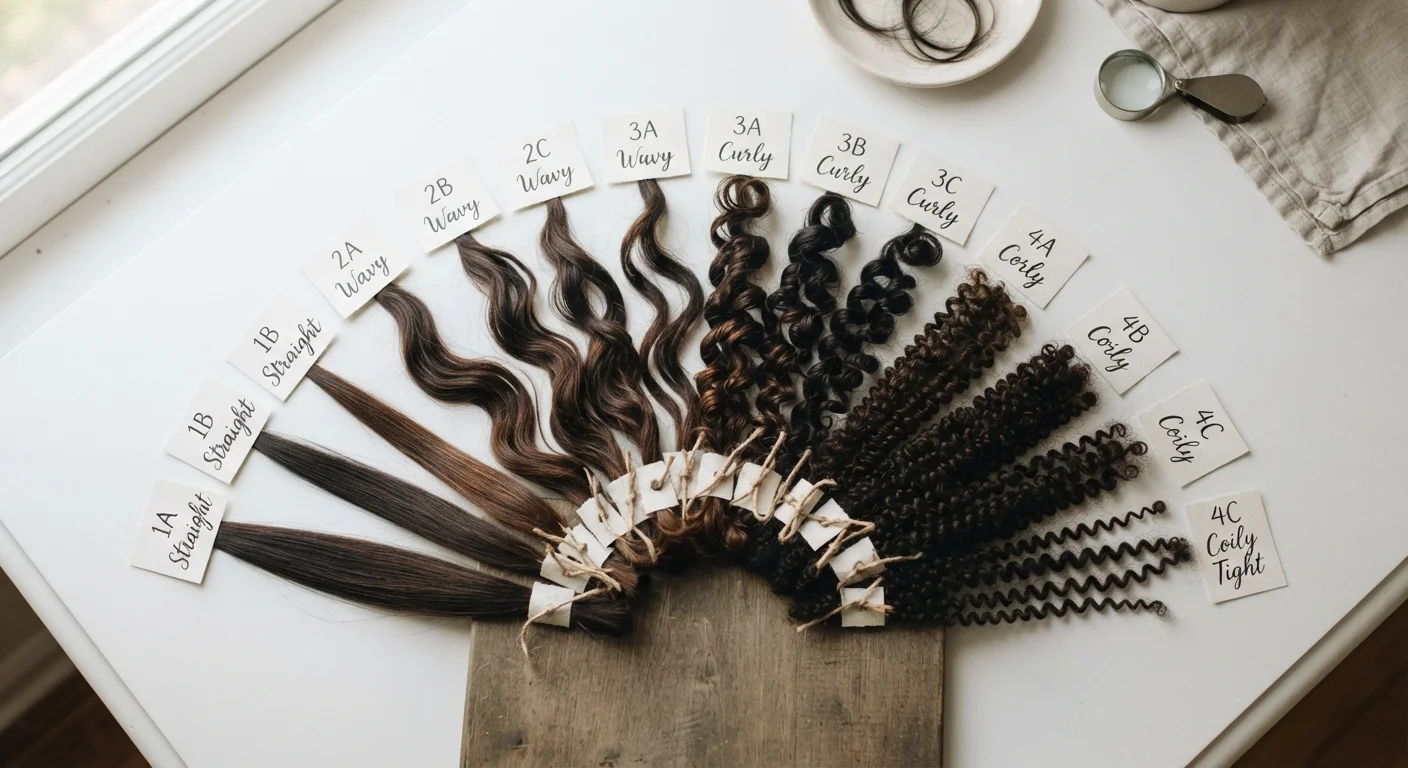
When stylists talk about hair texture, they typically mean two related things: strand diameter (fine, medium, or coarse) and curl pattern (straight, wavy, curly, or coily).
Strand diameter affects how hair responds to weight and product load:
- Fine strands are smaller in diameter and can be easily overwhelmed by dense formulas, leading to greasiness or limpness.
- Medium strands tend to be versatile and tolerate a range of products.
- Coarse strands have a larger diameter and often feel drier because the cuticle has more surface area; they typically benefit from richer formulations.
Curl pattern influences how natural oils travel down the strand (oils move more easily down straight strands and have a harder time navigating tight coils) and how products distribute. For a deeper look at decoding product ingredient labels for your specific texture, the personal care ingredients reference glossary is a useful companion resource.
Start With One Characteristic at a Time
If figuring out all three traits at once feels overwhelming, start with porosity — it has the most direct impact on how your hair responds to moisture and products. Once you have a feel for that, layer in density and then strand diameter. Building understanding gradually is more useful than trying to map everything at once.
Putting the Trio Together in Practice
The most useful insight this framework offers is that no single characteristic tells the whole story. Someone with coarse, high-porosity, low-density hair has a very different set of needs from someone with fine, low-porosity, high-density hair — even if both describe their hair as 'dry.'
A simple starting approach: assess each trait separately, note how your hair actually behaves (not how you wish it did), and use that information to evaluate whether a product's formula makes sense for your combination. Much like how understanding your skin type leads to better skincare decisions, knowing your hair's structure leads to more confident, less wasteful choices.
These aren't rigid categories — hair characteristics exist on a spectrum and can shift with age, health, environment, and styling habits. Treat this as a living framework you revisit, not a fixed label.
This article is for general educational purposes only and is not a substitute for advice from a licensed cosmetologist or dermatologist. If you're experiencing significant hair loss or scalp concerns, consult a qualified healthcare professional.
Frequently Asked Questions
The most commonly used method is the float test: drop a clean, product-free strand into a glass of room-temperature water. If it sinks quickly, porosity is likely high; if it floats, porosity is likely low. Note that this is an informal test with limitations and is best used alongside other observations about how your hair behaves with moisture.
Yes. Porosity can increase with chemical processing, heat damage, and sun exposure — all of which lift or damage the cuticle. Hair that was once low porosity may become higher porosity after repeated coloring or heat styling. Protective habits can help slow this change.
It can be a factor. High-density hair tends to trap oils and product buildup more readily, so some people find they need to cleanse more frequently. Low-density hair may look weighed down quickly, making lightweight, residue-free products a better fit.
No. 'Thick' often refers to strand diameter (coarse texture), while 'dense' refers to how many strands you have. You can have coarse, low-density hair or fine, high-density hair — these combinations are common and require different approaches.
Generally yes, though it's less about matching a label to your type and more about matching ingredients to your hair's behavior. Coarse textures often benefit from richer, emollient formulas; fine textures usually do better with lighter, film-free options. Porosity and density then further refine what works.
Your scalp and strands are deeply connected. For a fuller picture of how scalp conditions influence your hair's health day-to-day, exploring foundational guidance on scalp care alongside this framework gives you a more complete routine.
The content on this site is for informational purposes only and is not a substitute for professional advice. Always consult a qualified professional for guidance specific to your situation.