

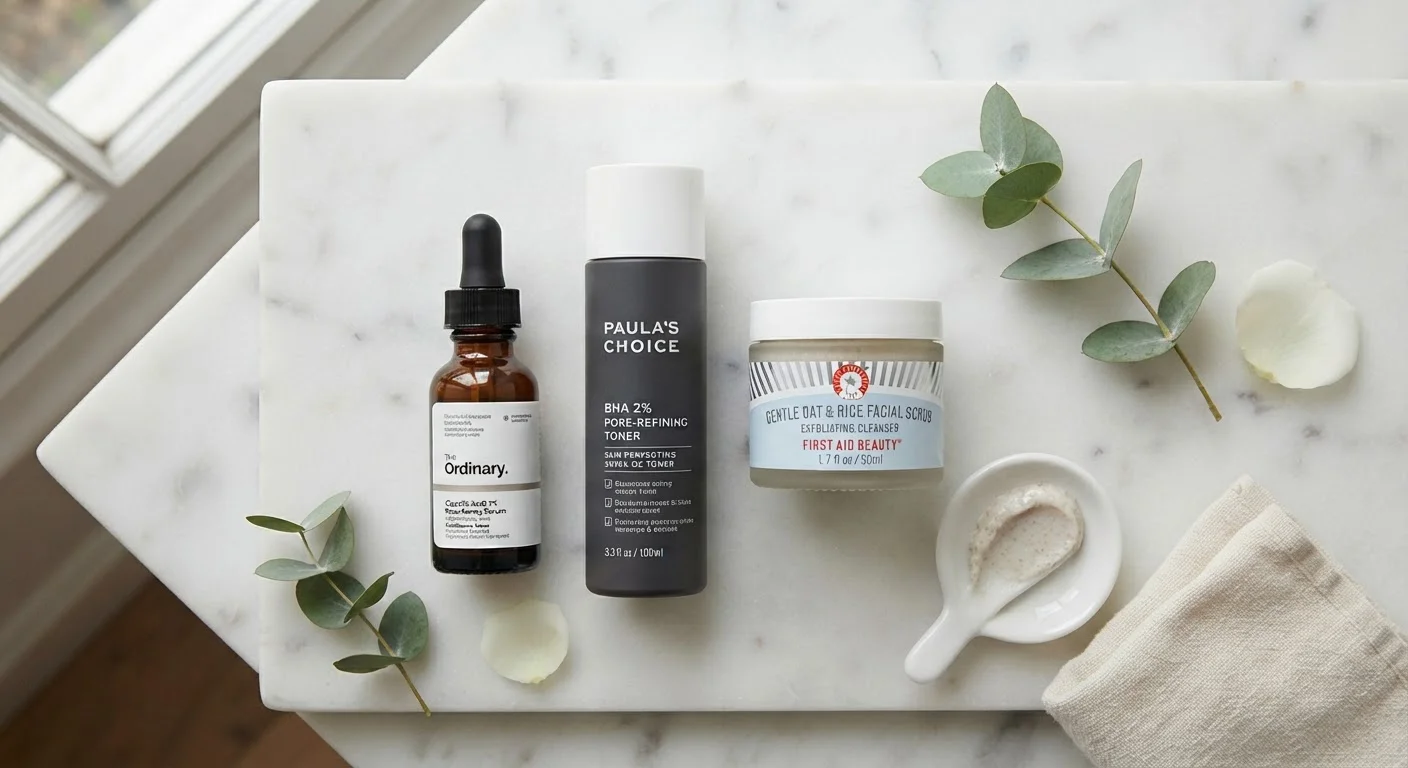
Our Verdict
Neither chemical exfoliants nor physical scrubs are universally superior — the right choice depends on your skin type, concerns, and how consistently you can use a product safely. Chemical exfoliants tend to offer more targeted, evidence-backed results for a wider range of skin concerns, while physical scrubs suit those who prefer tactile, straightforward routines and use a gentle formula.
| Best for | Recommended |
|---|---|
| Those with acne-prone or congested skin | Chemical exfoliants (BHAs) |
| Those seeking to address dullness or uneven tone | Chemical exfoliants (AHAs) |
| Those who prefer a simple, tactile cleansing ritual | Physical scrubs (gentle formulas) |
| Those with sensitive or easily irritated skin | Gentle enzyme-based chemical exfoliants |
What Exfoliation Actually Does
Exfoliation is the process of removing dead skin cells from the surface of your skin — cells your body sheds naturally but that can build up and cause dullness, clogged pores, or rough texture. The two main methods to speed this process along are chemical exfoliants and physical scrubs, and they work through completely different mechanisms.
Understanding those differences isn't just academic. Choosing the wrong method for your skin type can leave you with irritation, broken capillaries, or a compromised skin barrier. For a plain-language breakdown of the ingredients involved, check out the Personal Care Ingredients Reference — it's a useful companion to this guide.
| Chemical Exfoliants | Physical Scrubs | |
|---|---|---|
| How it works | Dissolves bonds between dead skin cells | Buffs away cells through friction |
| Best skin types | Most types; depends on acid chosen | Normal to oily; not sensitive or broken skin |
| Acne-prone skin suitability | High (especially BHAs) | Low — can aggravate breakouts |
| Risk of irritation | Moderate if overused or too strong | Higher with coarse particles or pressure |
| Results timeline | Gradual; builds over weeks | Immediate surface smoothness |
| Typical frequency | 2–3 times per week | Once or twice per week |
| Environmental concern | Minimal (rinse-off) | Some; microbeads now largely banned in U.S. |
Chemical Exfoliants: How They Work
Chemical exfoliants use acids or enzymes to loosen the bonds that hold dead skin cells together, allowing them to shed more evenly. The main categories are:
- AHAs (alpha-hydroxy acids) — such as glycolic acid and lactic acid — work primarily on the skin's surface and are well-suited for addressing dullness, dry texture, and uneven tone. They're water-soluble, meaning they interact with the outer layers of skin.
- BHAs (beta-hydroxy acids) — salicylic acid is the most common — are oil-soluble and can penetrate into pores, making them a strong option for oily or acne-prone skin.
- Enzyme exfoliants — often derived from papaya or pineapple — offer a gentler option that works more slowly and is often better tolerated by sensitive skin types.
Chemical exfoliants are generally applied as serums, toners, or leave-on treatments. Frequency matters: most formulations are designed for use two to three times per week, not daily. Starting with a lower concentration and building up slowly is the standard guidance from dermatologists.
Start Low, Go Slow with Acids
If you're new to chemical exfoliants, begin with a low concentration — around 5–8% for AHAs or 0.5–2% for BHAs — and use it just once or twice a week. Give your skin four to six weeks to adjust before considering a stronger formula. Always apply SPF in the morning when using AHAs, as they can increase sun sensitivity.
Physical Scrubs: How They Work
Physical scrubs rely on abrasive particles — think sugar, salt, finely ground oats, or synthetic microbeads (now largely banned in the U.S. for rinse-off products due to environmental concerns) — to manually buff away dead skin cells through friction.
Their appeal is immediacy: skin often feels smoother right after use. However, the key variable is particle size and shape. Coarsely ground or jagged particles can cause micro-tears in the skin, particularly if applied with significant pressure. This is why some physical scrubs have earned a poor reputation, especially around sensitive or active breakout areas.
Avoid Scrubbing Over Active Breakouts
Using a physical scrub over active pimples, pustules, or inflamed skin can spread bacteria and worsen breakouts. The friction can also create small abrasions that make skin more vulnerable to infection. If you have active acne, pause physical scrubs until the area has calmed, and consider a BHA-based chemical exfoliant instead.
Gentle physical scrubs — those with fine, rounded particles and a creamy base — are less likely to cause irritation and can work well for normal-to-oily skin types as a once-weekly refresh. It's worth noting that some dermatologist-debunked myths around scrubbing harder equaling better results persist — they don't.
Choosing Based on Your Skin Type and Goals
There's no universal winner here, but there are useful patterns to lean on:
- Oily or acne-prone skin
- BHA-based chemical exfoliants are often the go-to, since salicylic acid can work inside pores to clear congestion. Abrasive scrubs can aggravate active breakouts.
- Dry or dull skin
- AHAs like lactic acid can improve texture and glow while also offering mild hydration. Gentle physical scrubs used sparingly can also help, especially if a hydrating base is included.
- Sensitive skin
- Enzyme exfoliants are worth exploring before jumping to acids. Physical scrubs with coarse particles are generally not recommended.
- Normal or combination skin
- Either method can work. Many people rotate between a low-strength AHA serum and an occasional gentle scrub without issue.
For those building a stripped-back routine, the real tradeoffs of a minimalist skincare routine explores what you gain — and what you give up — when you pare back your steps.
The Over-Exfoliation Risk
Both methods carry a real risk of over-exfoliation, which can weaken the skin's protective barrier. Signs include persistent redness, tightness, increased sensitivity, or skin that suddenly feels oily despite dehydration. Ironically, over-exfoliated skin can look worse than under-exfoliated skin.
The fix is almost always to stop exfoliating entirely for a week or more and focus on gentle cleansing and moisturizing to let the barrier recover. Dermatologists consistently caution against the instinct to scrub more when skin looks dull — often less is genuinely more.
If you're curious about how natural versus synthetic ingredient choices play into your product decisions, natural vs. synthetic ingredients in personal care offers a clear-eyed look at how both types perform.
This article is for general informational and educational purposes only and does not constitute medical or dermatological advice. If you have a skin condition or concern, please consult a qualified dermatologist or healthcare professional.
The content on this site is for informational purposes only and is not a substitute for professional advice. Always consult a qualified professional for guidance specific to your situation.