

Small Pets Are More Capable Than Their Reputation Suggests
Rabbits are often dismissed as decorative. Guinea pigs are seen as starter pets. Birds get credit for talking but not much else. In reality, all three species demonstrate associative learning, can recognize their owners, and respond predictably to structured positive reinforcement — the same foundational mechanism used to train dogs and, as explored in our guide to cat training, even famously independent felines.
What differs across species is not raw ability but the conditions under which learning happens best. Prey animals like rabbits and guinea pigs are wired to be cautious; they learn when they feel safe, not when they feel pressured. Birds, depending on species, can be highly social and motivated by interaction itself. Understanding these baselines is the first step to effective training.
Before starting any training routine, make sure your pet's living environment is already meeting its core needs — the home environment guide for new pet owners covers what that foundation should look like. A stressed or under-enriched animal is not a ready learner.
Start with a marker signal, not just a treat
Before introducing any behavior, teach your pet that a specific sound — a click from a clicker tool, or a consistent word like "yes" — reliably predicts a reward. This is called marker training, and it solves timing problems that frustrate most beginners.
The marker bridges the gap between the moment the animal performs the right behavior and the moment you deliver the treat. Without it, your pet may associate the reward with whatever it was doing when the food arrived — not what you intended. Spend two or three short sessions simply marking and rewarding calm, neutral moments before introducing any specific behavior goal.
A marker signal closes the timing gap between good behavior and reward — it's the foundation everything else builds on.
Match the reward to what each species actually values
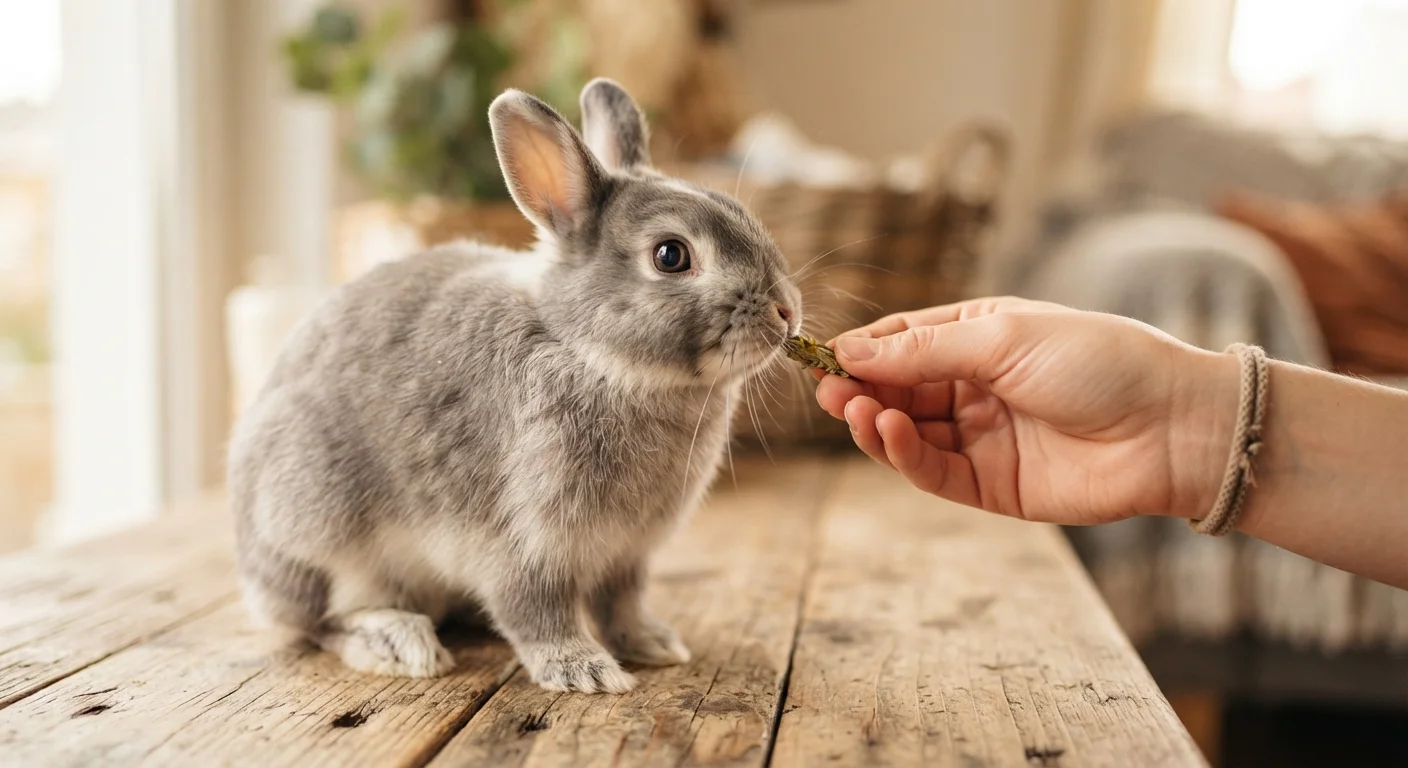
Treats are the most common reward, but their effectiveness depends entirely on the animal finding them genuinely motivating. For rabbits, small pieces of leafy greens, herbs like cilantro, or a sliver of fruit tend to work well — but treats should stay within safe dietary limits; too much sugar disrupts gut flora. For guinea pigs, bell pepper, romaine lettuce, or small amounts of cucumber often outperform commercial treat sticks.
For birds, the picture is more varied. Many parrots respond enthusiastically to millet, nutrient-dense seeds, or even access to a favored toy. Some birds are equally motivated by brief social interaction — a scratch on the head or a moment of direct attention. Identifying your bird's true currency through observation is more valuable than defaulting to food alone.
Using a reward your pet is genuinely motivated by is more important than the technique you apply around it.
Train rabbits using lure-and-reward for basic behaviors
Rabbits respond well to lure-based training, where a treat is used to physically guide the animal into a position before the marker is applied. Common starter behaviors include coming to a name, hopping onto a target mat, and standing up on hind legs (a natural behavior that lends itself to cuing).
Keep sessions no longer than three to five minutes and always end when the rabbit is still engaged — not when it has already lost interest and walked away. Rabbits communicate discomfort through body language: flattened ears, a hunched posture, or thumping are signs to pause the session. Never restrain a rabbit to continue training; forcing contact can cause lasting fear responses and, in extreme cases, physical injury from panicked struggling.
Rabbits learn best when they feel they have a choice — never restrain or corner them during a session.
Use target training to build guinea pig confidence
Target training — teaching an animal to touch its nose to a designated object like the tip of a chopstick or a colored card — is particularly well-suited to guinea pigs. It gives the animal a clear, achievable task and gives you precise control over where it moves and how it engages, without requiring physical handling.
Start by holding the target a few centimeters from the guinea pig's face. The moment it sniffs or touches it, mark and reward. Gradually increase distance. Once the animal consistently follows the target, you can use it to guide movement through tunnels, onto scales for routine weigh-ins, or toward a specific resting spot. Guinea pigs are social animals — training in proximity to a bonded companion (without allowing that companion to steal rewards) can reduce anxiety in shy individuals.
Target training lets guinea pigs engage on their own terms, building trust before more complex handling is introduced.
Teach birds through shaping, step by step
Shaping is the process of rewarding successive approximations of a desired behavior rather than waiting for the complete behavior to appear spontaneously. It's especially effective with birds, whose fine motor capabilities and social intelligence allow rapid learning when sessions are structured well.
To teach a parakeet or parrot to step onto a perch or hand on cue, begin by marking and rewarding any movement toward the target, then proximity, then contact, then sustained standing — each stage separated by multiple successful repetitions before advancing. This avoids overwhelming the bird and keeps motivation high.
Birds that are stressed show it through feather-ruffling, biting, regurgitation attempts, or fleeing. These are not stubbornness — they are communication. Respecting these signals and ending the session before they escalate protects the trust you're building. Parrots especially can remember negative experiences with handlers for extended periods, so keeping early sessions positive is not just good practice — it's essential groundwork.
Shaping rewards progress toward a goal, not just the final behavior — it's the most flexible tool in bird training.
Generalize behaviors across environments and handlers
A rabbit that sits on cue in one room of the house may appear to "forget" the behavior entirely in a new space. This is normal. Animals don't automatically transfer learned behaviors across different contexts — a process called generalization must be deliberately trained.
Once a behavior is solid in one location, begin practicing it in slightly different contexts: a different room, with another person present, or with mild background noise. Introduce each new variable individually, and be prepared to temporarily lower your criteria — a rabbit that performs a full sit for a half-portion treat in a new environment is still making progress.
For households with multiple people, it helps for everyone to use the same cues and the same marker. Inconsistent signals from different handlers slow learning considerably and can produce animals that respond only to one person.
Generalization must be deliberately trained — animals don't automatically apply skills learned in one place to another.
Consistency and Patience Are the Real Training Tools
No matter the species, the owners who see the most progress share two traits: they keep sessions short and they stay consistent. Animals trained sporadically — a few times one week, nothing the next — rarely consolidate what they've learned. Daily two-to-five-minute sessions, ending on a successful behavior, build durable habits far more reliably than marathon sessions.
End Every Session on a Win
Before wrapping up a training session, ask for a behavior your pet already knows well and can perform confidently. Rewarding that final success leaves the animal in a positive emotional state and increases the likelihood it will engage willingly next time. This applies across rabbits, guinea pigs, and birds alike — finishing on a failure or a frustrating repetition erodes motivation gradually.
It's also worth recognizing that training is not purely behavioral — it has welfare implications. A well-trained animal typically experiences less stress during handling, veterinary visits, and household changes. That's a meaningful quality-of-life benefit, documented in rabbit and parrot enrichment research alike. For more on everyday habits that quietly affect your pet's wellbeing, see our piece on common oversights that undermine pet health.
This article is for general educational purposes only. Always consult a qualified veterinarian or certified animal behaviorist for guidance specific to your pet's health, temperament, or behavioral concerns.
The content on this site is for informational purposes only and is not a substitute for professional advice. Always consult a qualified professional for guidance specific to your situation.