

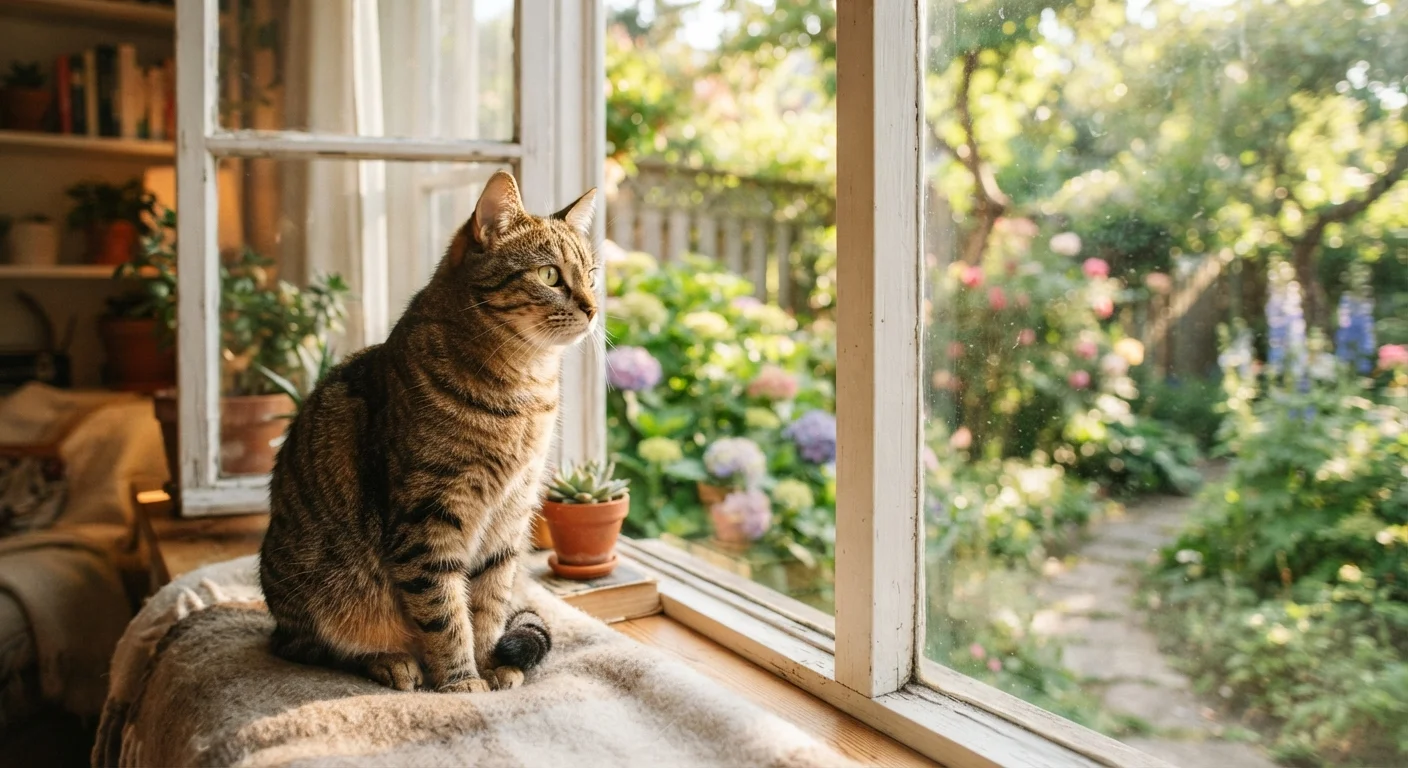
Option A
Indoor Enrichment
The controlled, consistent approach to feline stimulation.
Best for: Cats living in apartments or urban settings where outdoor access poses safety risks.
Option B
Outdoor Enrichment
The sensory-rich, naturalistic option for adventurous cats.
Best for: Cats in low-traffic, supervised settings where environmental hazards can be managed.
Why Enrichment Is a Non-Negotiable Part of Cat Care
Domestic cats retain the instincts of their wild ancestors — stalking, pouncing, climbing, and patrolling territory are not optional extras but core behavioral drives. When those drives go unaddressed, cats often develop stress-related or repetitive behaviors. Understanding why cats develop repetitive behaviors is the first step toward preventing them through smarter enrichment choices.
The enrichment debate is not simply about indoor versus outdoor. It is about whether a cat's environment — wherever it is — delivers enough variety, novelty, and sensory engagement to keep that animal genuinely thriving. Both approaches can succeed or fail depending on execution.
| Criterion | Indoor Enrichment | Outdoor Enrichment |
|---|---|---|
| Safety level | High — controlled environment | Variable — depends on supervision |
| Sensory variety | Moderate — requires active effort | High — naturally layered stimuli |
| Disease & parasite exposure | Low | Higher without preventive care |
| Owner time investment | Regular toy rotation and play needed | Supervision or enclosure setup needed |
| Suitability for kittens | Ideal for controlled socialization | Risky without full vaccination |
| Cost | Low to moderate (toys, furniture) | Varies (catio can be significant) |
| Prey drive satisfaction | Achievable via puzzle toys and play | High — real environmental triggers |
What Indoor Enrichment Actually Involves
Effective indoor enrichment goes well beyond leaving a few toys on the floor. Cats need vertical space — cat trees, wall-mounted shelves, and perches — because elevation is how they survey their territory and feel secure. Scratching posts placed near sleeping areas and entry points satisfy territorial marking instincts and keep claws healthy.
Puzzle feeders and food-dispensing toys tap into hunting cognition. Rather than eating from a static bowl, cats must work for their meal — a practice that reduces boredom and may help with weight management. Our guide on free feeding versus scheduled meals explains how feeding structure itself plays a role in a cat's daily behavioral rhythm.
Rotation matters enormously. A toy that was exciting on Monday is scenery by Friday. Cycling five or six toys so only two or three are available at a time preserves novelty. Window perches with bird feeders or squirrel activity outside provide passive visual stimulation that many cats will use for hours.
5,000+
Average steps a cat may walk indoors daily
Behavioral researchers note that activity levels drop significantly in understimulated indoor cats compared to those with structured enrichment.
2–3x
Higher parasite risk for outdoor cats
Veterinary parasitology studies consistently show outdoor and indoor-outdoor cats face substantially greater flea, tick, and intestinal parasite burdens.
10–15 yrs
Average indoor cat lifespan
The American Veterinary Medical Association notes indoor cats typically outlive free-roaming cats, whose average lifespan is often cited at 2–5 years in some studies.
What Outdoor Enrichment Actually Involves — and Its Real Risks
Outdoor environments deliver something indoor setups genuinely struggle to replicate: layered, unpredictable sensory input. Changing smells, textures underfoot, wind, insects, and birdsong engage a cat's senses simultaneously in ways that shift moment to moment. For cats with high prey drives, this variety is deeply satisfying.
The risks, however, are well-documented. Free-roaming cats face hazards including traffic, predators (coyotes and birds of prey in many U.S. regions), toxins in gardens or streets, and infectious diseases spread through contact with other animals. Parasites — fleas, ticks, and intestinal worms — are substantially more common in outdoor cats. These are not reasons to dismiss outdoor enrichment entirely, but they are reasons to structure it carefully.
Supervised options meaningfully reduce risk. Leash and harness training — more achievable than many owners expect, especially when started gradually — allows a cat to experience outdoor environments with owner oversight. Catios (enclosed outdoor enclosures) are increasingly popular and offer fresh air, natural light, and outdoor sights and sounds without free-roaming exposure. Training a cat to accept a harness follows the same positive-reinforcement principles used for other behavioral goals.
Catios: A Middle-Ground Worth Knowing
A catio is an enclosed outdoor structure — ranging from a simple window box to a large yard enclosure — that lets cats experience the outdoors safely. They can be DIY-built or purchased as kits, and attach directly to a window or door. Many cats adapt quickly to catio access and show measurably calmer indoor behavior as a result. If full outdoor access is not feasible or safe in your area, a catio is one of the most practical solutions available.
Building a Routine That Holds
Whichever approach fits your situation, consistency is what transforms good enrichment ideas into actual behavioral benefits. Cats are creatures of routine — irregular or unpredictable enrichment provides less psychological security than a reliable daily structure, even if that structure is modest.
Pet care routines that hold up under a busy schedule matter as much for mental stimulation as for feeding and grooming. Aim for at least two dedicated interactive play sessions daily, ideally using wand-style toys that mimic prey movement. Combine that with passive enrichment — window access, puzzle feeders, and environmental variety — to fill the hours between sessions. This framework applies whether your cat stays entirely indoors or enjoys supervised outdoor time.
Enrichment is also part of the broader picture of responsible daily pet ownership — alongside nutrition, veterinary care, and socialization. Cats who receive consistent mental and physical engagement are generally healthier, calmer, and less prone to stress-related illness over their lifetimes.
The content on this site is for informational purposes only and is not a substitute for professional advice. Always consult a qualified professional for guidance specific to your situation.