

How the DTI Ratio Is Calculated
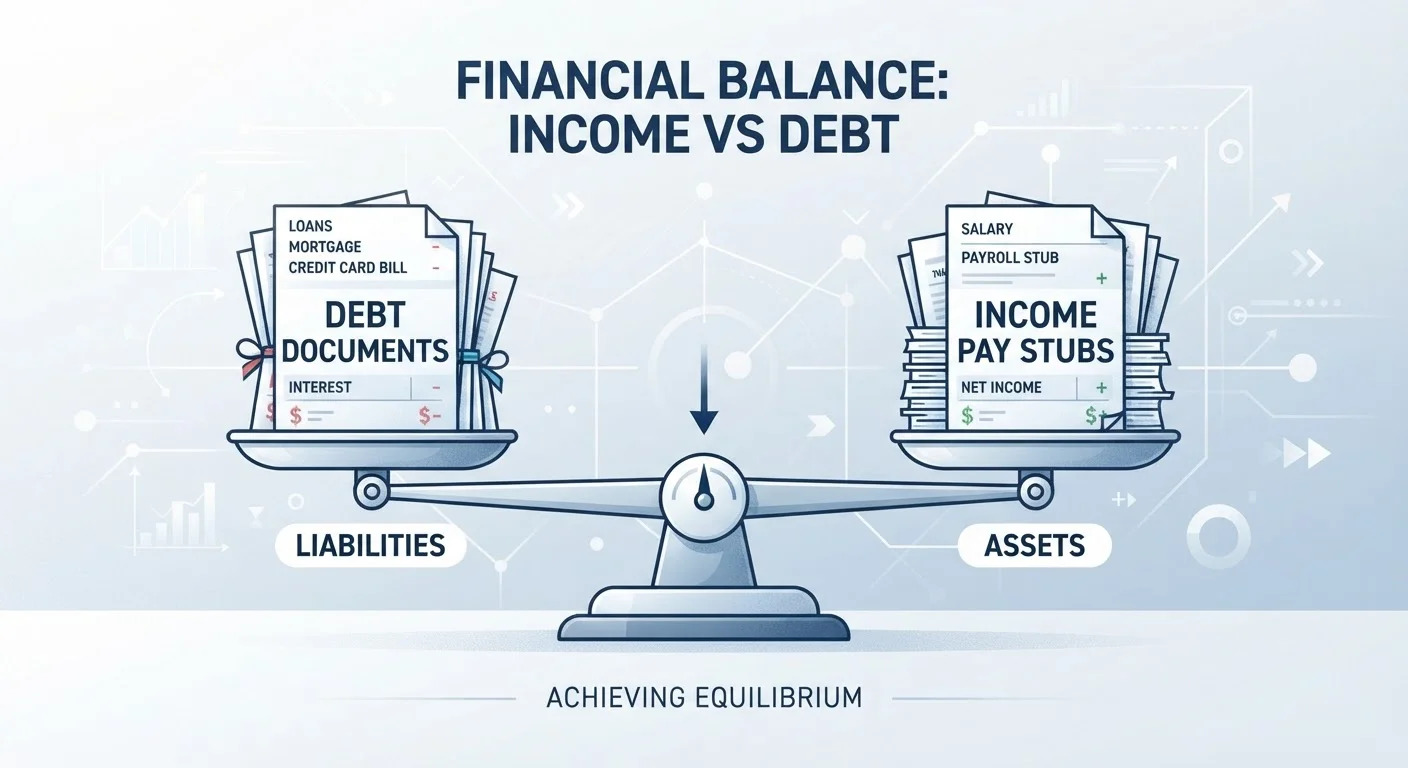
The math behind DTI is straightforward. Add up every recurring monthly debt payment you owe — mortgage or rent, auto loans, student loans, minimum credit card payments, and any personal loans. Divide that total by your gross monthly income (pre-tax earnings), then multiply by 100 to get a percentage.
Example: If your monthly debt payments total $1,800 and your gross monthly income is $5,500, your DTI is approximately 32.7%.
Before applying for any significant loan, it's worth brushing up on the full vocabulary lenders use. Our guide to debt terms every borrower should recognize explains the language — from amortization to principal — in plain English.
43%
Maximum DTI for most conventional mortgages
The Consumer Financial Protection Bureau (CFPB) identifies 43% as the typical upper threshold for a qualified mortgage under federal guidelines.
36%
DTI threshold lenders generally consider healthy
Many financial guidance sources, including the CFPB, cite 36% or below as a benchmark for a manageable debt load relative to income.
2 levers
Ways to reduce DTI ratio
Borrowers can lower DTI only by reducing monthly debt obligations or increasing gross income — or both simultaneously.
What Different DTI Ranges Signal to Lenders
Lenders don't treat all DTI levels the same way. Here's a general breakdown of how most conventional lenders interpret the ratio:
- Below 36%: Considered a strong position. Borrowers in this range are viewed as having manageable debt loads relative to their income and tend to qualify for favorable terms.
- 36%–43%: Still within the acceptable range for many loan products, including most conventional mortgages, though additional scrutiny is common.
- 43%–50%: Elevated risk in most lenders' eyes. Some government-backed mortgage programs allow DTIs in this range, but options narrow considerably.
- Above 50%: Most traditional lenders will decline applications at this level, viewing debt obligations as too large relative to income to safely service new credit.
Keep in mind: DTI is just one input in a lender's decision. Your credit score, employment history, assets, and loan type all factor in as well. Understanding what your credit score actually measures helps you see the full picture lenders consider.
Check Your DTI Before Applying for a Loan
Calculate your own DTI before submitting any credit application. Knowing your ratio in advance lets you address problems — such as paying off a small balance — before a lender pulls your file. It also helps you set realistic expectations about which loan products you're likely to qualify for.
DTI vs. Credit Utilization — Two Different Ratios That Both Matter
It's easy to conflate DTI with credit utilization, but they serve different functions. Credit utilization measures how much of your available revolving credit you're currently using — and it directly influences your credit score. DTI, by contrast, looks at cash flow: can your income support all your monthly debt obligations?
A borrower could have an excellent credit score with low utilization but a high DTI if they carry large installment loan balances. Conversely, someone with a modest credit score might have a low DTI. Lenders weigh both. For a deeper look at the utilization side, see our article on credit utilization and how it shapes your score.
DTI Does Not Appear on Your Credit Report
Because DTI relies on income data that credit bureaus don't collect, it will never show up on your credit report. Lenders calculate it themselves using documents you submit — pay stubs, tax returns, and bank statements. This means improving your DTI requires direct action on debt or income, not credit-reporting corrections.
Practical Ways to Improve Your DTI
Because DTI is a ratio, it responds to changes on either side of the equation — debt payments or income.
- Pay off smaller balances first: Eliminating a loan entirely removes its monthly payment from your numerator, producing an immediate drop in DTI.
- Avoid taking on new debt before a major loan application: Every new monthly obligation raises your DTI, even if the balance is modest.
- Increase gross income: A second income source, raise, or side work raises the denominator, reducing the overall ratio even if debt stays constant.
- Refinance high-rate debt: Lowering an interest rate can reduce the required monthly payment on an existing loan. Be aware that extending loan terms, however, may reduce your monthly payment while increasing the total interest paid over time.
Understanding how high-interest debt grows is essential here — carrying expensive balances inflates your monthly payment obligations and pushes DTI higher over time.
Sustainable improvement also often comes down to the habits you build day to day. Our article on financial habits that help people stay out of debt outlines the behaviors that tend to keep debt manageable over the long run.
This article is for general informational purposes only and does not constitute personalized financial or lending advice. Loan eligibility requirements vary by lender and loan type. Consult a licensed financial adviser or mortgage professional regarding your specific situation.
Frequently Asked Questions
Most lenders consider a DTI below 36% to be healthy. Ratios between 36% and 43% are generally still acceptable for many loan products, though you may face more scrutiny. Above 43%, qualifying for a mortgage or major loan becomes significantly harder.
No. Your DTI ratio is not part of your credit report and does not directly influence your credit score. However, lenders almost always review it separately alongside your credit score when evaluating an application.
Recurring monthly obligations count — mortgage or rent payments, car loans, student loans, minimum credit card payments, and personal loan payments. Utilities, groceries, and insurance premiums are typically excluded.
The two levers are reducing monthly debt payments and increasing gross income. Paying off a smaller loan entirely, refinancing to lower a monthly payment, or taking on additional income can each move the ratio meaningfully.
No — they measure different things. Credit utilization compares your revolving balances to your credit limits and directly affects your score. DTI compares all monthly debt payments to gross income and is assessed separately by lenders.
Lenders use gross income — your earnings before taxes and other deductions. This is a consistent, verifiable figure that makes comparisons straightforward across applicants.
The content on this site is for informational purposes only and is not a substitute for professional advice. Always consult a qualified professional for guidance specific to your situation.