

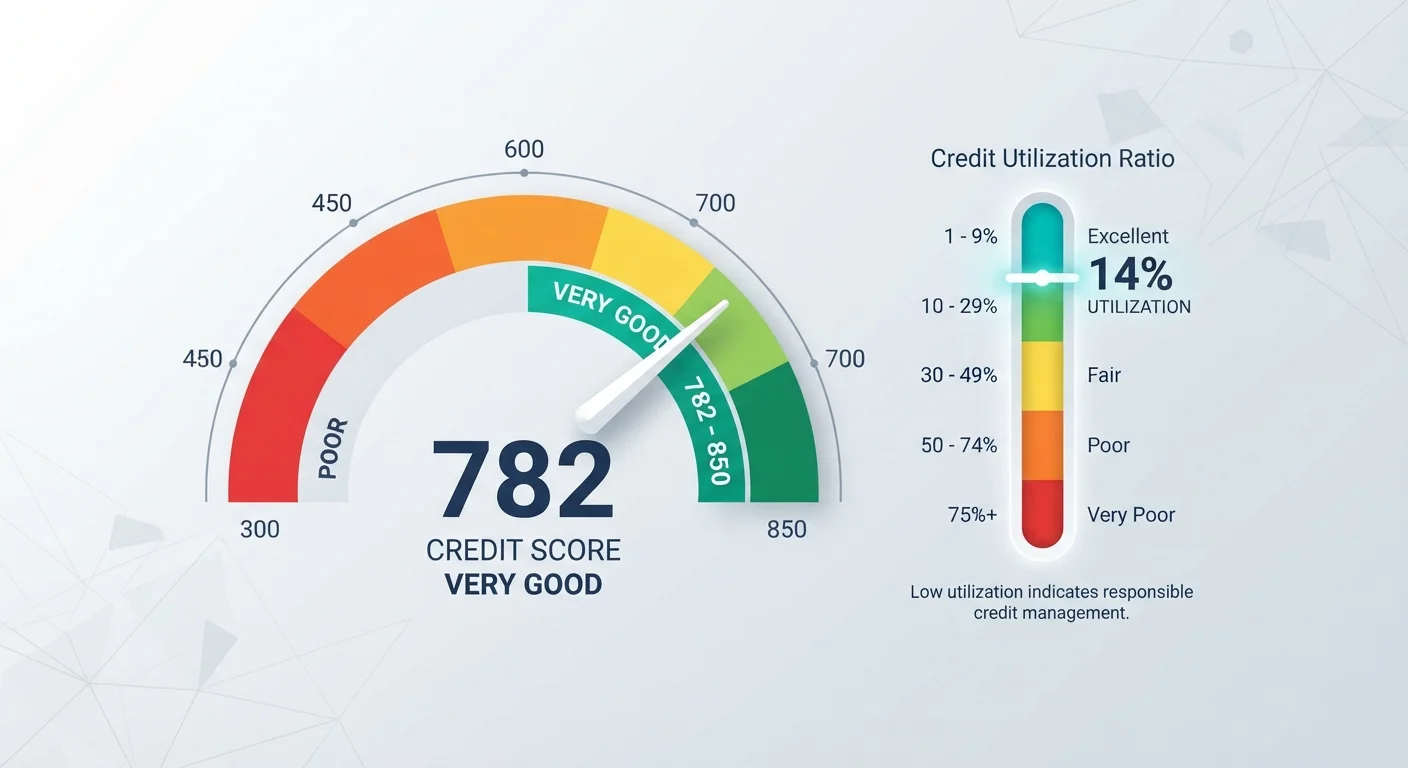
How Credit Utilization Is Calculated
The math behind credit utilization is straightforward: divide your total revolving credit balances by your total revolving credit limits, then multiply by 100 to get a percentage. If your combined card balances total $3,000 and your combined limits total $15,000, your utilization is 20%.
What's less obvious is which accounts count. Utilization only applies to revolving credit — primarily credit cards and personal lines of credit. Installment loans such as auto loans, student loans, and mortgages are excluded from this calculation entirely. This distinction matters because consumers sometimes assume paying down a car loan will reduce their utilization; it won't.
Another important nuance: utilization is a snapshot, not an average. Credit card issuers generally report your balance to the credit bureaus on or shortly after your statement closing date. Whatever balance appears at that moment is what the scoring model sees. This is why carrying a balance doesn't necessarily mean your reported utilization is high — and why timing your payments strategically can influence the number that gets reported.
~30%
Share of FICO score tied to amounts owed
According to FICO's published scoring factor breakdown, 'amounts owed' — which includes utilization — is the second-largest component of a FICO score.
<10%
Utilization rate among consumers with top credit scores
FICO data on high scorers (800+) consistently shows very low average utilization, often in the single digits.
28%
Average credit utilization rate among U.S. cardholders
Experian's State of Credit reports have historically found average revolving utilization in the upper 20s to 30% range for American consumers.
Why It Carries So Much Weight in Scoring Models
Credit utilization is the second-largest factor in a FICO score, representing roughly 30% of the total. Only payment history — whether you pay on time — carries more weight. This means your utilization ratio can meaningfully lift or sink your score independent of whether you've ever missed a payment.
Scoring models interpret high utilization as a potential sign of financial stress. A consumer using 80% of their available credit may be seen as more likely to default than one using 15%, even if both have spotless payment records. The logic is that consumers close to their credit limits have less financial cushion.
This dynamic also explains why utilization is sometimes called the most "actionable" credit factor. Unlike payment history, which records past behavior that takes time to age off, or length of credit history, which you can't speed up, utilization can change dramatically within a single billing cycle. Common misconceptions about credit scores — such as the idea that carrying a small balance helps your score — often stem from misunderstanding how utilization actually functions in scoring models.
Time Your Payments for Maximum Impact
If you want a lower utilization ratio reported to the credit bureaus, consider making a payment before your statement closing date rather than waiting for the due date. This reduces the balance your issuer reports, which is the figure scoring models use. Check your card's billing cycle to identify the closing date.
Common Misunderstandings and What to Do Instead
One of the most persistent myths is that you must carry a balance from month to month to benefit your score. In reality, carrying a balance only increases the amount you owe in interest — it does not improve utilization or signal responsible use. Paying your statement balance in full each month while keeping utilization low is the approach consistent with strong credit health.
Another misconception involves credit limit increases. Requesting a higher limit does reduce your utilization ratio (assuming balances stay flat), but the process may involve a hard inquiry from the issuer. For context on how that affects your score, see our explainer on hard vs. soft credit inquiries.
It's also worth noting that credit utilization is separate from your debt-to-income ratio (DTI), which lenders calculate independently when evaluating loan applications. Your DTI compares your monthly debt payments to your gross monthly income — it doesn't appear on your credit report but is a critical underwriting factor. Learn more in our overview of the debt-to-income ratio and why lenders monitor it.
If you're preparing to apply for new credit and want to assess where your utilization and other factors stand, our financial readiness checklist can help you identify gaps before submitting an application.
Utilization Resets Each Reporting Cycle
Unlike a missed payment, which can stay on your credit report for up to seven years, high utilization doesn't leave a lasting mark. Once you reduce your balances and a new statement is reported, your score can recover relatively quickly. This makes utilization one of the faster levers available for improving a credit score.
This article is for general informational and educational purposes only and does not constitute personalized financial advice. For guidance specific to your situation, consult a qualified financial professional.
Frequently Asked Questions
Most credit experts suggest keeping utilization below 30% as a baseline, but consumers with the highest scores tend to stay below 10%. There's no universally perfect number, but lower utilization generally signals less credit risk to lenders and scoring models.
Yes, but the timing matters. Issuers typically report your balance on your statement closing date, not your due date. If you pay in full after the statement closes, the reported balance may still reflect a high utilization figure. Paying before the statement closes can result in a lower reported balance.
Closing a card removes its credit limit from your total available credit, which raises your utilization ratio if you carry balances on other cards. This is one reason financial educators generally caution against closing older accounts without considering the impact.
Both. Scoring models typically evaluate your overall utilization across all revolving accounts as well as per-card utilization. A single card maxed out near its limit can drag down your score even if your aggregate ratio looks fine.
Credit utilization has no memory — it's evaluated fresh each scoring cycle. Once a lower balance is reported to the credit bureaus (usually after your statement closes), you can see score improvements relatively quickly compared to other credit factors.
Yes, assuming your balances stay the same. A higher credit limit lowers the percentage of available credit you're using. However, applying for an increase may trigger a hard inquiry, which can briefly affect your score.
The content on this site is for informational purposes only and is not a substitute for professional advice. Always consult a qualified professional for guidance specific to your situation.