

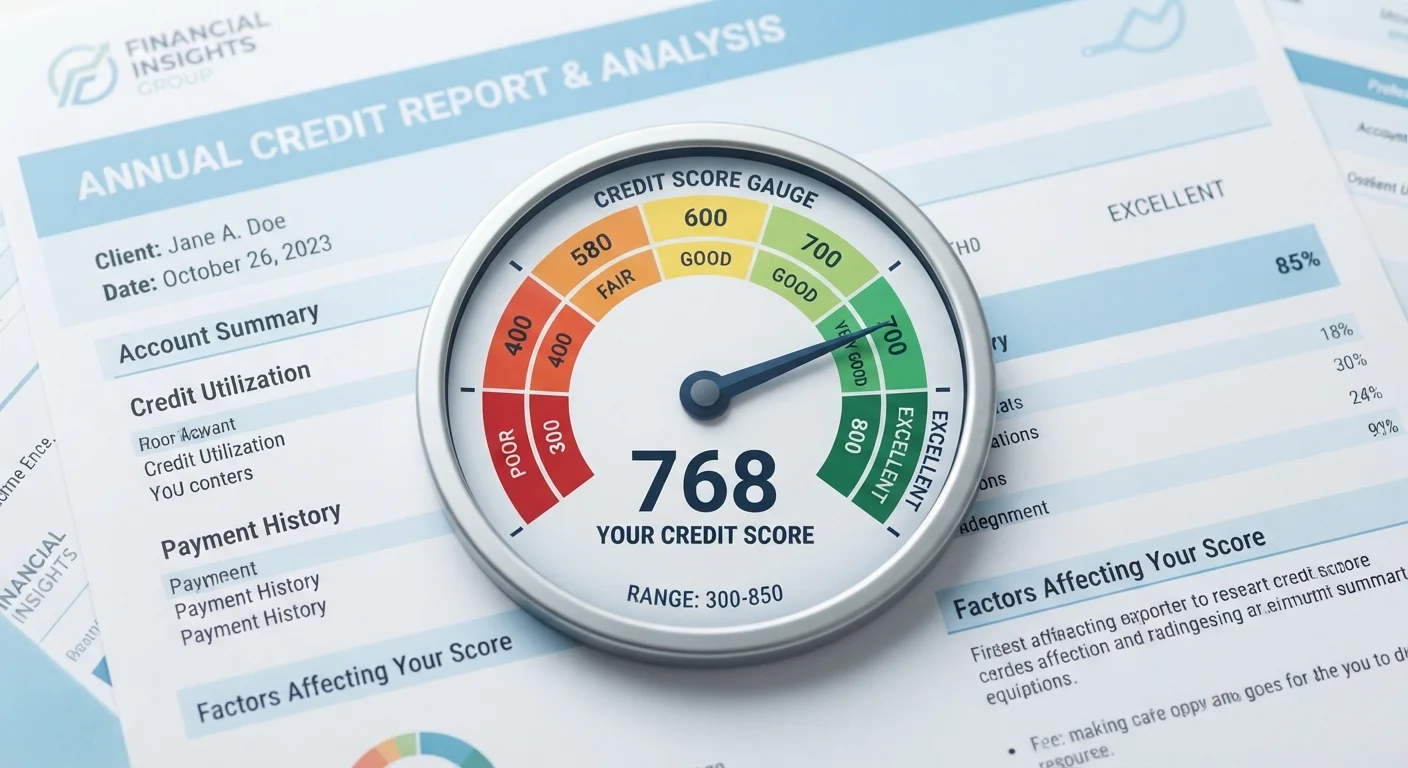
Five Factors, One Number
A credit score doesn't measure whether you're responsible with money in general. It measures five very specific behaviors drawn from your credit report. Understanding each factor — and the weight it carries — turns an opaque three-digit number into something you can actually influence.
The FICO Score, the model most lenders use, breaks down as follows:
- Payment history: ~35%
- Amounts owed (credit utilization): ~30%
- Length of credit history: ~15%
- Credit mix: ~10%
- New credit inquiries: ~10%
Each factor reflects a different question a lender is asking about your borrowing habits.
35%
Share of FICO Score from payment history
According to FICO's published scoring breakdown, payment history is the single largest component of the standard FICO Score.
~30%
Share driven by amounts owed
FICO's model weights credit utilization and total balances as the second-largest scoring factor, making it nearly as impactful as payment history.
200M+
Americans with a scoreable credit file
The Consumer Financial Protection Bureau has estimated that the large majority of American adults have enough credit history to generate a credit score.
Payment History: The Heaviest Weight
Payment history answers one question: do you pay what you owe, on time? At roughly 35% of your score, it carries more weight than any other single factor. A single missed payment — particularly one that goes 30 days past due and gets reported to the credit bureaus — can noticeably drag your score down.
Positive payment history, built consistently over months and years, is the most reliable way to establish or restore a strong score. Automatic payments and calendar reminders are practical ways to protect this factor.
Set Up Autopay for Minimum Payments
Even if you plan to pay more, automating at least the minimum payment on every account protects your payment history from accidental late marks. A single reported late payment can have an outsized effect relative to the minor cost of setting up autopay. Review your statements regularly to confirm charges and adjust manual payments on top.
Credit Utilization: How Much You Owe vs. How Much You Could
Credit utilization measures the percentage of your available revolving credit — primarily credit cards — that you're currently using. If you have a combined credit limit of $10,000 across all cards and carry a $3,000 balance, your utilization is 30%.
Scoring models generally reward lower utilization. Consumers with the highest scores tend to keep utilization well below 30%, though there is no single universally agreed threshold. Utilization is recalculated each time lenders report your balances to the bureaus, which typically happens monthly. Our dedicated explainer on credit utilization covers the mechanics in depth.
The Three Smaller Factors That Still Matter
Length of credit history accounts for roughly 15% of your score. Scoring models consider the age of your oldest account, your newest account, and the average age of all accounts. This is why closing old accounts can sometimes work against you — it can shorten your average credit age. For more context, see our piece on common credit score myths.
Credit mix (about 10%) reflects whether you manage different types of credit — revolving accounts like credit cards alongside installment loans like auto or student loans. A varied mix can signal broader credit management experience, though opening accounts solely to diversify isn't generally advisable.
New credit inquiries (about 10%) tracks how often you've applied for new credit recently. Each hard inquiry — when a lender pulls your report as part of an application — can have a small, temporary effect on your score. Multiple inquiries for the same type of loan within a short window are typically grouped as a single inquiry by scoring models, acknowledging that rate shopping is a reasonable consumer behavior.
Rate Shopping Is Treated Differently
When you apply for a mortgage, auto loan, or student loan, multiple hard inquiries made within a short window — often 14 to 45 days depending on the scoring model — are typically counted as a single inquiry. This allows consumers to compare rates from different lenders without disproportionate score impact. The same grouping does not apply to credit card applications.
What a Credit Score Doesn't Measure
A credit score is not a comprehensive judgment of your financial health. It contains no information about your income, savings, investments, net worth, or employment history. Two people with identical credit scores could have wildly different financial pictures.
This is why lenders often look beyond the score itself. Debt-to-income ratio — a measure of how your monthly debt payments compare to your gross income — is a separate calculation that many lenders weigh heavily. Our article on the debt-to-income ratio explains how that metric works and why it matters alongside your credit score.
Understanding these boundaries helps you see that improving your score is about managing the five trackable factors above — not every aspect of your financial life at once. For strategies on managing debt while building credit, the Saving & Debt hub is a useful starting point.
This article is for general informational and educational purposes only and does not constitute personalized financial or credit advice. Consult a qualified financial professional for guidance specific to your situation.
Frequently Asked Questions
Under the FICO model, scores of 670 and above are generally considered good, with 740 and above considered very good, and 800 and above considered exceptional. Scores below 580 are typically classified as poor. Different lenders may apply their own thresholds when making credit decisions.
No. Checking your own score is classified as a soft inquiry and has no impact on your credit score. Only hard inquiries — triggered when a lender reviews your credit as part of an application — can affect your score. For more detail, see our article on <a href="/money-finance/credit-and-banking/hard-inquiries-vs-soft-inquiries-on-your-credit-report">hard vs. soft inquiries</a>.
Building credit from scratch or recovering from a setback takes time because scoring models emphasize consistent behavior over months and years. Responsible habits — on-time payments and low utilization — can produce measurable improvement within six to twelve months, though significant recovery from serious negative marks may take longer.
No. Credit scores are based solely on your credit report data, which tracks borrowing and repayment behavior. Income, savings balances, employment status, and net worth are not factored in. Lenders often look at income separately when evaluating applications.
Your credit report is the detailed record of your credit accounts, payment history, balances, and inquiries. Your credit score is a numerical summary calculated from that report. Think of the report as the raw data and the score as the calculated result. Our guide on <a href="/money-finance/credit-and-banking/reading-a-credit-report-without-getting-lost">reading a credit report</a> walks through every major section.
The content on this site is for informational purposes only and is not a substitute for professional advice. Always consult a qualified professional for guidance specific to your situation.