

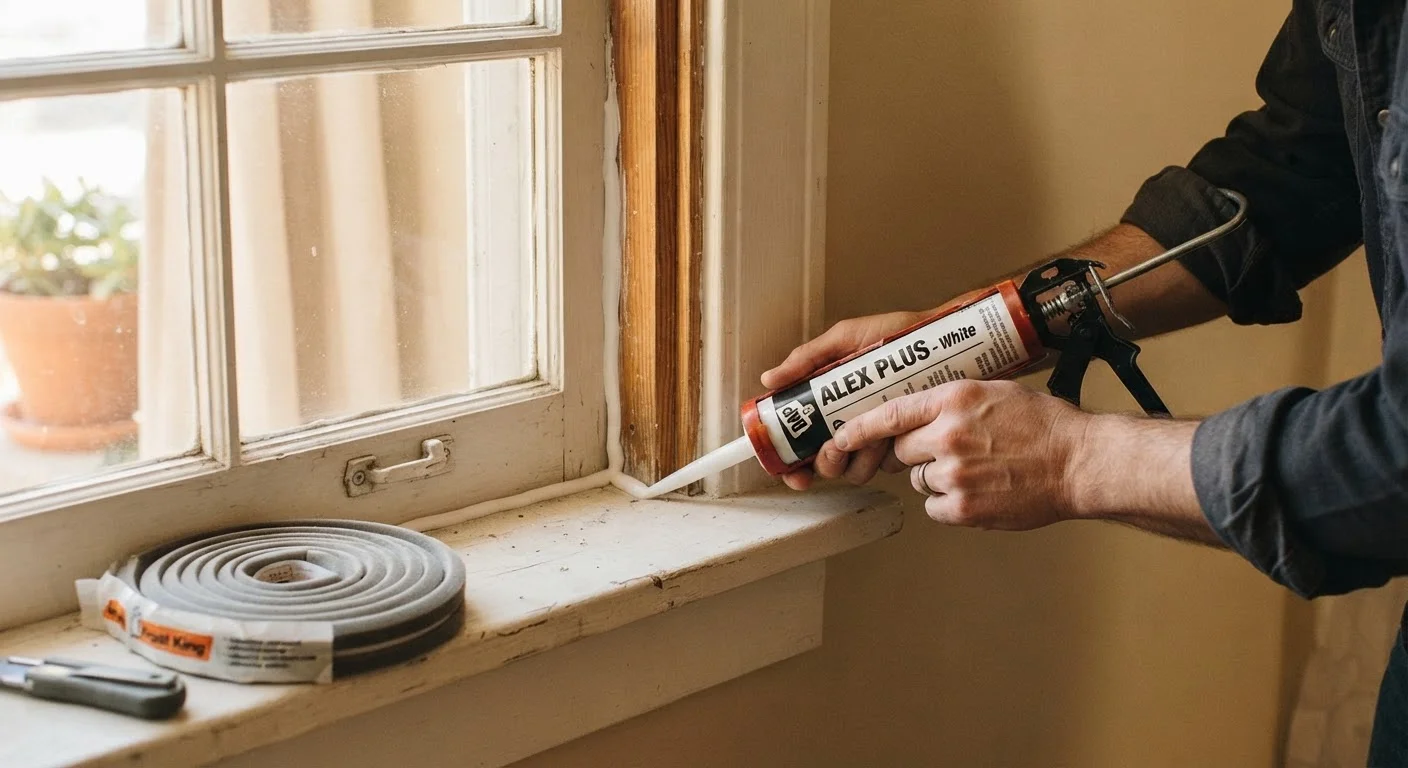
Option A
Caulk
The permanent, flexible sealant for stationary cracks and joints.
Best for: Sealing fixed gaps where two surfaces meet and do not move relative to each other, such as around window frames, door frames, and baseboards.
Option B
Weatherstripping
The compressible, replaceable seal for moving parts.
Best for: Creating an airtight seal on operable components - doors and windows that open and close regularly - where caulk would crack and fail.
Why the Distinction Matters
Air leaks are one of the leading causes of energy waste in American homes. The U.S. Department of Energy estimates that drafts and uncontrolled air infiltration can account for 25-40% of the energy used for heating and cooling. But not every gap is the same, and reaching for the wrong fix can mean the problem returns within a single season.
The core rule is straightforward: caulk seals stationary surfaces; weatherstripping seals moving ones. Applying caulk to a door's moving edge will cause it to crack and peel quickly. Placing foam tape in a fixed crack between a frame and a wall won't bond properly and will eventually fall away. Getting the match right the first time saves both effort and money.
As part of a broader winter weatherproofing plan, understanding where each material belongs is the essential first step.
| Criterion | Caulk | Weatherstripping |
|---|---|---|
| Best application | Fixed, stationary joints and cracks | Operable doors and windows |
| Movement tolerance | Low - cracks when repeatedly flexed | High - designed to compress and rebound |
| Typical lifespan | 5-20 years depending on type and location | 1-5 years depending on material and use |
| DIY difficulty | Low - gun and basic prep required | Low to moderate - measuring and cutting needed |
| Material cost | Generally low per tube | Low to moderate per linear foot |
| Paintable | Depends on type (latex yes, silicone no) | Typically no |
| Water resistance | High with silicone or siliconized latex | Moderate - not a primary waterproofing tool |
When to Use Caulk
Caulk is a flexible sealant that is applied wet and cures into a semi-rigid or elastic bead. It excels anywhere two different materials meet along a fixed joint - surfaces that don't move relative to each other after installation.
Common caulk locations
- Between window and door frames and the surrounding wall or siding
- Along baseboards, crown molding, and trim where they meet walls
- Around plumbing pipes and electrical conduit penetrating through walls or floors
- At the joint where a bathtub or sink meets a tiled wall
- Along the sill plate where a home's framing meets its foundation
Choosing the right caulk type
Silicone caulk is highly durable, waterproof, and resistant to temperature extremes - ideal for exterior joints and wet areas like bathrooms. It cannot be painted, however, so it's a poor choice for interior trim. Latex (or acrylic latex) caulk cleans up with water, accepts paint readily, and works well for interior joints. Siliconized latex blends both properties, offering paintability with enhanced moisture resistance - a versatile choice for most interior-exterior transitions.
For large gaps (typically wider than ½ inch), press a foam backer rod into the gap first to provide support before applying caulk over it. This prevents the caulk from sinking and cracking in the center.
25-40%
Home energy loss from air infiltration
The U.S. Department of Energy estimates that drafts through gaps and cracks account for roughly a quarter to nearly half of heating and cooling energy use in typical homes.
$0.05-$0.50
Cost of weatherstripping per linear foot
Material costs for common weatherstripping types range widely by material; foam tape is the least expensive, while reinforced door shoes and metal V-strips fall at the higher end.
1-2 years
Typical foam tape weatherstripping lifespan
Self-adhesive foam tape compresses permanently with repeated door or window use, making annual inspection and replacement a practical maintenance habit for high-traffic openings.
When to Use Weatherstripping
Weatherstripping is a category of compressible sealing materials designed to close the gap between a movable component - a door, a window sash - and its frame. Unlike caulk, it must flex, compress, and spring back repeatedly without losing effectiveness.
Common weatherstripping locations
- Along the top and sides (the doorstop) of exterior door frames
- At the door threshold (the bottom seal)
- Around the sash of double-hung or casement windows
- Along the meeting rail where two window sashes overlap
- On attic hatches and garage doors
Types of weatherstripping
V-strip (tension seal): A folded strip of metal or plastic that fits into the channel of a window or door frame and exerts outward pressure to close small gaps. Long-lasting and barely visible once installed.
Foam tape: Self-adhesive, easy to apply, and inexpensive - but it compresses permanently over time and typically needs replacing every 1-2 years in high-use openings.
Door sweeps and door shoes: Mounted to the bottom edge of a door to seal the threshold gap. Door shoes (which wrap around the bottom of the door) tend to be more durable than stick-on sweeps.
Bulb or tubular gaskets: Rubber or vinyl profiles stapled or tacked to door stops. They compress firmly when the door closes and are well-suited to exterior doors. Inspect these annually, as UV exposure causes them to harden and crack.
These small maintenance tasks are among the commonly overlooked upkeep items that quietly drive up energy costs when left unaddressed.
Don't Caulk Weep Holes or Expansion Joints
Certain gaps in a home's exterior are intentional and must not be sealed. Weep holes - small openings at the bottom of brick veneer or window frames - allow moisture trapped inside wall cavities to drain out. Sealing them can lead to water damage and mold. Similarly, expansion joints in concrete or masonry are designed to flex with temperature changes; caulking them with a rigid sealant (rather than a purpose-made flexible backer) can cause cracking. When in doubt about whether a gap is intentional, consult a qualified contractor before sealing it.
Applying Both Materials Correctly
Successful air sealing comes down to surface preparation and material selection working together. Before applying either product, clean the surface thoroughly - remove old caulk residue, dirt, and moisture. Both caulk and most weatherstripping adhesives require a dry, clean surface to bond properly.
When caulking, cut the tube tip at a 45-degree angle and apply steady, consistent pressure as you move along the joint. Smooth the bead with a damp fingertip or a caulk tool before it skins over. Avoid caulking in temperatures below 40°F (4°C), as most formulas won't cure properly in the cold.
When installing weatherstripping, measure the opening carefully, cut the material to length with clean cuts, and test the door or window closes fully without excessive resistance. Too tight is nearly as problematic as too loose - it causes premature wear and can warp door frames over time.
Done together, caulk and weatherstripping form a complementary system. Think of it this way: caulk fills in the house's skin; weatherstripping seals its doors. Both are needed for a genuinely tight building envelope - the complete boundary between conditioned indoor air and the outside.
The content on this site is for informational purposes only and is not a substitute for professional advice. Always consult a qualified professional for guidance specific to your situation.