

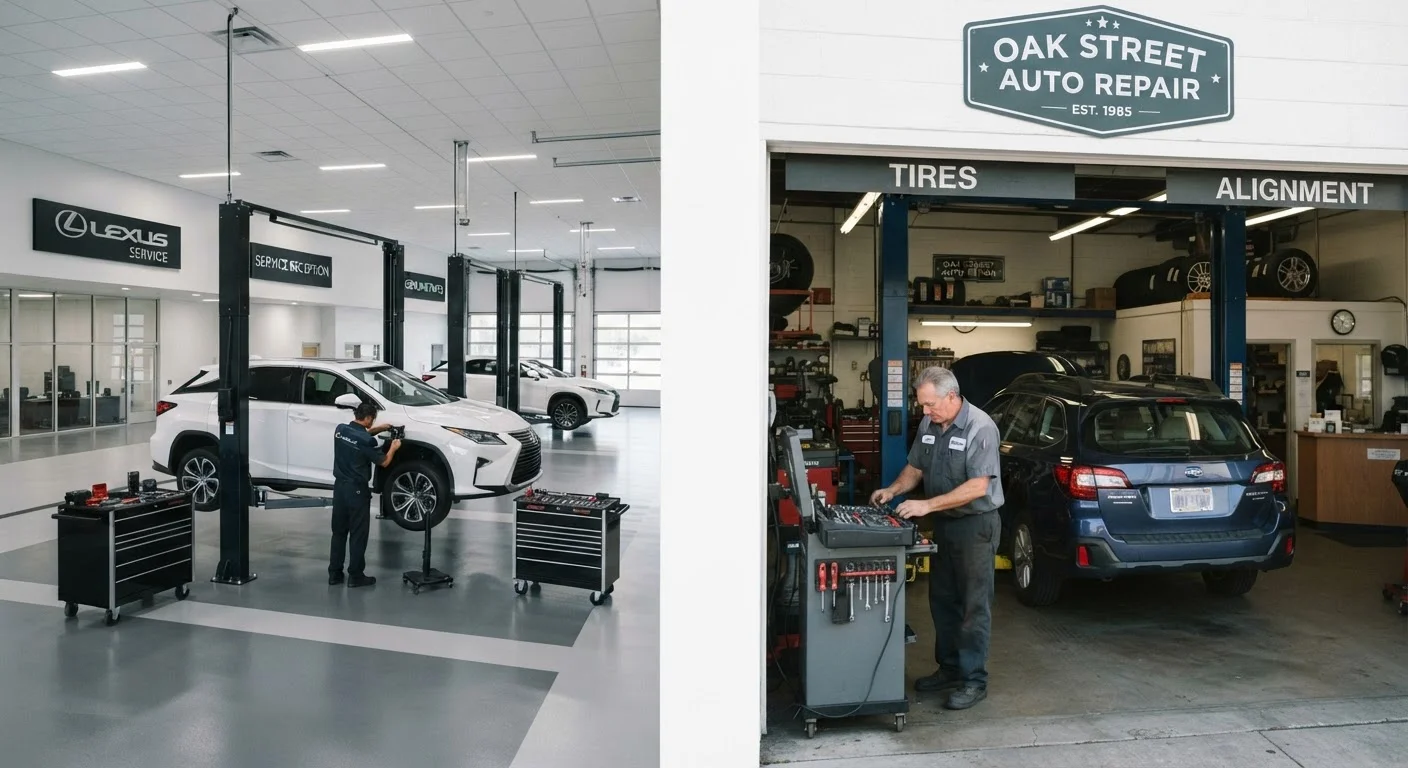
Our Verdict
Neither dealerships nor independent mechanics are universally better. Dealerships tend to make the most sense for vehicles still under warranty, complex manufacturer-specific repairs, or recalls. Independent shops are often the practical choice for routine maintenance on older vehicles, general repairs, and drivers watching costs closely. The strongest approach is knowing what each does well and matching that to your vehicle's specific needs.
| Best for | Recommended |
|---|---|
| Vehicles still under factory or powertrain warranty | Dealership |
| Recall repairs and software updates | Dealership |
| Routine maintenance on vehicles older than five years | Independent Mechanic |
| Cost-conscious drivers needing general repairs | Independent Mechanic |
Why This Decision Matters More Than Most Drivers Realize
Where you take your car for service affects more than just your bill. It can influence your warranty coverage, the quality of parts installed, and whether the shop has the right diagnostic equipment for your specific vehicle. Yet most drivers choose based on habit or convenience rather than the actual factors at play.
Understanding the real trade-offs between dealership service departments and independent repair shops gives you a clearer framework - one that can save you money on routine work and protect you when it counts. This is especially relevant if you're also thinking through longer-term vehicle costs. How depreciation affects every vehicle decision is another lens worth applying as your car ages.
What Dealership Service Centers Offer
Dealership service departments employ factory-trained technicians who specialize in a single brand. They have direct access to manufacturer-issued technical service bulletins, proprietary diagnostic software, and original equipment manufacturer (OEM) parts - components made to the exact specifications of your vehicle.
This specialization matters most in specific situations:
- Warranty repairs: Any work covered under your factory or powertrain warranty must typically be performed at an authorized dealership to be reimbursed.
- Recall work: Recalls are handled exclusively by dealerships at no charge to you.
- Complex, brand-specific diagnostics: Some modern vehicles require proprietary scan tools that aftermarket shops may not have.
The trade-off is cost. Dealership labor rates are generally higher than independent shops, and their parts pricing reflects that OEM supply chain. For straightforward maintenance tasks, that premium may not be justified.
Ask About Certified Pre-Owned Requirements
If you own a certified pre-owned (CPO) vehicle, check your CPO agreement carefully. Some CPO warranties specifically require dealership service for covered repairs. Reading the fine print before your first service visit can prevent unexpected coverage disputes later.
What Independent Mechanics Bring to the Table
Independent shops range from small family-owned garages to multi-bay operations with advanced diagnostic equipment. The best of them employ ASE-certified technicians - mechanics who have passed standardized competency exams administered by the National Institute for Automotive Service Excellence.
Their advantages are real and practical:
- Lower overhead, lower labor rates: Independent shops often charge meaningfully less per hour than dealerships.
- Flexibility on parts: They can use OEM parts, aftermarket alternatives, or rebuilt components depending on your budget and needs - and a good mechanic will explain those options.
- Relationship-based service: Many drivers find that a trusted independent mechanic provides more individualized communication and continuity of care.
If you're deciding on oil service intervals or fluid types, this is also a good time to consult resources like what drivers should know about synthetic vs. conventional oil.
| Dealership Service | Independent Mechanic | |
|---|---|---|
| Technician training | Factory-trained, brand-specific | ASE-certified or general experience |
| Parts used | OEM (manufacturer original) | OEM, aftermarket, or rebuilt options |
| Labor rates | Generally higher | Often lower |
| Diagnostic tools | Proprietary manufacturer software | Aftermarket tools; varies by shop |
| Warranty work & recalls | Can perform; required for recalls | Cannot perform manufacturer warranty work |
| Best vehicle age | Newer, under-warranty vehicles | Older, out-of-warranty vehicles |
| Personalized service | Variable; larger operation | Often more direct communication |
The Warranty Question - Clearing Up a Common Misconception
One of the most persistent myths in auto service is that taking your car to an independent shop voids your factory warranty. Under the Magnuson-Moss Warranty Act, a federal law, manufacturers generally cannot void your warranty simply because you used an independent shop for maintenance - provided the work was performed correctly and with appropriate parts.
However, there are important nuances. If an independent shop performs a repair incorrectly and that faulty repair causes a subsequent problem, the manufacturer may deny a warranty claim for that related damage. Keeping detailed service records - including receipts showing what parts were used - is your protection.
For vehicles still within their new-car warranty period, many owners choose dealerships for warranty-adjacent work simply to avoid any ambiguity, which is a reasonable approach.
Always Keep Your Service Records
Whether you use a dealership or an independent shop, save every service receipt. Records should show the date, mileage, work performed, and parts used. If a warranty dispute arises, these documents are your primary evidence that maintenance was performed correctly and on schedule.
How to Make the Call for Your Specific Situation
Rather than picking a side permanently, treat this as a situational decision. A few practical questions can guide you:
- Is the vehicle under warranty? If yes, use the dealership for any work that might interact with warranty coverage.
- Is this a recall or technical service bulletin repair? Go to the dealership - it's free and the only appropriate venue.
- How old is the vehicle? Vehicles beyond warranty age are strong candidates for independent shop service, especially for routine work.
- How complex is the repair? Brand-specific electronic systems, transmission reprogramming, or ADAS (Advanced Driver Assistance System) calibration may genuinely require dealer equipment.
- Have you gotten an estimate? For any significant repair, getting written estimates from multiple shops - including at least one dealership and one reputable independent - is basic due diligence.
Your overall cost of ownership extends well beyond repair bills. If you're also evaluating financing decisions, the trade-offs between financing and paying cash for a car are worth reviewing alongside your service strategy.
This article is for general informational purposes only and does not constitute professional mechanical, legal, or financial advice. Consult a qualified mechanic or licensed professional for guidance specific to your vehicle and situation.
The content on this site is for informational purposes only and is not a substitute for professional advice. Always consult a qualified professional for guidance specific to your situation.