

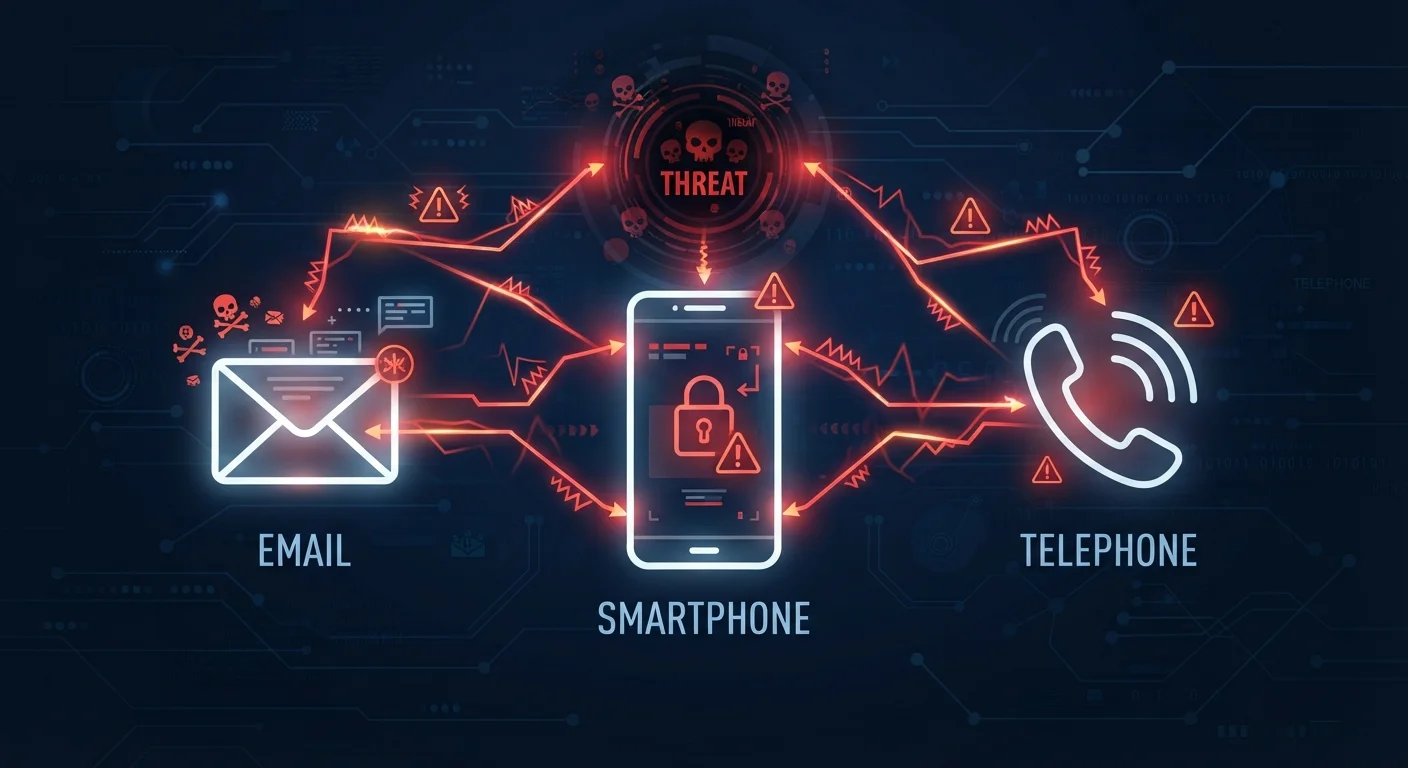
The Same Trick, Three Different Doors
Phishing, smishing, and vishing are not separate criminal inventions — they are the same social engineering strategy delivered through different communication channels. Each one impersonates a trusted source, creates urgency, and nudges you toward an action that hands over sensitive information or access. The channel determines how the scam arrives; the psychological mechanism is nearly identical across all three.
Understanding each delivery method helps you recognize the warning signs before you act. See our guide to social engineering for a deeper look at the psychological tactics scammers rely on.
| Phishing delivery channel | |
| Smishing delivery channel | SMS text message |
| Vishing delivery channel | Voice phone call |
| Core deceptive tactic shared by all three | Impersonation + artificial urgency |
| U.S. number to report smishing texts | 7726 (SPAM) (FTC consumer guidance) |
| Where to report vishing calls in the U.S. | reportfraud.ftc.gov (Federal Trade Commission) |
Phishing: The Email Impersonator
Phishing arrives in your inbox. A scam email might appear to come from your bank, a delivery carrier, a government agency, or a well-known retailer. The message typically warns of a problem — a suspended account, an undelivered package, a suspicious charge — and includes a link or attachment designed to steal your credentials or install malware.
Modern phishing emails are often indistinguishable from legitimate ones at a glance. Attackers copy real brand logos, mimic formatting, and spoof sender addresses so the "From" field shows a plausible domain. The tell-tale signs are usually in the details: hover over any link before clicking and confirm the actual URL matches the organization's real domain. Legitimate institutions rarely ask for passwords or full account numbers by email.
Spear phishing is a targeted variant — the attacker researches the victim and personalizes the message, making it far more convincing. Your name, employer, or recent activity (gathered from data you may share without realizing it) can be used to build credibility.
Phishing
A scam delivered via email in which an attacker impersonates a trusted organization to trick recipients into revealing credentials, clicking malicious links, or opening infected attachments.
Smishing
A phishing attack delivered via SMS text message, often containing a shortened or disguised link and urgent language designed to prompt an immediate response.
Vishing
Voice phishing — a scam conducted over a phone call in which the attacker impersonates a legitimate authority (bank, government agency, tech support) to extract sensitive information or payment.
Spear Phishing
A highly targeted phishing attempt personalized with the victim's real name, employer, or other specific details to appear more credible than a generic mass message.
Caller ID Spoofing
A technique that falsifies the phone number displayed on a recipient's caller ID, making a scam call appear to originate from a legitimate or familiar number.
Multi-Factor Authentication (MFA)
A security process requiring two or more verification steps to access an account, such as a password plus a one-time code sent to a separate device, reducing risk even when credentials are stolen.
Smishing and Vishing: When Scams Call and Text
Smishing (SMS + phishing) reaches you by text message. A typical smishing message claims to be from a bank fraud department, postal service, or government agency, and includes a short link and an urgent prompt. Because people tend to trust texts more than emails — and because links in texts are harder to inspect on a small screen — smishing has a notably high click-through rate among scam formats.
Red flags include unsolicited texts from unknown numbers, URLs that use number-letter substitutions (like "0" for "o"), and requests to confirm personal details through a link rather than through the organization's official app.
Vishing (voice + phishing) uses a phone call. The caller may claim to be IRS enforcement, Social Security Administration staff, tech support, or a bank fraud investigator. Calls can now be spoofed to display a legitimate-looking number on your caller ID — including real government or bank numbers. Pressure tactics are central: callers may claim you owe money immediately, that your account is being closed, or that law enforcement is involved.
A key defense: hang up and call back using a number you look up independently — from the organization's official website, not one provided during the call. Legitimate agencies and banks will not demand immediate payment by gift card, wire transfer, or cryptocurrency. After any suspected breach, follow the steps in our article on protecting your accounts after a data breach.
Gift Cards Are Never a Legitimate Payment Method
No real government agency — including the IRS or Social Security Administration — will ever ask you to pay a debt, fine, or fee using gift cards, wire transfers, or cryptocurrency. Any caller making this demand is running a scam regardless of what number appears on your caller ID. Hang up and report the call.
How to Respond — and Build Lasting Habits
The practical response to all three is the same: slow down. Urgency is the scammer's most reliable tool. Before clicking a link, calling a number, or sharing any information, pause and verify through a channel you control — type the organization's URL directly into your browser or call the number on your statement.
Enable multi-factor authentication on accounts where it is available. Even if a scammer captures your password through a phishing site, a second verification step creates a meaningful barrier. Report suspected phishing emails to your email provider and to the organization being impersonated. You can forward phishing texts to 7726 (SPAM) in the U.S., and report vishing calls to the FTC at reportfraud.ftc.gov.
Building consistent daily habits matters more than any single defensive action. Our guide to online safety habits that experts actually practice outlines the routines that form a reliable personal security posture over time.
~3.4B
Phishing emails sent per day globally
Widely cited industry estimate based on email security research; reflects the scale of mass phishing campaigns.
98%
Of cyberattacks rely on social engineering
Frequently cited in cybersecurity industry reports, reflecting how attacker focus on human behavior rather than purely technical exploits.
$10B+
Lost to fraud in the U.S. in a single recent year
According to Federal Trade Commission consumer fraud reporting data, covering all fraud types including phone and email scams.
The content on this site is for informational purposes only and is not a substitute for professional advice. Always consult a qualified professional for guidance specific to your situation.