

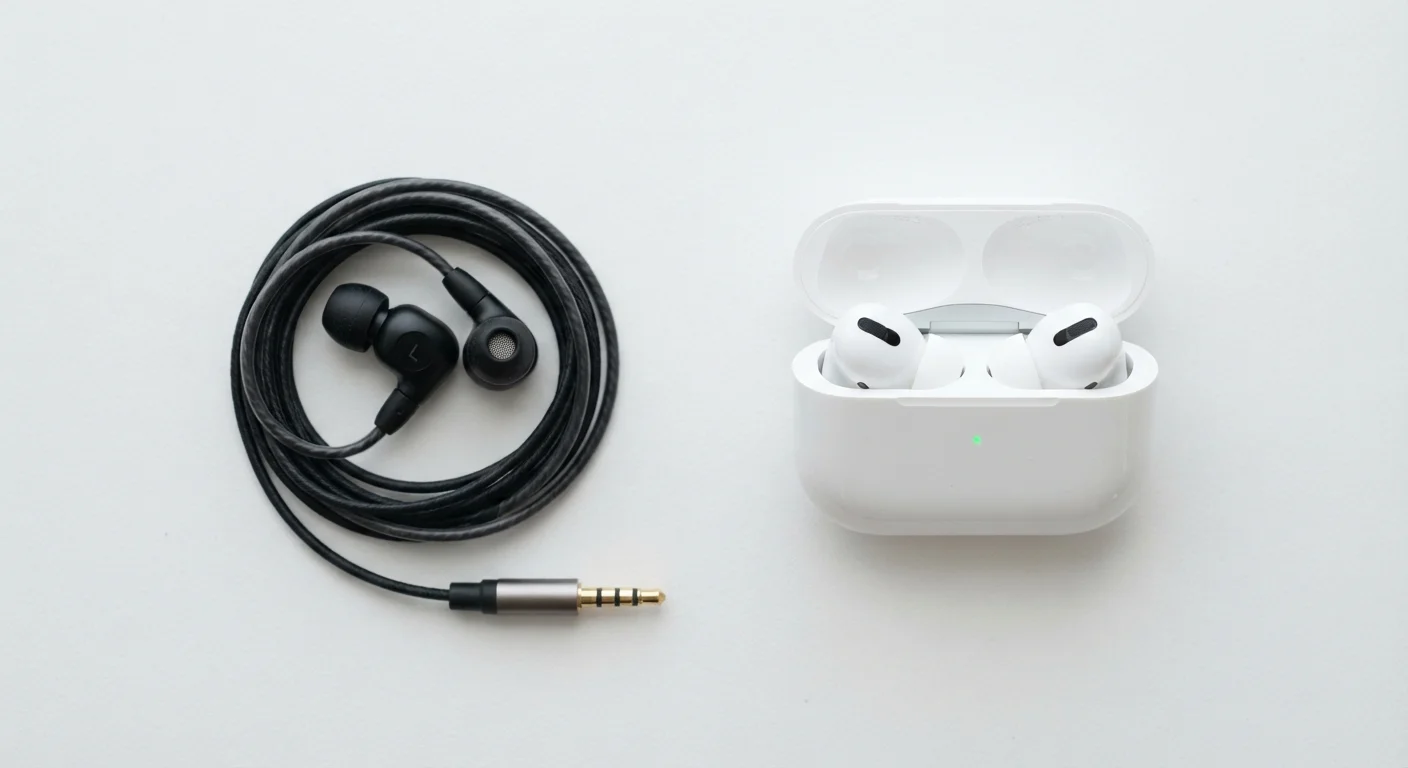
Option A
Wired Earbuds
The dependable, no-fuss classic.
Best for: Listeners who want consistent audio quality, zero charging hassle, and a straightforward plug-and-play experience.
Option B
True Wireless Earbuds
The cable-free, feature-rich modern option.
Best for: Active users and commuters who want freedom of movement, Bluetooth convenience, and features like active noise cancellation.
What Separates These Two Technologies
Wired earbuds connect directly to a device through a physical cable — traditionally via a 3.5mm headphone jack, though some now use USB-C. The signal travels as an analog or digital electrical current with no encoding delay and no battery required on the earbuds themselves.
True wireless earbuds (often abbreviated TWS) use Bluetooth to transmit audio from your phone or laptop to each earbud independently. There are no cables at all — not even between the two earbuds. They rely entirely on internal batteries and a charging case for power. The technology has matured considerably, but the fundamentals still mean you're trading a physical connection for wireless freedom.
Understanding this core difference makes every other tradeoff — audio quality, reliability, cost — much easier to evaluate on its own terms.
| Criterion | Wired Earbuds | True Wireless Earbuds |
|---|---|---|
| Battery required | None | Yes — earbuds + charging case |
| Audio latency | Virtually zero | Moderate (codec-dependent) |
| Connection type | 3.5mm jack or USB-C | Bluetooth |
| Noise cancellation (ANC) | Rarely available | Widely available |
| Typical price range | Lower starting cost | Generally higher cost |
| Risk of loss | Low (tethered) | Higher (two separate pieces) |
| Freedom of movement | Limited by cable | Full freedom |
| Compatibility | Requires headphone jack or adapter | Works with any Bluetooth device |
Audio Quality: Wired vs. Wireless Signal Paths
A common assumption is that wired always sounds better. The reality is more nuanced. Wired earbuds deliver an uncompressed analog signal, which removes any audio encoding as a variable. However, the quality of the drivers, the fit in your ear, and the source device's output all matter just as much.
True wireless earbuds compress audio using Bluetooth codecs — standards like AAC, aptX, or LDAC — before transmitting it wirelessly. Higher-quality codecs (LDAC, for instance) can transmit significantly more audio data, narrowing the gap with wired listening. For most everyday music and podcast listening, many people can't reliably distinguish the difference in a real-world environment.
Where wired earbuds hold a clear edge is audio latency. True wireless earbuds introduce a small delay between the audio source and playback. For watching video, this can cause a noticeable lip-sync offset, depending on the codec and device. For audio-only use, it's rarely a problem.
~40%
Smartphone models lacking a 3.5mm headphone jack
Industry analysts have tracked a steady decline in headphone jack inclusion among flagship smartphones since 2016, making adapters increasingly necessary for wired earbuds.
4–8 hrs
Typical true wireless earbud playback per charge
Most consumer TWS earbuds deliver between four and eight hours on a single charge, with the case extending total listening time significantly.
990 kbps
Maximum audio data rate of Sony's LDAC codec
LDAC, a high-resolution Bluetooth codec, can transmit up to 990 kbps — roughly three times more audio data than the standard SBC codec used as a Bluetooth baseline.
Battery Life, Reliability, and Everyday Practicality
Wired earbuds have no battery. That means no charging routine, no dead earbuds before a flight, and no degradation of capacity over time. For anyone who finds device charging management stressful, this is a genuinely meaningful advantage.
True wireless earbuds typically offer four to eight hours of playback per charge from the earbuds themselves, with the charging case providing two to four additional full charges. That's enough for most daily use — but it does require the habit of putting them back in the case. Forgetting to charge is the most common complaint among TWS users.
Bluetooth connectivity has become very reliable at short distances, but interference from Wi-Fi networks, walls, and crowded wireless environments (like a busy gym or airport) can still cause audio dropouts. Wired connections are immune to this entirely.
One often-overlooked risk with true wireless earbuds: each earbud is a small, individual object. Losing one — down a drain, on a bus — renders the pair unusable in a way that's expensive to fix.
Headphone Jack Adapters: A Middle Path
If your phone no longer has a 3.5mm headphone jack but you prefer wired earbuds, USB-C to 3.5mm adapters are widely available and inexpensive. Audio quality through these adapters is generally comparable to a built-in jack, as they typically include a small digital-to-analog converter (DAC). It adds a step, but it keeps your wired earbuds compatible with modern devices.
Which Should You Choose?
The honest answer is that neither format is universally superior. Just as decisions about value versus convenience appear across many spending categories — the same logic explored in discussions of cost versus longevity in everyday purchases — the right earbuds depend on how you actually use them.
If your phone still has a headphone jack and you spend most of your listening time at a desk or during light activity, wired earbuds offer dependable performance with far less complexity. If you're regularly on the move, doing workouts, or commuting in loud environments where noise cancellation matters, the cable-free experience of true wireless is a practical upgrade worth the tradeoff.
As with many technology decisions, the smartest move is to match the format to your real daily habits — not to the most impressive spec sheet or the most popular option at any given moment.
The content on this site is for informational purposes only and is not a substitute for professional advice. Always consult a qualified professional for guidance specific to your situation.