

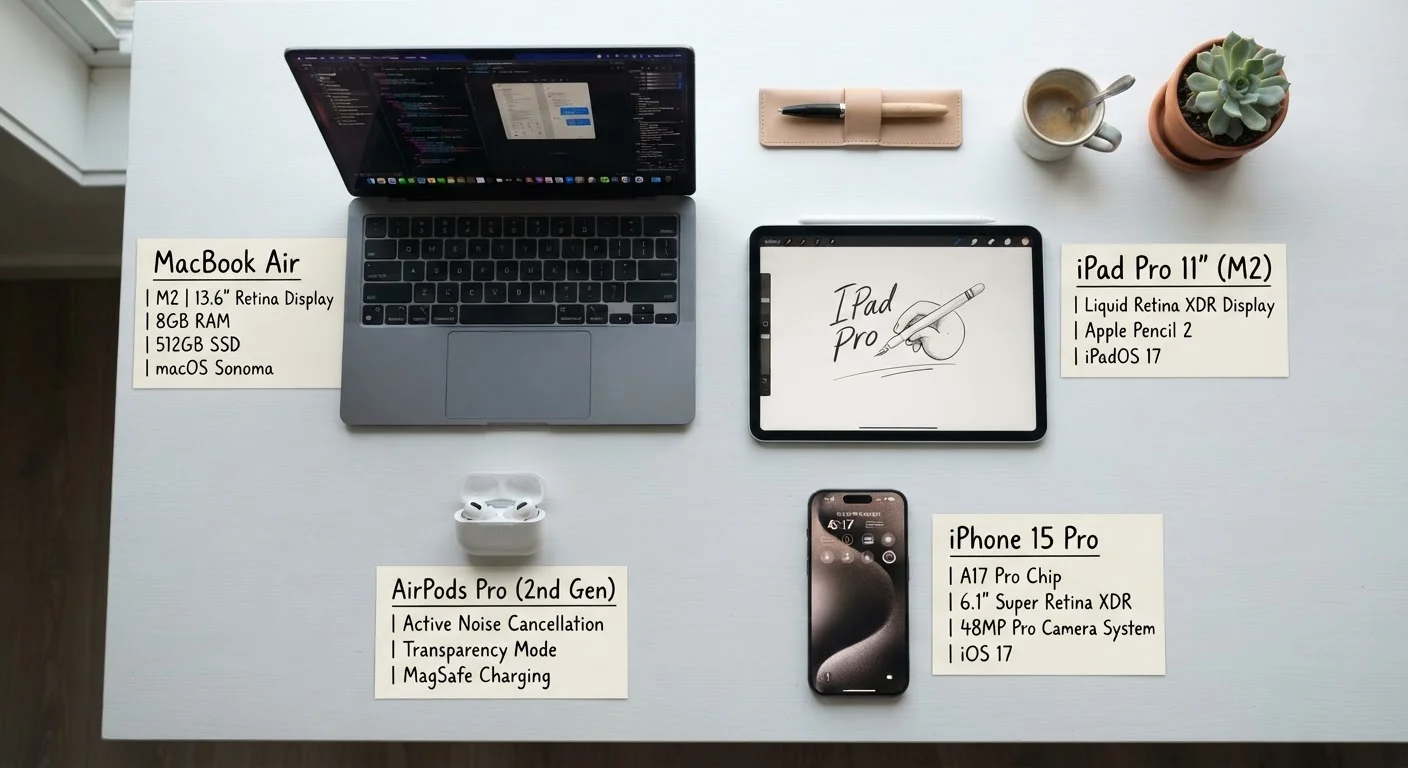
Why Gadget Specs Feel Like a Foreign Language
You're about to buy a new phone, laptop, or tablet. The listing says it has "8GB RAM, 2.4GHz octa-core processor, 500 nits display, and IP68 rating." Unless you work in tech, that sentence might as well be encrypted. Spec sheets are written for engineers, but they're read by everyone else.
This glossary translates the most common gadget specifications into plain English — the kind you can actually use when comparing devices, reading reviews, or deciding whether a spec actually matters to you. Think of it as a companion reference, similar in spirit to guides like the Personal Budget Glossary and the Insurance Jargon Decoded glossary — straightforward definitions for terms that shouldn't require a degree to understand.
| Typical smartphone RAM range | 4GB – 16GB (Common across mainstream Android and iOS devices) |
| IP68 water resistance depth (typical) | Up to 1.5m for 30 minutes (Per IEC standard 60529; manufacturer conditions may vary) |
| Standard laptop display refresh rate | 60Hz (basic) to 165Hz (gaming) (Varies by device category and price tier) |
| Average flagship phone battery capacity | 4,000 – 5,000 mAh (Based on widely available market data) |
| Wi-Fi 6 max theoretical speed | Up to 9.6 Gbps (IEEE 802.11ax specification; real-world speeds vary significantly) |
The Core Spec Terms, Defined
The following definitions cover the specifications you'll encounter most often across smartphones, laptops, tablets, and smart home devices. Understanding them helps you evaluate what you're actually paying for — and what you can safely ignore for your particular needs.
RAM
Short for Random Access Memory. RAM is your device's short-term working memory — it holds the apps and data you're actively using. More RAM means you can run more apps simultaneously without slowdowns or automatic reloading.
Storage (GB / TB)
The permanent space where your files, photos, apps, and operating system live. Unlike RAM, storage retains data when the device is off. GB (gigabytes) and TB (terabytes) measure capacity; 1TB equals 1,000GB.
Processor / CPU
The central processing unit is the brain of your device, executing instructions for every task you perform. Clock speed (measured in GHz) indicates how many operations it can perform per second; core count refers to how many parallel tasks it can handle.
GHz (Gigahertz)
A measure of processor clock speed — how many billion cycles per second the CPU completes. Higher GHz can mean faster processing, but core count, architecture, and software efficiency also heavily influence real-world performance.
Nits
A unit of display brightness. A screen measured at 500 nits is considerably brighter than one at 200 nits, making it easier to read outdoors. Higher nit counts are especially valuable on phones and tablets used in sunlight.
Resolution (HD, FHD, 4K)
The number of pixels packed into a display. FHD (Full HD, 1920×1080) is a common standard for sharp, clear images. 4K offers roughly four times the pixels of FHD, which matters more on larger screens viewed up close.
IP Rating
Ingress Protection rating indicates how resistant a device is to solids (like dust) and liquids. The two digits after 'IP' each have a meaning: the first covers dust, the second covers water. IP68, for example, means full dust resistance and the ability to withstand submersion in fresh water under defined conditions.
Wi-Fi Standard (Wi-Fi 5, Wi-Fi 6, Wi-Fi 6E)
The version of wireless networking a device supports. Wi-Fi 6 and 6E offer faster theoretical speeds and better performance in congested environments (like apartment buildings) than older Wi-Fi 5. The device and router must both support the same standard to benefit.
Bluetooth Version
The iteration of Bluetooth wireless technology built into a device. Higher versions generally offer better range, lower power consumption, and support for more simultaneous connections. Bluetooth 5.0 and above is common in current devices.
mAh (Milliampere-Hour)
A measurement of battery capacity. A larger mAh number means the battery can theoretically hold more charge, but real-world battery life also depends on screen brightness, processor efficiency, software, and usage habits.
GPU
Graphics Processing Unit — a chip dedicated to rendering images, video, and visual effects. In smartphones and tablets, the GPU handles gaming, video playback, and AR features. Devices with integrated GPUs share resources with the CPU; dedicated GPUs have their own memory.
Refresh Rate (Hz)
How many times per second a display redraws its image, measured in Hertz. A 60Hz screen updates 60 times per second; a 120Hz screen updates 120 times. Higher refresh rates make scrolling and animations look noticeably smoother.
Once you know what these specs mean individually, you can start thinking about how they interact. A fast processor paired with too little RAM, for example, can still result in a sluggish experience — the specs work as a system, not in isolation. For a broader look at how these factors affect long-term value, see our gadget lifespan guide.
How to Use Specs When Comparing Devices
Specs are only useful when framed by your actual habits. Here's how to filter what matters:
- Casual users (browsing, streaming, messaging): Prioritize battery life, display brightness (nits), and storage. Processor speed is rarely a limiting factor.
- Mobile workers (documents, video calls, cloud apps): RAM and connectivity specs (Wi-Fi standard, Bluetooth version) matter more than raw processor clock speed.
- Outdoor or active users: IP ratings for water and dust resistance become genuinely important rather than a marketing footnote.
- Privacy-focused users: Look for hardware security specs like a dedicated secure enclave or biometric authentication — not always highlighted prominently.
No single spec determines whether a device is right for you. Context is everything. Just as you'd consult a plain-language wellness glossary to navigate an unfamiliar conversation rather than memorize every clinical term, use this reference as a starting point — not a scorecard.
Specs Describe Capability, Not Guarantee
Manufacturers test devices under controlled conditions that may not match everyday use. An IP68 rating, for example, typically applies to fresh water — not saltwater, chlorinated pools, or high-pressure jets. Always review the manufacturer's specific testing conditions before assuming a device is fully waterproof. Similarly, battery life estimates in spec sheets are typically measured under light, idealized usage.
Specs describe hardware capability, not user experience. A device with impressive numbers can still feel slower, dimmer, or more fragile than a rival with slightly lower specs, depending on software optimization, build quality, and your personal usage patterns.
The content on this site is for informational purposes only and is not a substitute for professional advice. Always consult a qualified professional for guidance specific to your situation.