

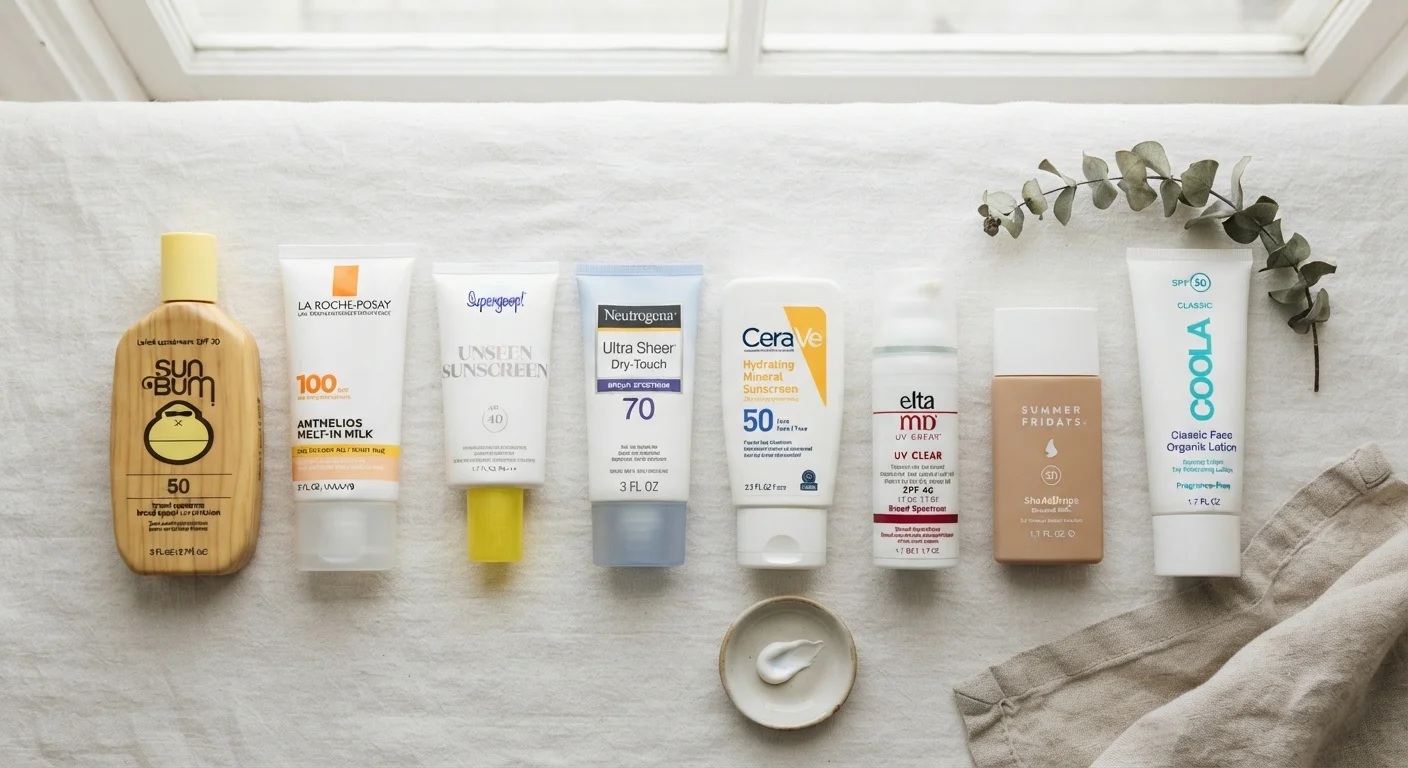
SPF: What the Number Actually Measures
Sun Protection Factor — SPF — measures how much UVB radiation reaches your skin compared to unprotected skin. The number is a ratio, not a percentage of time. SPF 30, for example, means that roughly 1/30th of the UVB that would otherwise hit bare skin gets through; SPF 50 allows about 1/50th through.
Translated into percentages: SPF 15 filters about 93% of UVB rays, SPF 30 filters about 97%, and SPF 50 filters about 98%. The jumps beyond SPF 50 become increasingly marginal — SPF 100 filters roughly 99%. No sunscreen blocks 100% of UVB radiation.
One critical caveat: these numbers assume the product is applied at a specific density — about 2 milligrams per square centimeter of skin. Most people apply far less than that in practice, which meaningfully reduces the effective protection received.
| SPF 30 UVB filtration | ~97% (FDA sunscreen labeling guidelines) |
| SPF 50 UVB filtration | ~98% (FDA sunscreen labeling guidelines) |
| Standard application density | 2 mg/cm² of skin (FDA testing standard for SPF values) |
| Highest PA rating tier | PA++++ (PPD 16+) (Japan Cosmetic Industry Association system) |
| Water-resistance windows (U.S.) | 40 or 80 minutes (FDA sunscreen monograph) |
| Broad-spectrum requirement | Must pass FDA critical wavelength test (FDA OTC drug regulations) |
Broad-Spectrum and UVA: The Protection SPF Doesn't Cover
SPF only addresses UVB rays — the ones primarily responsible for sunburn. UVA rays penetrate deeper into the skin and are strongly associated with premature aging and long-term skin damage. A high SPF number tells you nothing about UVA coverage.
The term broad-spectrum on a U.S. label signals that a product has passed the FDA's standard for UVA protection proportional to its UVB protection. In the United States, only products that pass this test are permitted to use the broad-spectrum claim. If a sunscreen isn't labeled broad-spectrum, it's protecting against sunburn but leaving UVA exposure largely unaddressed.
For everyday use — including time near windows or in a car — dermatology organizations generally recommend a broad-spectrum sunscreen. See our personal care ingredients reference for a plain-language look at the active ingredients you'll find inside these formulas.
SPF (Sun Protection Factor)
A measure of how much UVB radiation reaches the skin compared to unprotected skin. Higher numbers indicate more UVB is filtered, though no product blocks 100%.
Broad-spectrum
A U.S. FDA-regulated label claim indicating a sunscreen provides proportional protection against both UVA and UVB rays, having passed the agency's critical wavelength test.
PA rating
A UVA-protection grading system (PA+ to PA++++) used primarily in Asian markets, based on the Persistent Pigment Darkening (PPD) measurement. More plus signs signal stronger UVA coverage.
UVA rays
Longer-wavelength ultraviolet rays that penetrate deeply into the skin and are associated with premature aging and long-term skin damage. Not measured by SPF alone.
UVB rays
Shorter-wavelength ultraviolet rays that primarily cause sunburn. SPF numbers specifically measure protection against UVB radiation.
Mineral sunscreen
A formulation using zinc oxide or titanium dioxide as active ingredients. These physical blockers sit on the skin surface and scatter UV radiation rather than absorbing it.
PA Ratings: The Asian Market's UVA Scale
If you've shopped Japanese, Korean, or other Asian-market sunscreens, you've likely seen a PA rating — a system developed in Japan to communicate UVA protection in a more granular way than the broad-spectrum designation alone.
PA ratings run from PA+ to PA++++, with each additional plus sign representing a higher level of UVA protection. The underlying measurement is the PPD factor — a measure of how much UVA causes skin darkening. Here's how the tiers map:
- PA+ — some UVA protection (PPD 2–3)
- PA++ — moderate UVA protection (PPD 4–7)
- PA+++ — high UVA protection (PPD 8–15)
- PA++++ — very high UVA protection (PPD 16+)
PA ratings are not required or officially recognized by the U.S. FDA, but they're voluntarily included on many products sold in the American market, particularly those formulated for Asian consumers or imported from Asia. They offer a useful, at-a-glance signal of UVA strength that broad-spectrum labeling alone doesn't provide.
PA Ratings and U.S. Regulation
The PA rating system is not part of the U.S. FDA's official sunscreen regulatory framework, so it's voluntary when it appears on products sold in the American market. The FDA's broad-spectrum test is the domestic standard for UVA claims. PA ratings are most meaningful as a comparative tool when evaluating Asian-formulated sunscreens side by side, where the designation is consistently applied. When both broad-spectrum and a PA rating appear, they give a more complete picture together.
Other Label Terms Worth Knowing
Water-resistant labels in the U.S. must specify either 40 or 80 minutes of retained effectiveness during water exposure — those are the only two permitted claims under FDA rules. "Waterproof" and "sweatproof" are not allowed claims in the U.S. because no sunscreen is fully impervious to water.
Mineral vs. chemical refers to the type of UV-filtering active ingredients. Mineral sunscreens use zinc oxide or titanium dioxide, which sit on the skin's surface and scatter UV rays. Chemical sunscreens use organic compounds (such as avobenzone or octinoxate) that absorb UV energy and convert it to heat. Both types can be effective when formulated and applied correctly.
Reef-safe is a marketing term, not a regulated claim in the U.S. It generally indicates the formula omits oxybenzone and octinoxate, which some jurisdictions have banned due to environmental concerns, but the term itself has no standardized legal definition nationwide.
Just as decoding ingredient lists matters across many product categories — whether you're reading a skincare label or evaluating claims on other packaged products — sunscreen labels reward a little literacy with meaningfully better choices.
This article is for general informational purposes only and is not medical or dermatological advice. Consult a licensed healthcare professional or dermatologist for guidance tailored to your skin type, health history, or specific concerns.
The content on this site is for informational purposes only and is not a substitute for professional advice. Always consult a qualified professional for guidance specific to your situation.