

What a Bank Statement Actually Is
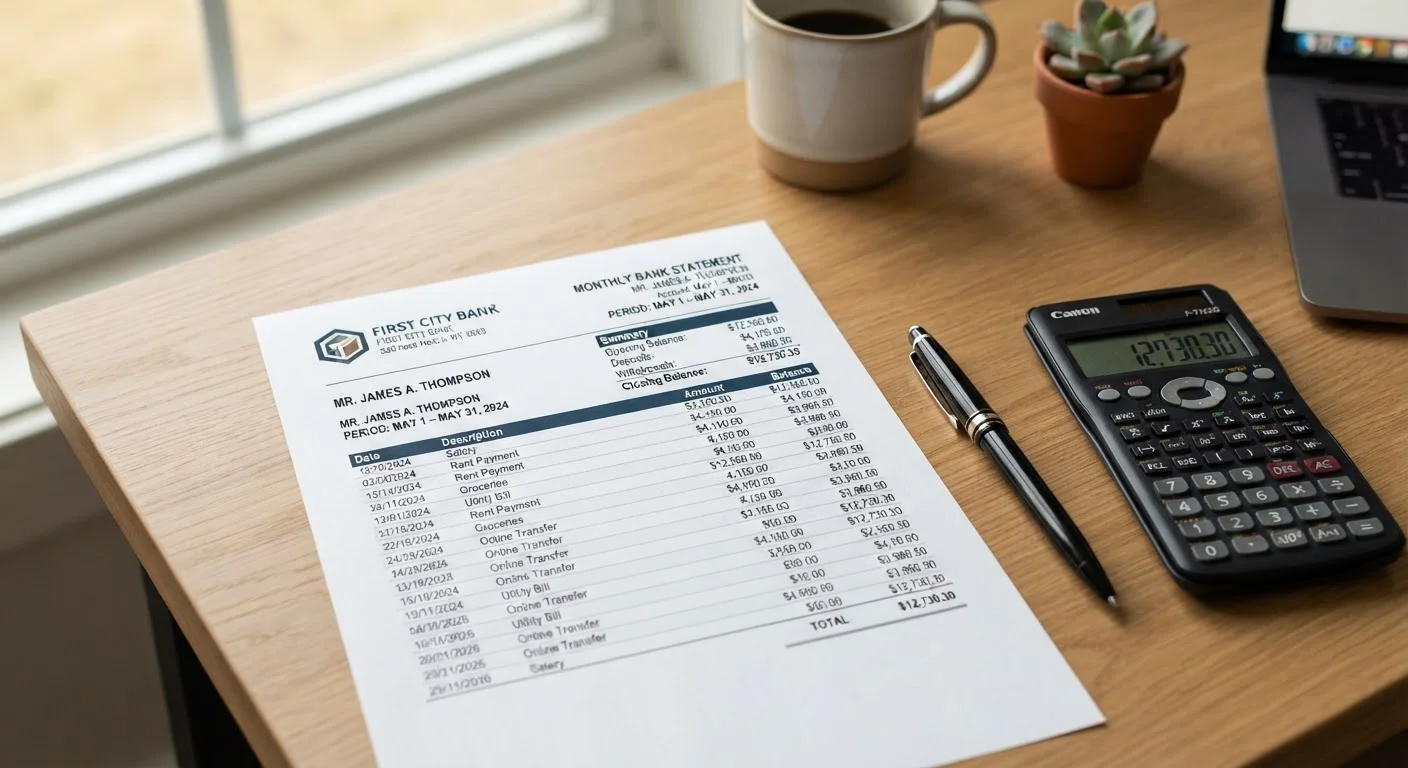
A bank statement is a formal periodic summary — typically monthly — that your financial institution produces for each account you hold. It is both a legal record of account activity and a personal finance tool. Every deposit you made, every purchase cleared, every fee charged, and every interest payment credited appears here in chronological order.
Statements are used to reconcile your own records, spot unauthorized transactions, track spending patterns, and satisfy documentation requirements for loans, rentals, or tax filings. If you are working on a budgeting framework, your statement is the raw data source that makes that work possible.
| Typical statement frequency | Monthly (some accounts offer quarterly) |
| Federal retention recommendation | Keep statements at least 1 year; 7 years for tax-related accounts (IRS general guidance) |
| Error dispute window | 60 days from statement date (Regulation E for electronic transfers) (Consumer Financial Protection Bureau (CFPB)) |
| Delivery formats | Paper mail, secure online portal, PDF download |
| Opening vs. closing balance | Closing balance of one period = opening balance of the next |
The Header Block: Account Identification
The top section of any statement contains administrative information you should verify every time you open a new statement:
- Statement period: The exact start and end dates covered. Transactions outside this window appear on adjacent statements.
- Account number: Usually masked (e.g., ••••4872) for security on paper statements.
- Account type: Identifies whether this is a checking, savings, money market, or other product. If you are unsure how these differ, our overview of checking vs. savings accounts clarifies the distinctions.
- Routing number: May appear here or in a separate section; this nine-digit number identifies your bank for ACH transfers and direct deposits.
- Opening and closing balances: The balance at the first and last day of the statement period. These are the anchor figures for reconciliation.
Statement Period
The specific date range — usually one calendar month — that a bank statement covers. Only transactions settled within this window are included.
Posted Date
The date a transaction is officially recorded and settled by the bank, which may differ from the date it was initiated or authorized.
ACH Transfer
Automated Clearing House transfer — an electronic bank-to-bank transaction used for direct deposits, bill payments, and payroll. Often appears as 'ACH CR' (credit) or 'ACH DB' (debit) on statements.
Running Balance
The account balance shown after each individual transaction is applied. It lets you trace exactly when and why your balance changed.
NSF Fee
Non-Sufficient Funds fee — charged when a transaction is attempted but the account does not have enough money to cover it. The transaction may be declined or returned.
Average Daily Balance
The sum of an account's end-of-day balances divided by the number of days in a period. Banks often use this figure to calculate interest earned or fees owed.
The Transaction Register: Reading Each Line
The transaction register is the longest and most detailed section. Each row typically includes:
- Date posted: The date the bank officially settled the transaction — distinct from the date you initiated it.
- Transaction date (or effective date): When the purchase or deposit actually occurred. A weekend debit card swipe may post the following business day.
- Description / memo field: A truncated merchant name, ACH originator code, or internal bank descriptor. Codes like
ACH CR(ACH credit),POS DB(point-of-sale debit), orOD FEE(overdraft fee) are common shorthand. - Debit column: Money leaving the account.
- Credit column: Money entering the account.
- Running balance: The account balance after each individual transaction — useful for pinpointing exactly when a balance dropped below a threshold.
If a transaction description is unrecognizable, cross-reference it against your email receipts or the merchant's billing name before disputing it — many legitimate charges appear under a parent company name.
Fees, Interest, and Special Line Items
Buried below routine transactions are rows that directly affect your cost of banking:
- Monthly maintenance fee: Charged if a minimum balance or direct deposit requirement was not met during the period.
- Overdraft or NSF fee: Applied when a transaction is paid or returned due to insufficient funds.
- Interest earned: For interest-bearing accounts, this credit line shows the yield applied to your average daily balance.
- ATM fees: Both out-of-network surcharges (from the ATM owner) and fees your own bank charges for non-network use may appear as separate line items.
- Wire transfer fees: Domestic and international wires typically carry flat fees listed individually.
Monitoring these lines monthly is one of the simplest ways to reduce unnecessary banking costs and supports broader debt and saving strategies. For definitions of related financial terminology — such as APR or charge-off — see our debt terms reference guide.
60 days
Window to dispute an electronic transaction error
Under Regulation E, consumers generally have 60 days from the statement date to report unauthorized electronic fund transfers to their bank.
$35
Median overdraft fee (historically common)
Overdraft fees have historically averaged around $35 per occurrence at large U.S. banks, though many institutions have reduced or eliminated them in recent years.
This article provides general financial information for educational purposes only and does not constitute personalized financial or legal advice. Consult a qualified financial professional for guidance specific to your situation.
The content on this site is for informational purposes only and is not a substitute for professional advice. Always consult a qualified professional for guidance specific to your situation.