

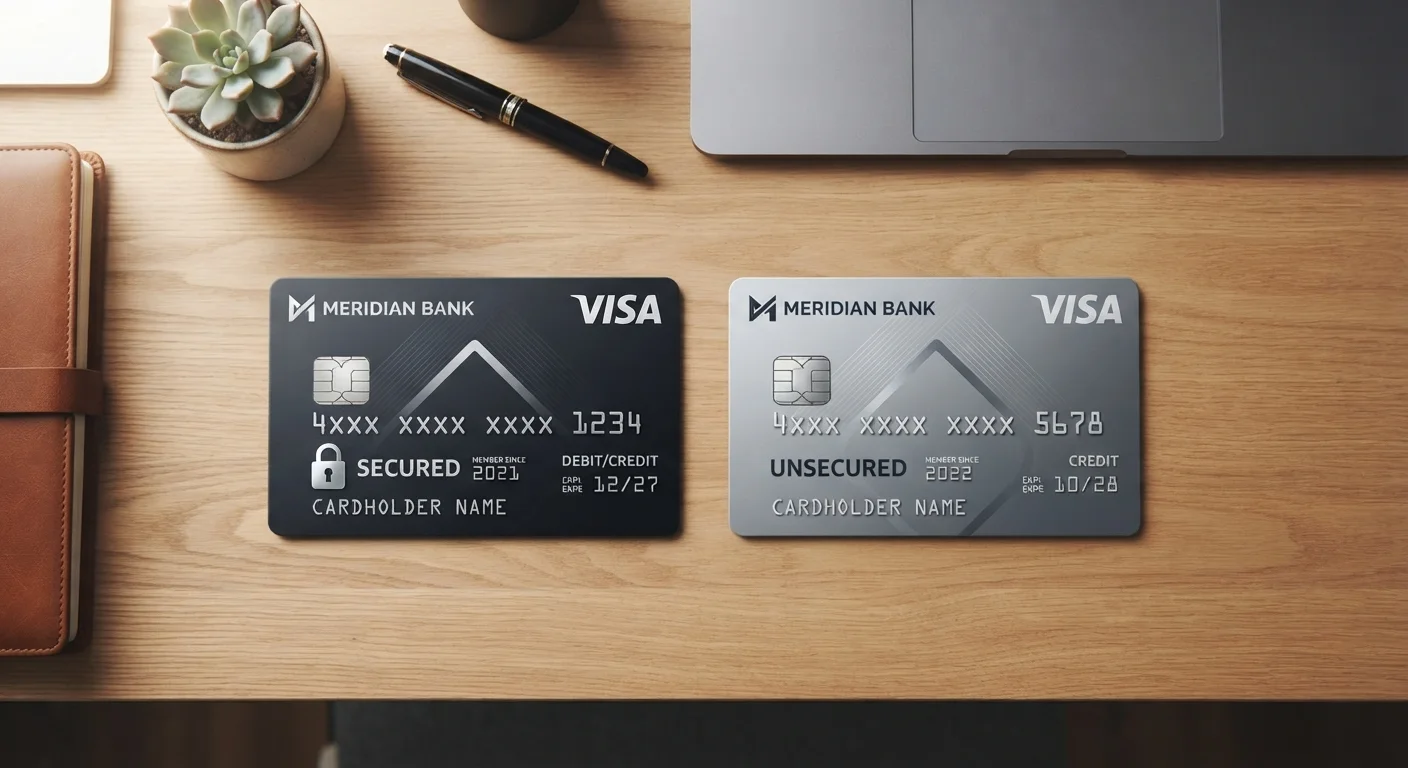
Our Verdict
Secured cards are the more accessible entry point for people with no credit history or damaged credit — the deposit reduces lender risk and lowers the approval bar. Unsecured cards reward established creditworthiness with more flexible terms and no tied-up cash. Neither type is inherently superior; the right choice depends entirely on where you are in your credit journey.
| Best for | Recommended |
|---|---|
| Building credit from scratch or recovering from past credit problems | Secured credit card |
| Consumers with established credit history seeking flexible terms | Unsecured credit card |
| Those who want to avoid tying up cash as a deposit | Unsecured credit card |
| Anyone facing repeated rejections for standard credit products | Secured credit card |
The Core Structural Difference
The distinction between secured and unsecured credit cards comes down to one word: collateral. A secured card requires you to place a refundable cash deposit with the issuer before you can use the card. That deposit — typically ranging from $200 to $500, though it varies by issuer — usually equals your credit limit. If you deposit $300, you generally have $300 in available credit.
An unsecured card carries no such requirement. The issuer extends a credit line based on your credit history, income, and overall financial profile. There's no money held against your account. If you default, the lender has no collateral to fall back on — which is why unsecured credit comes with a higher qualification bar.
Both card types function identically at the point of purchase: you swipe, tap, or enter card details, and the charge posts against your available credit. The structural difference sits behind the scenes, at the account-opening and risk-management level.
Treat a Secured Card Like Any Other Card
A common misconception is that because you've deposited funds, overspending is safer. In reality, exceeding your limit or carrying a high balance still damages your credit and may trigger fees. Use your secured card for small, predictable purchases you can pay off in full each month. This keeps utilization low and builds the payment history your score needs.
How Each Card Affects Your Credit
From a credit-building standpoint, secured and unsecured cards work the same way. Both report your payment history, credit utilization, and account age to the three major credit bureaus — Equifax, Experian, and TransUnion. Because payment history is the single largest factor in most credit scoring models, using either type responsibly and paying on time has a real impact on your score.
Credit utilization — the percentage of available credit you're using — matters just as much on a secured card. Carrying a high balance relative to your limit on a secured card can hurt your score in the same way it would on an unsecured card. Keeping utilization below 30% is a widely cited general guideline, though lower is typically better.
When you apply for either type, the issuer will usually run a hard inquiry on your credit report. Hard inquiries have a small, temporary effect on your score — typically minor — but it's worth understanding they occur regardless of which card type you pursue.
~35%
Weight of payment history in FICO scores
According to FICO's published score factor breakdown, payment history is the single largest component of a FICO score.
~30%
Weight of credit utilization in FICO scores
FICO's published framework identifies amounts owed — closely tied to utilization ratio — as the second largest scoring factor.
Secured vs. Unsecured: A Side-by-Side Look
The practical trade-offs between these two card types extend beyond the deposit requirement. Fees, credit limits, and upgrade paths all differ in ways that matter when you're choosing which to pursue.
| Secured Card | Unsecured Card | |
|---|---|---|
| Collateral required | Yes — cash deposit upfront | No — credit extended on trust |
| Typical credit limit | Equal to deposit amount | Based on creditworthiness |
| Qualification difficulty | Lower — accessible to thin/poor credit | Higher — requires established credit |
| Reports to credit bureaus | Yes | Yes |
| Deposit refundable | Yes, when account closes in good standing | N/A — no deposit required |
| Upgrade path available | Often, after consistent on-time payments | Not applicable |
| Annual fees | Common, especially at entry level | Varies widely by card type |
One frequently overlooked detail: the deposit on a secured card is refundable. When you close the account in good standing or graduate to an unsecured product, your issuer returns the deposit. It is not a fee — it's collateral. That said, some secured cards do charge annual fees on top of the deposit, which is worth factoring into your evaluation.
Choosing Based on Your Credit Situation
If you're building credit from scratch, a secured card is usually the more realistic starting point. Unsecured card approvals depend on demonstrated creditworthiness, which you don't yet have. A secured card lets you establish a track record — on-time payments, responsible utilization — that eventually makes unsecured products accessible.
If you have an existing credit history in good standing, an unsecured card gives you credit access without requiring you to park cash with an issuer. Depending on your profile, unsecured cards may also offer higher credit limits, which can further benefit your utilization ratio.
It's also worth knowing that many issuers offer a formal upgrade path: after a period of on-time payments (commonly 12 months, though terms vary), they may convert your secured account to an unsecured one and return your deposit. This isn't automatic — check the terms before opening any secured account.
Where you do your banking can also shape your options. Credit unions and banks each offer secured and unsecured card products, and their qualification criteria, fees, and upgrade policies can differ meaningfully.
This article is for general informational and educational purposes only and does not constitute personalized financial or credit advice. Consult a qualified financial professional regarding decisions specific to your situation.
The content on this site is for informational purposes only and is not a substitute for professional advice. Always consult a qualified professional for guidance specific to your situation.