

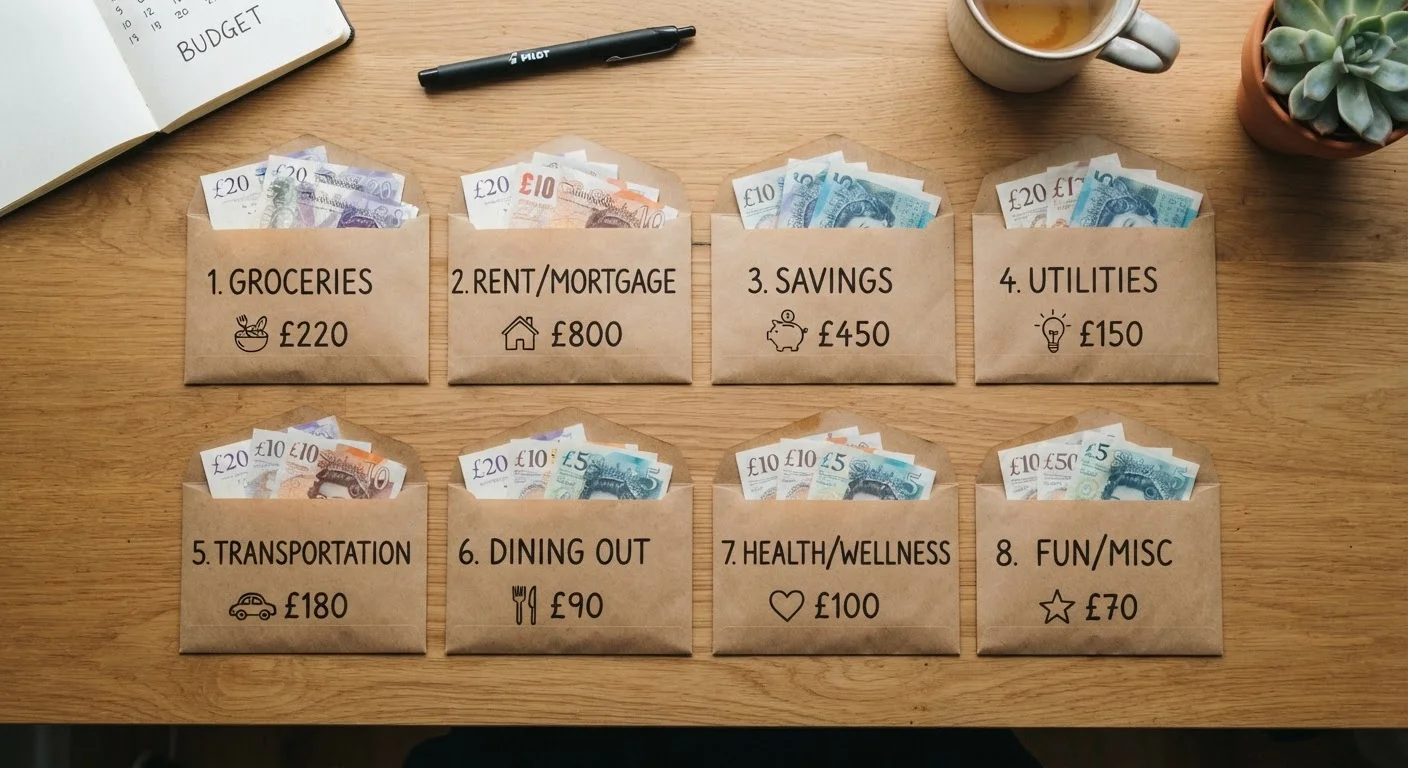
How the Envelope Method Works
The mechanics are straightforward. At the start of each budget period - typically a month - you calculate your expected take-home income and subtract fixed, non-negotiable obligations like rent and loan payments. The remaining discretionary income is then divided into labeled envelopes, each representing a spending category you want to control: groceries, gas, dining, entertainment, clothing, and so on.
Throughout the month, you spend only from the relevant envelope. Buy groceries? Cash comes out of the grocery envelope. Go to a restaurant? The dining envelope absorbs it. When an envelope reaches zero, that category is closed for the period. The rule is firm by design - the physical constraint replaces willpower with a structural limit.
This approach sits within a broader family of allocation-first budgeting methods. Unlike the 50/30/20 rule, which assigns percentages to broad buckets, envelope budgeting operates at the granular, transaction level, making it better suited to people who need category-level accountability rather than a high-level framework.
Start With Your Problem Categories First
Rather than creating envelopes for every possible expense at once, identify the two or three categories where you most frequently overspend and build your system around those first. Mastering a small set of envelopes builds the habit before you scale. Complexity added too early is a common reason people abandon the method within the first month.
Physical Cash vs. Digital Envelopes
The traditional method uses literal paper envelopes and banknotes - you withdraw your discretionary income in cash at the start of the month and physically sort it. The tactile experience is intentional: handling cash reinforces the reality of spending in a way that a card swipe does not.
For people who rarely use cash, digital equivalents preserve the same logic. Dedicated budgeting apps allow users to create virtual envelopes, funding each with a dollar amount that decrements as transactions are recorded. Some banks also offer sub-account features that approximate this structure. The behavioral benefit is slightly reduced compared to physical cash, but the category discipline remains intact.
Whichever format you use, the underlying principle is the same: money is spoken for before it's spent, not accounted for after the fact. This is distinct from tracking-based approaches where you observe spending retroactively.
Envelope Apps Vary in How They Track Spending
Some digital envelope apps sync directly with bank accounts and auto-categorize transactions, while others require manual entry. Manual entry adds a small friction that some users find reinforces mindfulness - each transaction is a deliberate act. Choose the format that matches your discipline level, not the one that sounds most convenient.
Who Benefits Most from This System
Envelope budgeting tends to deliver the most noticeable results for people who consistently overspend in a handful of discretionary categories - dining, shopping, or entertainment - without a clear sense of where the money goes. The visible, finite nature of each envelope creates a natural pause before a purchase.
It also suits those new to structured budgeting who find percentage-based frameworks too abstract. Having a concrete dollar amount in a labeled container is easier to internalize than a rule like "keep discretionary spending under 30%." For a broader orientation to budgeting concepts, the Personal Budget Glossary provides useful foundational vocabulary.
The method is less effective for people with highly variable income - freelancers or commission-based workers - because establishing envelope amounts requires a reasonably predictable income baseline. It also demands active, ongoing engagement; it is not a set-it-and-forget-it system.
~33%
Americans with a detailed monthly budget
According to Gallup survey data, roughly one-third of U.S. adults report maintaining a detailed household budget - suggesting a majority lack a structured spending plan.
~$300
Estimated monthly discretionary overspend
Financial wellness research consistently finds that consumers underestimate discretionary spending by meaningful margins, often by several hundred dollars per month.
Building Your Envelope Categories
Choosing the right categories is where most people either succeed or give up. The goal is to reflect how you actually spend, not how you wish you spent. Reviewing two to three months of bank and card statements before setting up envelopes reveals genuine patterns rather than aspirational ones.
Core discretionary envelopes typically include groceries, dining out, transportation (fuel and parking), personal care, entertainment, and clothing. Fixed bills - rent, subscriptions with stable amounts, insurance - should be handled separately through automatic payments, not envelopes. Consider treating savings as its own envelope, funded at the beginning of the period, before discretionary envelopes are filled. This mirrors the "pay yourself first" principle and connects naturally to goals like building an emergency fund.
For a practical framework for grouping your costs, see our guide on categorizing everyday expenses - it pairs directly with the envelope setup process.
Envelope Budgeting in the Context of a Broader Financial Plan
The envelope method addresses spending control, but it is one component of a complete financial picture. Debt repayment, retirement contributions, and long-term savings goals all require parallel planning that extends beyond monthly cash allocation. Once envelope spending is stabilized, many people find it easier to redirect freed-up cash toward debt reduction or savings goals.
If you want to understand where envelope budgeting fits within a full budgeting framework - from calculating net income to setting financial goals - the complete personal budgeting framework offers a structured end-to-end view.
Envelope budgeting is a tool, not a financial plan. Its strength is behavioral: it changes the experience of spending by imposing a physical or visual constraint. Used consistently, that constraint can meaningfully reshape spending habits over time.
This article is for general informational and educational purposes only and does not constitute personalized financial advice. Consult a qualified financial professional for guidance specific to your situation.
Frequently Asked Questions
No. Many people use digital tools - apps or bank sub-accounts - that replicate the same category-based limits without requiring cash. The core principle is identical: money is allocated before it's spent, and each category has a firm ceiling.
You have two options: stop spending in that category until the next budget period, or consciously transfer money from another envelope. That trade-off decision is part of the method's discipline - it makes you aware of what you're sacrificing.
They overlap but are not identical. Both assign every dollar a job before it's spent. Envelope budgeting is a specific implementation focused on physical or virtual cash allocation by category, while <a href="/money-finance/budgeting-basics/zero-based-budgeting-vs-percentage-based-budgeting-two-schools-of-thought">zero-based budgeting</a> is a broader philosophy that can be applied through multiple systems.
Fixed, auto-paid bills - rent, mortgage, insurance premiums, utility auto-pay - don't need an envelope because the amount is set and the payment is automatic. Envelopes are most useful for discretionary, variable categories where overspending is a real risk.
Most practitioners recommend between five and ten categories. Too few and you lose meaningful control; too many and the system becomes burdensome to maintain. Start simple and add categories only when they represent a genuine spending pattern.
It can - by making overspending in discretionary categories harder. Many people find that seeing a physical or visual cash limit curbs impulse purchases. Treating savings as its own envelope, funded at the start of each period, reinforces the habit further.
The content on this site is for informational purposes only and is not a substitute for professional advice. Always consult a qualified professional for guidance specific to your situation.