

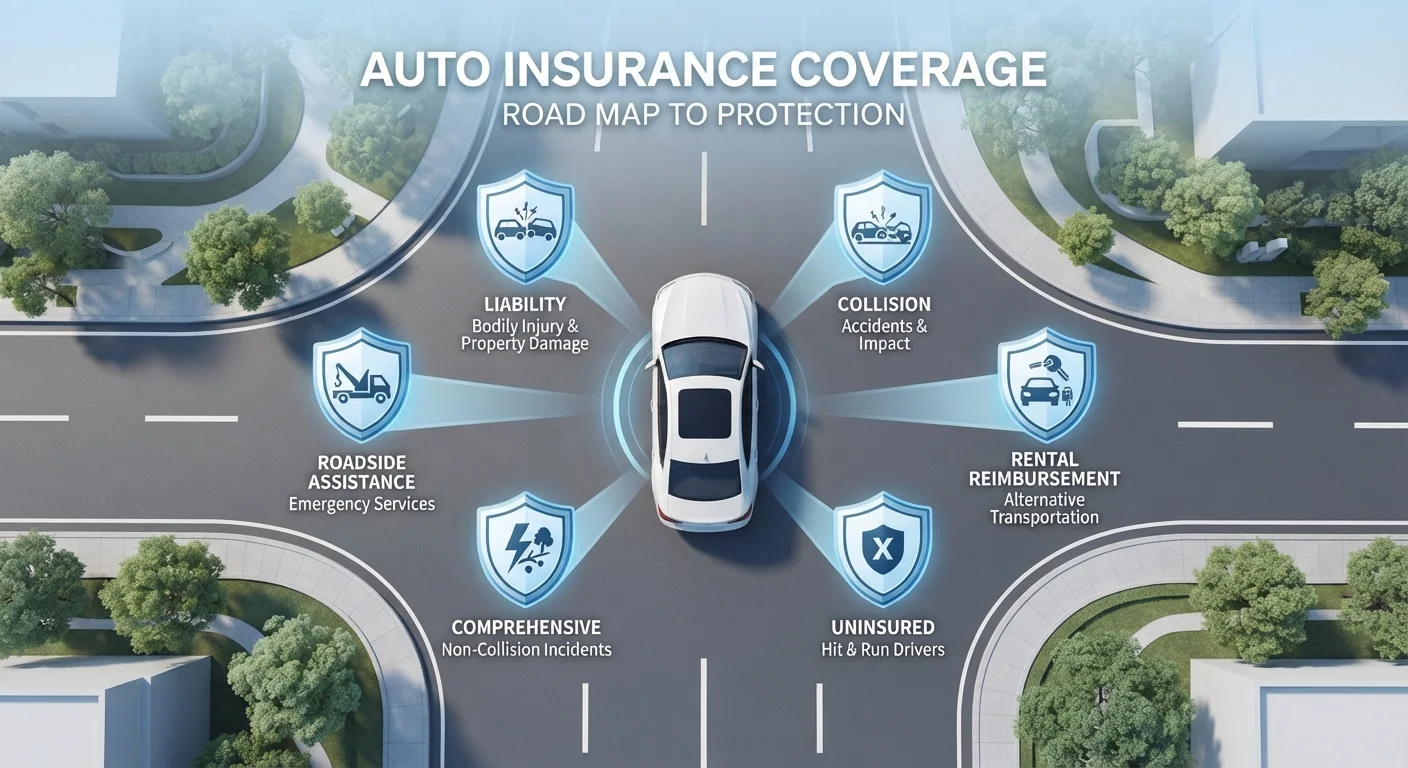
Liability Coverage: Protecting Others from Your Mistakes
Liability coverage is the foundation of any auto insurance policy - and the only type required by law in nearly every U.S. state. It pays for damages and injuries you cause to other people when you're at fault in an accident. It does not cover your own vehicle or your own medical bills.
Liability coverage has two components:
- Bodily injury liability (BI): Pays for medical expenses, lost wages, and legal costs if you injure someone else in an accident.
- Property damage liability (PD): Covers repair or replacement of another person's vehicle or property you damaged.
State minimums are often expressed as a split limit - for example, 25/50/25, meaning $25,000 per injured person, $50,000 per accident for all injuries combined, and $25,000 for property damage. These minimums can be inadequate in a serious accident, so many drivers carry higher limits. For broader protection beyond what auto liability alone provides, umbrella insurance can extend your liability protection above those limits.
Don't Rely Solely on State Minimums
State-mandated liability minimums set a legal floor - they're not necessarily enough to cover a serious accident. Medical bills and vehicle repairs from a significant collision can exceed minimum limits quickly, leaving you personally responsible for the remainder. Many insurance professionals suggest evaluating higher limits based on your assets and income, not just what the law requires.
Collision and Comprehensive: Protecting Your Own Vehicle
While liability covers the other party, collision and comprehensive coverages protect your own car. Lenders typically require both when you finance or lease a vehicle.
Collision Coverage
Collision pays to repair or replace your vehicle after it's damaged in an accident - whether you hit another car, a guardrail, or a tree. Fault doesn't matter for this coverage. You pay your deductible first; the insurer covers the rest up to your car's actual cash value.
Comprehensive Coverage
Comprehensive covers damage from events that aren't collisions - theft, vandalism, hail, flooding, fire, and striking an animal. Think of it as protection from things that happen to your car, rather than accidents you're involved in. A deductible applies here as well.
Together, collision and comprehensive are often called "full coverage" when combined with liability - though that term isn't an official insurance category. Understanding how liability-only and full coverage differ can help you decide which combination fits your situation.
~13%
U.S. drivers estimated to be uninsured
According to an Insurance Research Council study, roughly one in eight drivers on American roads carries no auto insurance.
~$4,700
Average collision claim payment
The Insurance Information Institute has reported average collision claim costs in this range, though actual amounts vary widely by vehicle type and severity.
12 states
No-fault states requiring PIP
Approximately a dozen U.S. states operate under no-fault insurance laws, mandating that drivers carry personal injury protection (PIP) coverage.
Uninsured and Underinsured Motorist Coverage
Even if you drive carefully, you can't control other drivers - or whether they carry adequate insurance. Uninsured motorist (UM) and underinsured motorist (UIM) coverages fill the gap when the at-fault driver can't pay.
- Uninsured motorist (UM): Pays your medical bills and, in many states, vehicle repairs when the at-fault driver has no insurance at all.
- Underinsured motorist (UIM): Steps in when the other driver's policy limits are too low to cover the full cost of your injuries or damages.
These coverages are required in some states and optional in others. Given that a meaningful share of drivers on U.S. roads carry no insurance or only the bare minimum, UM/UIM coverage can be a practical safeguard worth considering.
Medical Payments and Personal Injury Protection
Liability covers the other party's medical bills. But what about yours? Two coverage types address your own medical costs after an accident:
Medical Payments (MedPay)
MedPay covers reasonable medical and funeral expenses for you and your passengers, regardless of who caused the accident. It applies whether you're in your own car, someone else's, or struck as a pedestrian. Coverage limits tend to be modest.
Personal Injury Protection (PIP)
PIP is broader than MedPay. In addition to medical costs, it can cover a portion of lost wages, rehabilitation expenses, and even household services you can't perform while injured. PIP is required in states with no-fault insurance laws, meaning each driver's own insurer pays their medical costs regardless of fault.
Understanding how these fit alongside your health insurance is part of building a coordinated household insurance picture.
No-Fault States Work Differently
In no-fault states, your own insurer pays your medical bills after an accident regardless of who caused it - that's the role PIP plays. In at-fault (tort) states, the driver who caused the accident is responsible for the other party's medical costs through their liability coverage. The rules in your state determine which coverages are required and how claims are processed.
This article provides general information about auto insurance coverage types and is not personalized insurance or legal advice. Coverage terms, requirements, and availability vary by state and insurer. Always review your actual policy documents and consult a licensed insurance agent for guidance specific to your situation.
Frequently Asked Questions
Liability coverage meets the legal minimum in most states, but it only pays for damage you cause to others - not to your own vehicle or your own medical bills. Whether you need additional coverages depends on your car's value, your financial situation, and your risk tolerance. See <a href="/insurance-basics/insurance-types/liability-vs-full-coverage-auto-insurance-choosing-the-right-fit">how liability and full coverage compare</a> for a deeper look.
Comprehensive covers damage to your vehicle from events other than a collision - such as theft, vandalism, fire, hail, flooding, or hitting an animal. It does not cover damage from crashing into another vehicle or object. A deductible typically applies before the insurer pays out.
Uninsured motorist (UM) coverage is designed for exactly this situation. It can pay for your vehicle repairs and medical expenses when the at-fault driver carries no insurance. Underinsured motorist (UIM) coverage fills the gap when the other driver's policy limits aren't enough to cover your losses.
Medical payments (MedPay) and personal injury protection (PIP) serve similar purposes but differ in scope. PIP is broader - it can cover lost wages and rehabilitation in addition to medical bills. Some states require PIP; others offer MedPay as an optional add-on. Rarely would you carry both, as they overlap significantly.
Rental reimbursement is a separate, optional add-on coverage - it is not automatically included in standard policies. If you want your insurer to pay for a rental while your car is being repaired after a covered claim, you generally need to add this coverage explicitly.
Yes. Umbrella insurance typically requires you to maintain a minimum level of underlying liability coverage on your auto policy before it kicks in. <a href="/insurance-basics/insurance-types/umbrella-insurance-when-your-other-policies-arent-enough">Umbrella policies add protection above your auto and home limits</a>, so the two policies work in sequence.
The content on this site is for informational purposes only and is not a substitute for professional advice. Always consult a qualified professional for guidance specific to your situation.