

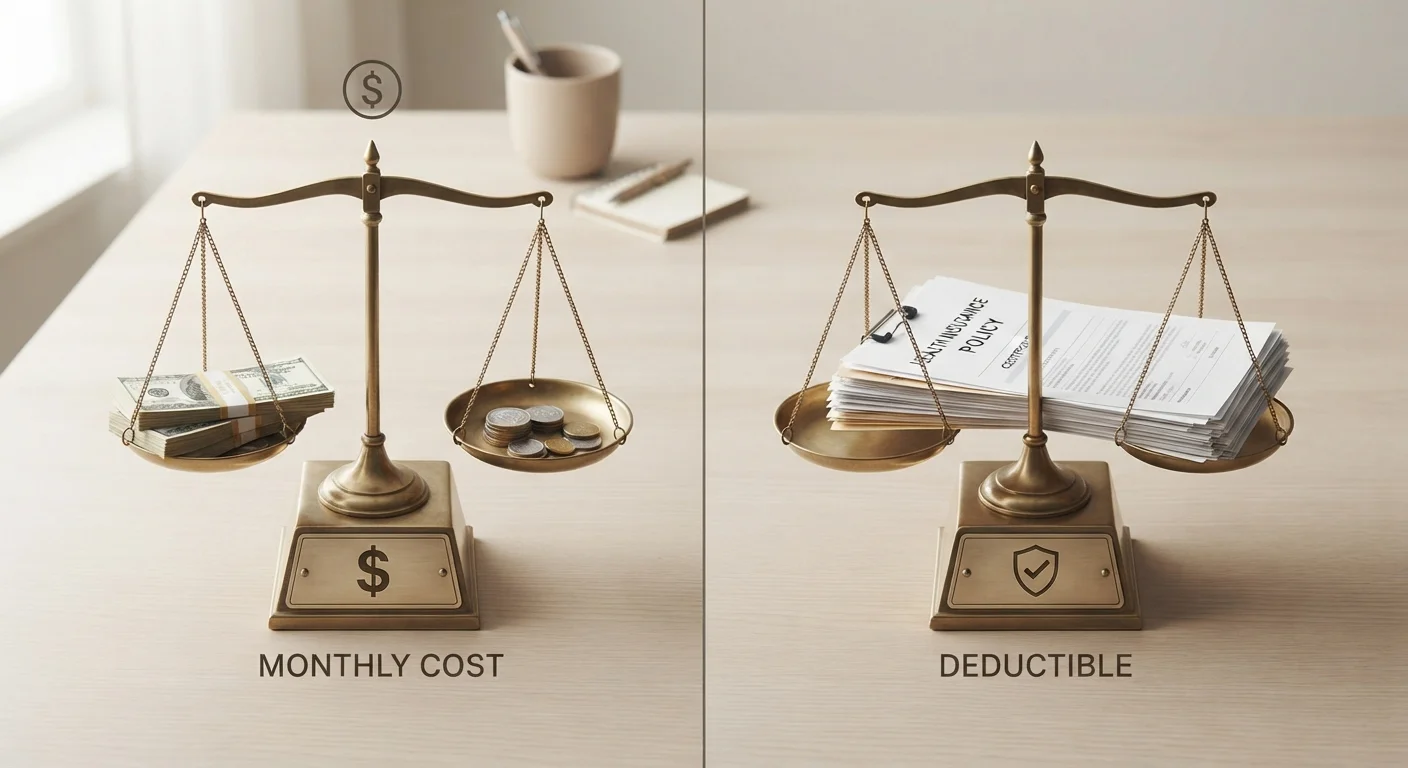
Option A
High Deductible
The upfront-risk, lower-monthly-cost structure.
Best for: People who are generally healthy or financially prepared to cover a larger share of an unexpected claim.
Option B
Low Deductible
The pay-more-monthly, pay-less-when-claiming structure.
Best for: People who expect to use their insurance regularly or want predictable out-of-pocket costs when something goes wrong.
The Basic Tradeoff Explained
Your deductible is the amount you pay out of pocket before your insurer starts covering a claim. Your premium is the fixed amount you pay - monthly, quarterly, or annually - just to keep the policy active. These two numbers move in opposite directions by design.
When you agree to take on more financial risk yourself (via a higher deductible), the insurer takes on less - so they charge you a lower premium. When you want the insurer to step in sooner (low deductible), they price that exposure into a higher premium. This is the core tradeoff in virtually every type of insurance: health, auto, homeowners, and renters alike.
For a plain-language breakdown of what each of these terms means on its own, see Deductibles, Premiums, and Copays: What Each Term Actually Means.
| Criterion | High Deductible | Low Deductible |
|---|---|---|
| Monthly Premium | Lower | Higher |
| Amount You Pay Before Coverage Kicks In | More (e.g., $1,500-$5,000+) | Less (e.g., $250-$1,000) |
| Best When You File Claims | Infrequently | Frequently |
| Cash Reserve Needed | Yes - to cover potential deductible | Less critical |
| HSA Eligibility (health plans) | Often eligible | Usually not eligible |
| Financial Risk Per Claim | Higher | Lower |
Running the Numbers: When Does a High Deductible Pay Off?
The math hinges on a concept sometimes called the break-even point. Suppose Plan A costs $200/month with a $500 deductible, and Plan B costs $140/month with a $2,000 deductible. Plan B saves you $60/month - or $720/year - in premiums. But if you file a claim, Plan B exposes you to $1,500 more in out-of-pocket costs ($2,000 minus $500).
Divide the extra deductible exposure ($1,500) by your monthly savings ($60): that gives you 25 months - just over two years. If you go more than two years without a significant claim, the high-deductible plan saves you money. If you file a claim sooner, the low-deductible plan would have cost you less overall.
~$1,735
Average individual HDHP deductible (employer-sponsored, 2023)
According to the Kaiser Family Foundation's 2023 Employer Health Benefits Survey, average deductibles for high-deductible health plans have risen steadily over the past decade.
$500
Typical minimum deductible to qualify an HDHP for HSA use
The IRS sets minimum deductible thresholds each year for a health plan to qualify as an HDHP, making the owner eligible to contribute to a Health Savings Account.
This break-even calculation won't capture every nuance - claim severity, the type of coverage, and your personal risk tolerance all matter. But it gives you a structured starting point rather than guessing. For a fuller picture of everything that shapes what you pay, see Everything That Can Raise or Lower Your Insurance Premium.
How Deductibles Work Differently Across Insurance Types
Not all deductibles behave the same way. In auto insurance, your deductible typically applies per claim - so if you have two separate accidents in a year, you pay your deductible twice. In health insurance, your deductible usually resets annually; once you've met it for the year, covered services cost you less (or nothing, up to your out-of-pocket maximum) for the remainder of that period.
Homeowners insurance sometimes uses percentage-based deductibles for specific perils like wind or hail damage - for example, 1% or 2% of the home's insured value - rather than a flat dollar amount. On a $300,000 home, a 2% deductible means you'd pay the first $6,000 of any qualifying claim yourself.
Percentage Deductibles: A Special Case
Some homeowners and specialty policies use a percentage of your insured home value as the deductible rather than a flat dollar amount. These are especially common for hurricane, wind, or earthquake coverage in high-risk regions. Because the dollar amount scales with your home's insured value, percentage deductibles can be significantly larger than a flat deductible - something worth calculating carefully before selecting a policy.
Understanding how your deductible interacts with your out-of-pocket maximum is equally important - especially in health plans. The two are related but distinct. See Out-of-Pocket Maximum vs. Deductible: Two Numbers That Often Get Confused for a clear side-by-side explanation.
This article is for general informational and educational purposes only and does not constitute personalized insurance, financial, or legal advice. Coverage terms, deductible structures, and premium calculations vary by insurer, policy type, and state. Always read your policy documents carefully and consult a licensed insurance agent or adviser for guidance specific to your situation.
The content on this site is for informational purposes only and is not a substitute for professional advice. Always consult a qualified professional for guidance specific to your situation.