

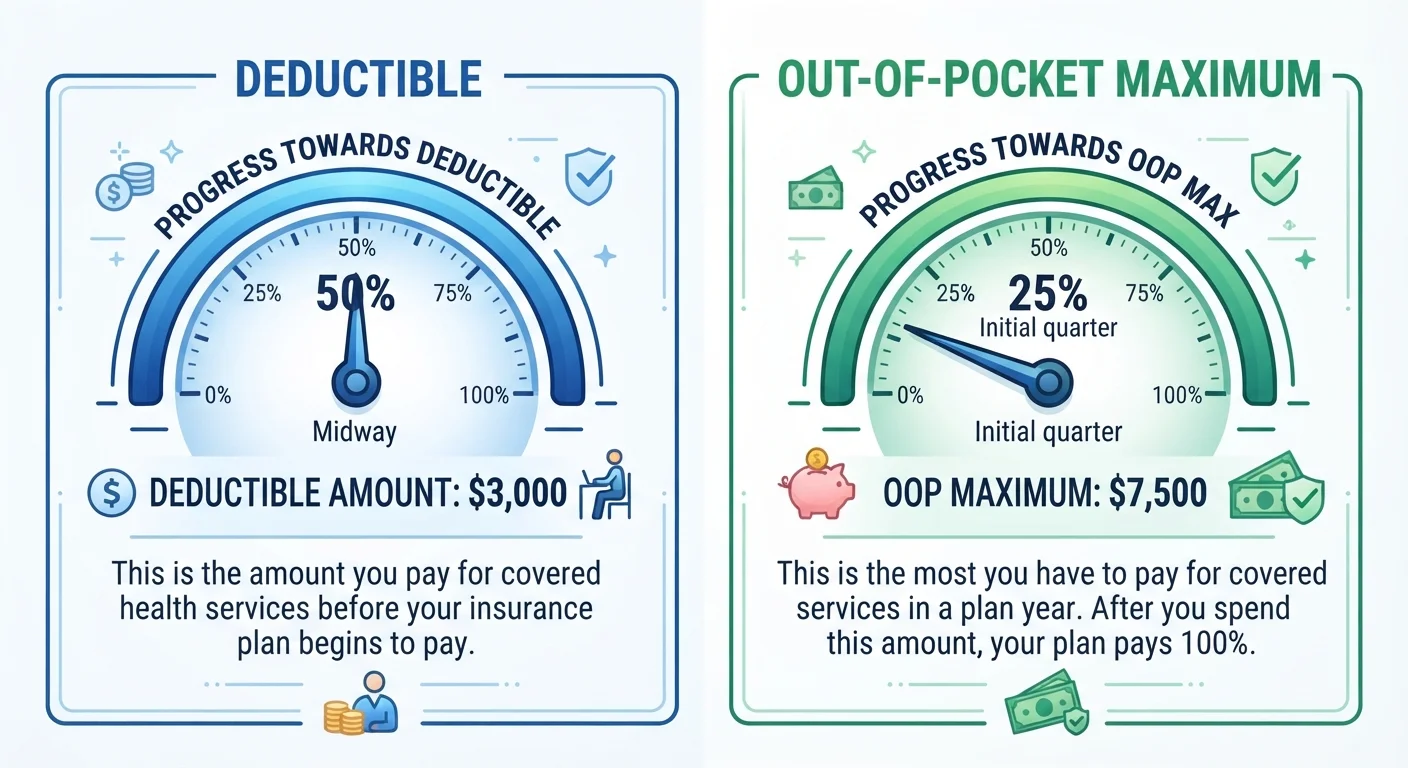
Option A
Deductible
The threshold you cross before insurance starts sharing costs.
Best for: Understanding when your insurer begins covering a portion of your medical bills each year.
Option B
Out-of-Pocket Maximum
The annual ceiling on what you'll ever pay, no matter what.
Best for: Knowing the absolute limit on your personal exposure during a high-cost medical year.
What Each Term Actually Means
Both numbers appear on every health insurance summary of benefits, and both are expressed in dollars. That's where the similarity ends.
The deductible is the amount you pay out of your own pocket for covered health care services before your insurance plan begins to share costs. If your deductible is $1,500, you pay the first $1,500 of covered medical expenses each plan year. After that threshold is met, your insurer steps in - typically through a cost-sharing arrangement called coinsurance (for example, you pay 20%, they pay 80%).
The out-of-pocket maximum (sometimes called the out-of-pocket limit) is the most you will ever have to pay for covered services in a single plan year. Once your combined payments - deductible, coinsurance, and eligible copays - reach that ceiling, your insurance pays 100% of covered costs for the remainder of the year. Under the Affordable Care Act, most plans must cap this amount at federally set limits, which are adjusted annually.
For a plain-language breakdown of all the cost terms that appear on a policy, see Deductibles, Premiums, and Copays: What Each Term Actually Means.
| Criterion | Deductible | Out-of-Pocket Maximum |
|---|---|---|
| What it represents | Amount you pay before insurer shares costs | Total annual cap on your covered spending |
| When it matters most | Early in the plan year, first major claim | During a high-cost or high-utilization year |
| What happens once you hit it | Cost-sharing (coinsurance/copays) begins | Insurer pays 100% of covered costs |
| Premiums count toward it? | No | No |
| Coinsurance counts toward it? | No - coinsurance starts after | Yes |
| Relative size | Always ≤ out-of-pocket maximum | Always ≥ deductible |
| Federally capped by law? | Indirectly, via the OOP limit | Yes, for ACA-compliant plans |
How the Two Numbers Interact
Think of your deductible and your out-of-pocket maximum as two points on the same timeline. Your deductible is the starting gate; your out-of-pocket maximum is the finish line.
Here's a simple illustration: Suppose your plan has a $1,000 deductible and a $4,000 out-of-pocket maximum, with 20% coinsurance after the deductible.
- You pay the first $1,000 of covered bills yourself (the deductible).
- For the next $15,000 in covered expenses, you pay 20% - that's $3,000 in coinsurance.
- At that point you've paid $1,000 + $3,000 = $4,000, which equals your out-of-pocket maximum.
- Every additional covered expense that year costs you nothing.
Your deductible is always a smaller number than - or, at most, equal to - your out-of-pocket maximum. A plan can never legally require you to meet a deductible that exceeds the out-of-pocket limit.
$9,450
2024 ACA individual out-of-pocket maximum
The ACA sets a federal ceiling on out-of-pocket maximums for individual coverage on compliant plans; the 2024 limit was $9,450 per individual and $18,900 per family.
$1,735
Average individual deductible, employer plan
According to KFF's 2023 Employer Health Benefits Survey, the average annual deductible for single coverage in employer-sponsored plans was approximately $1,735.
One important nuance: not everything you spend applies to both counters. Services subject to a flat copay (a fixed fee, like $30 for a primary care visit) may or may not count toward your deductible depending on your plan design, but copays typically do count toward your out-of-pocket maximum. Always confirm this with your plan documents.
For a deeper look at how all three major cost figures interact, see Deductible, Premium, and Out-of-Pocket Maximum: Why Each Number Matters.
What Does and Doesn't Count Toward Each
A frequent source of confusion is what actually accumulates toward each number. Here's a clear breakdown:
Counts toward your deductible:
- Payments you make for covered services before cost-sharing kicks in (e.g., an ER visit, lab work, imaging)
Counts toward your out-of-pocket maximum:
- Everything that counted toward your deductible
- Coinsurance payments after the deductible
- Eligible copays (varies by plan)
Does NOT count toward either:
- Premiums - the monthly cost to maintain your coverage
- Costs for out-of-network providers (on most plans)
- Services your plan excludes from coverage entirely
- Amounts above a provider's allowed charge
This distinction matters enormously. A $400 monthly premium is real money, but it does nothing to reduce how much you'd owe after a hospital stay. For more on that relationship, see The Relationship Between Your Deductible and Your Monthly Premium.
Embedded vs. Non-Embedded Family Deductibles
On a family plan with an embedded deductible, each family member has their own individual deductible within the larger family deductible. On a non-embedded (aggregate) plan, the entire family must collectively meet one combined deductible before cost-sharing begins for anyone. This distinction can significantly affect how quickly your family reaches the cost-sharing phase, so it's worth checking your Summary of Benefits and Coverage document.
It's also worth noting that family plans have two sets of thresholds - individual and family - which adds another layer. When one family member meets the individual deductible, the insurer starts cost-sharing for that person, even if the family deductible hasn't been met yet.
Choosing a Plan: Which Number Should You Focus On?
The right emphasis depends on how much care you expect to use.
If you're generally healthy and rarely see a doctor beyond preventive care (which is typically covered before the deductible under ACA-compliant plans), you might focus on keeping your deductible manageable while accepting a higher out-of-pocket maximum you'll likely never reach. Pairing a high-deductible health plan (HDHP) with a health savings account (HSA) is one common strategy in this situation - though whether that's appropriate depends on your specific circumstances.
If you have ongoing medical needs, chronic conditions, or are planning a procedure, the out-of-pocket maximum becomes the number to scrutinize. It's the most you can lose in a bad year, and a lower ceiling may be worth a higher premium.
For broader context on how these numbers fit into overall plan design, Health Insurance Explained: Coverage, Costs, and Key Terms walks through the full picture.
This article is for general informational and educational purposes only and does not constitute personalized insurance, financial, or legal advice. Coverage terms, costs, and limits vary by plan and provider. Always read your plan documents carefully and consult a licensed insurance agent or adviser for guidance specific to your situation.
The content on this site is for informational purposes only and is not a substitute for professional advice. Always consult a qualified professional for guidance specific to your situation.