

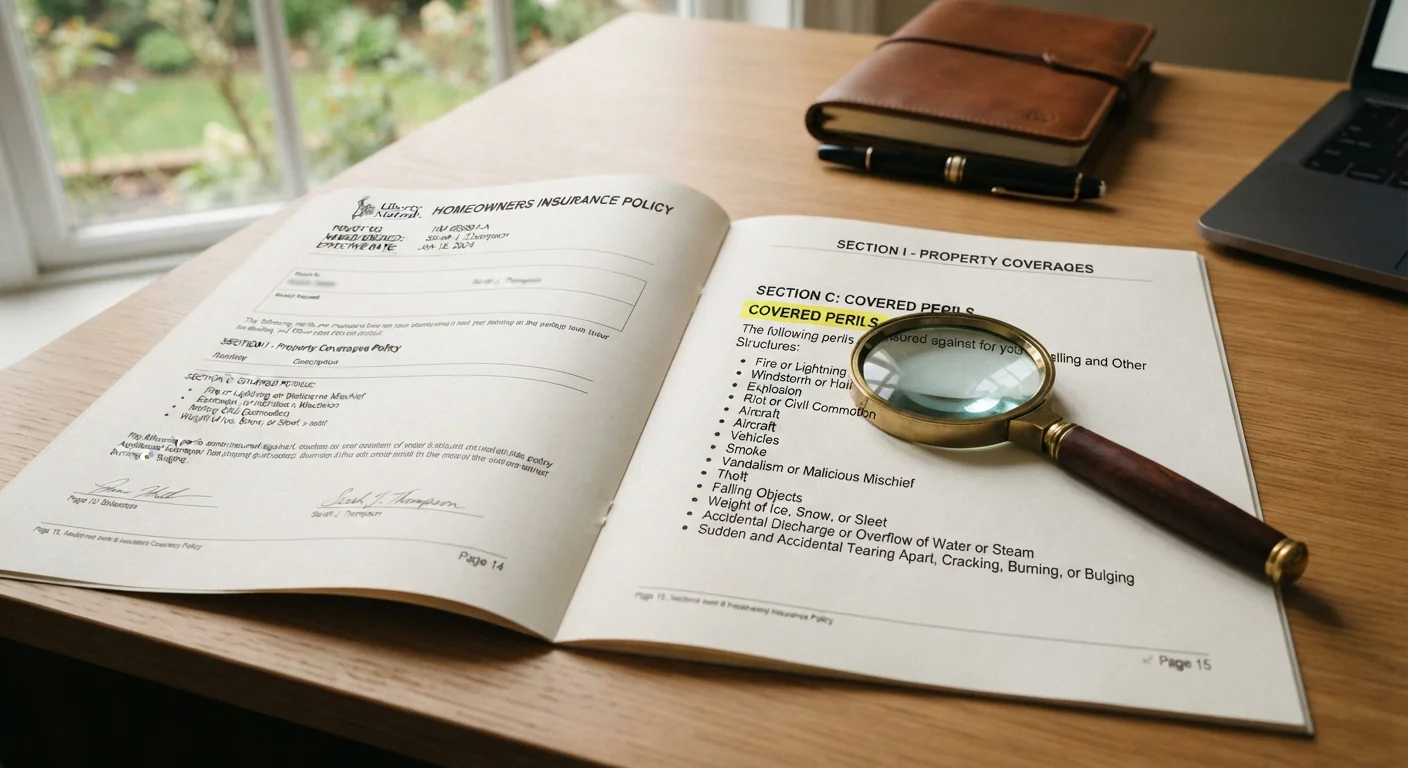
Named Perils vs. Open Perils: Two Fundamentally Different Approaches
Insurance policies take one of two approaches to defining which events trigger coverage, and the difference has major real-world consequences.
Named-peril policies list every covered event explicitly. Common examples include fire, lightning, explosion, windstorm, hail, theft, and vandalism. If the cause of your loss isn't on that list, the claim is denied - full stop. The burden is on you, the policyholder, to show that your loss falls within a listed peril.
Open-peril policies (also called 'all-risk' or 'special form' policies) work in reverse. They cover any cause of loss unless it is specifically excluded. The burden shifts to the insurer to point to a written exclusion in order to deny a claim. This generally provides broader protection, but it does not mean unlimited protection - exclusions still carve out significant categories of loss.
Many homeowners policies use a hybrid: open-peril coverage for the structure of the home, and named-peril coverage for personal property inside it. Renters policies often use the named-peril approach throughout. Understanding which type you have shapes everything about how a claim is evaluated. See the role of exclusions in defining real policy limits to understand what sits on the other side of the perils list.
~40%
Small businesses that never reopen after a major disaster
The Federal Emergency Management Agency (FEMA) has cited figures suggesting a significant share of small businesses do not reopen after disasters - often because their coverage did not match the actual cause of loss.
1 in 50
Homeowners filing a property claim each year
According to the Insurance Information Institute, roughly one in fifty homeowners files a property claim annually, making peril awareness a practical concern for millions of policyholders.
Why the Cause of Loss - Not the Damage - Is What Counts
One of the most common misunderstandings about insurance is that coverage follows the damage. It doesn't. Coverage follows the cause.
Consider water damage. If a pipe inside your home bursts and soaks your floors, that's typically a covered peril under a standard homeowners policy - sudden and accidental discharge of water. But if floodwaters rise outside and seep through your foundation, that's a separate peril - flood - and it's excluded on virtually every standard home policy. The water damage looks the same in both cases. The cause determines whether you're covered.
The same logic applies to wind vs. flood after a hurricane. Damage clearly caused by wind may be covered; storm surge damage is typically not. Adjusters are specifically trained to identify the proximate cause of loss - the dominant event that set the damage in motion - because that determination drives the coverage decision.
This is why the common myths about what insurance covers so often involve perils people assumed were included but weren't.
How to Read the Perils Section in Your Own Policy
Most policyholders skip the perils section and go straight to the declarations page - the summary sheet listing coverage amounts and premiums. That's understandable, but the declarations page won't tell you what causes of loss are actually covered. For that, you need the policy form itself.
Look for section headings like "Perils Insured Against," "Covered Causes of Loss," or "Section I - Perils Insured Against." If your policy uses the named-peril approach, you'll see an explicit list. If it uses the open-peril approach, you'll see language like "We insure against risk of direct physical loss unless the loss is excluded."
Check Your Policy Type Before Assuming Coverage
If your policy says 'we cover the following perils' followed by a list, you have named-peril coverage. If it says 'we cover direct physical loss unless excluded,' you have open-peril coverage. Knowing which type you have takes less than a minute and tells you a great deal about how a future claim might be evaluated.
After identifying your policy type, cross-reference the exclusions section. Together, the perils and exclusions sections define the actual boundaries of your coverage. For more on how limits interact with what gets paid, see how coverage limits affect claim payouts.
If you're unsure what your policy covers, a licensed insurance agent or your insurer's customer service team can walk through the language with you. Coverage questions are best resolved before a loss occurs - not during a claim.
This article is for general informational purposes only and does not constitute insurance, legal, or financial advice. Coverage terms, perils, and exclusions vary by policy and insurer. Always read your actual policy documents and consult a licensed insurance professional regarding your specific coverage needs.
Frequently Asked Questions
A covered peril is a cause of loss - such as fire, lightning, windstorm, or theft - that your policy specifically agrees to pay for. When you file a claim, your insurer determines whether the event that caused the damage qualifies as a covered peril under your policy's terms.
A named-peril policy only covers events explicitly listed in the document. An open-peril (or 'all-risk') policy covers any cause of loss that is not specifically excluded. Open-peril policies tend to offer broader protection, but exclusions still apply and vary by policy.
No. Flood damage is a standard exclusion on most homeowners insurance policies. Separate flood insurance - typically through a private insurer or the National Flood Insurance Program - is required for that coverage.
Yes. The cause of the damage, not the damage itself, determines coverage. Water damage from a burst pipe may be covered, while water damage from rising floodwaters is typically excluded - even if the resulting damage looks identical.
Look for sections titled 'Perils Insured Against,' 'Covered Causes of Loss,' or similar language in your policy document. The declarations page summarizes your coverage, but the full conditions and perils details appear in the policy form itself.
Not exactly. 'All-risk' or open-peril coverage means any cause of loss is covered unless specifically excluded. Every all-risk policy still contains exclusions - common ones include flood, earthquake, intentional damage, and normal wear and tear.
The content on this site is for informational purposes only and is not a substitute for professional advice. Always consult a qualified professional for guidance specific to your situation.