

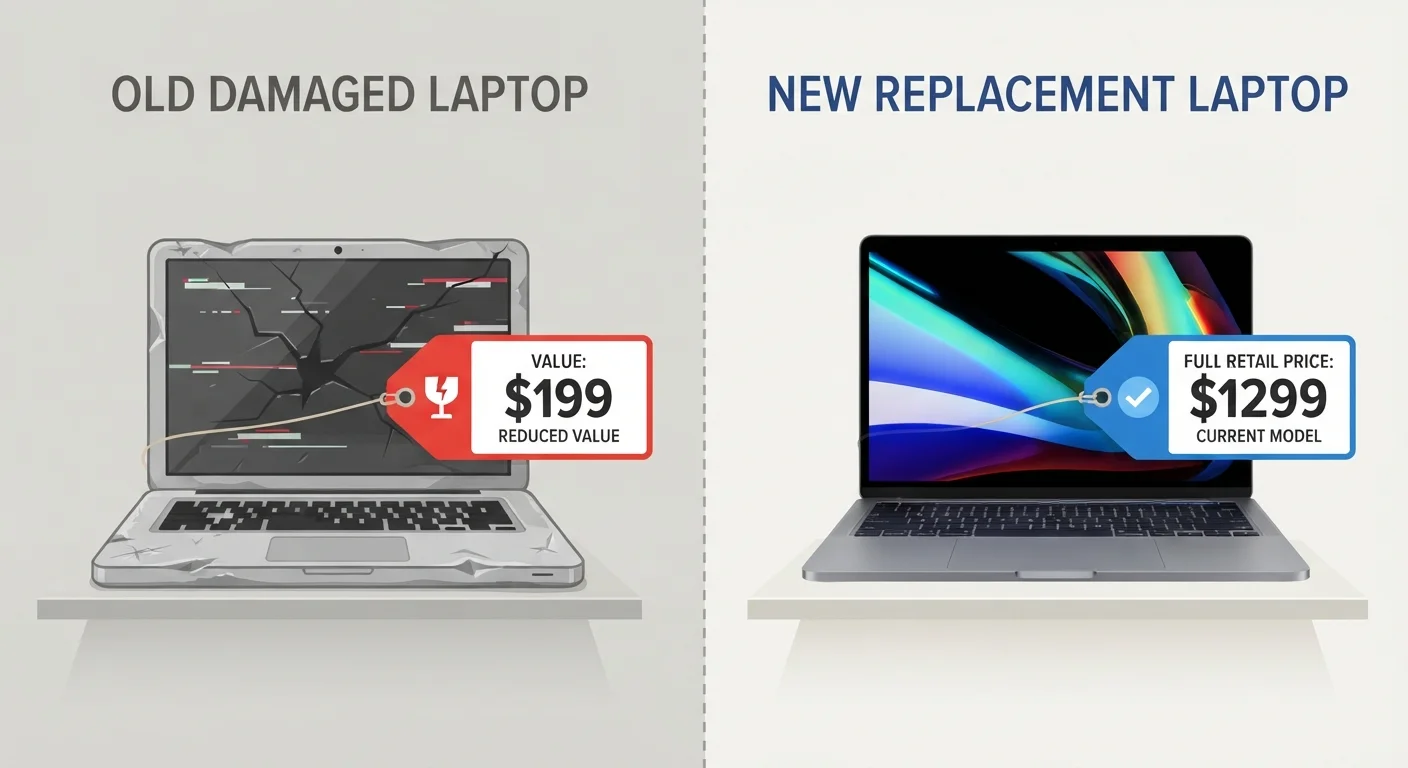
Option A
Actual Cash Value (ACV)
The depreciation-adjusted payout method.
Best for: Policyholders seeking lower premiums who can absorb the gap between an item's current market value and its original cost.
Option B
Replacement Cost Value (RCV)
The full-replacement payout method.
Best for: Homeowners and renters who want their insurer to cover the full cost of replacing a lost or damaged item with a comparable new one.
What These Two Terms Actually Mean
When you file a property insurance claim - whether for a flooded basement, a stolen laptop, or fire damage - the check you receive is not simply the original purchase price of what you lost. Instead, your insurer applies a valuation method specified in your policy to calculate how much you're owed. The two most common methods are Actual Cash Value (ACV) and Replacement Cost Value (RCV).
Actual Cash Value is calculated by taking the cost to replace an item and then subtracting depreciation - the reduction in value that occurs as an item ages or wears out. If your five-year-old refrigerator is destroyed and it would cost $1,200 to buy the same model new, but depreciation has reduced its current market value to $600, an ACV policy pays $600 (minus your deductible).
Replacement Cost Value, by contrast, does not subtract depreciation. Under an RCV policy, the same refrigerator scenario would yield a payout closer to $1,200 - enough to actually purchase a comparable new appliance. This is the essential distinction: ACV reflects what your property is worth today, while RCV reflects what it costs to replace it today.
This difference may sound technical, but it directly determines how much money lands in your hands after a loss. For more on how payout limits interact with valuation, see how coverage limits work.
| Criterion | Actual Cash Value (ACV) | Replacement Cost Value (RCV) |
|---|---|---|
| Payout basis | Current market value after depreciation | Cost to buy a comparable new item |
| Depreciation deducted | Yes | No |
| Typical premium cost | Lower | Higher |
| Out-of-pocket gap after a loss | Potentially large | Minimal (after deductible) |
| Best suited for | Budget-conscious policyholders with reserves | Those who need full replacement coverage |
| Risk if property is older | Higher - more depreciation, lower payout | Lower - age does not reduce payout |
How Depreciation Changes the Math
Depreciation is the engine that separates ACV from RCV payouts. Insurers calculate depreciation using several factors: the item's age, its expected useful life, and its condition at the time of the loss. Each insurer may apply its own depreciation schedule, so two companies can arrive at different ACV figures for the same item.
Consider a homeowner's policy covering personal property. A television purchased for $800 three years ago might be assigned a useful life of seven years. That means roughly 43% of its value has depreciated - leaving an ACV payout of around $456. An RCV policy for the same TV would pay whatever a comparable new television costs today, which could be higher or lower than the original price depending on the market.
~43%
Depreciation on a 3-year-old TV (7-year lifespan)
A simplified straight-line depreciation example illustrating how quickly consumer electronics lose insurable value under ACV policies.
Thousands
Potential dollar gap between ACV and RCV on a roof claim
Industry consumer guides frequently cite roof claims as among the largest areas where ACV policyholders face significant out-of-pocket shortfalls.
The depreciation gap tends to widen the older or more heavily used your property is. This is especially relevant for homeowners with older roofs: a roof installed 15 years ago may have minimal ACV left, meaning a storm claim under an ACV policy could leave a homeowner covering most of the replacement cost themselves. It's one reason common misconceptions about claim payouts can be financially painful when reality sets in.
Premium Cost vs. Payout Adequacy: The Core Trade-Off
RCV coverage costs more than ACV coverage - sometimes meaningfully so. That premium difference reflects the greater financial exposure an insurer takes on when it agrees to pay current replacement prices regardless of depreciation. For many policyholders, the relevant question is whether the premium difference is worth the additional payout protection.
There is no universal answer. Someone renting a modest apartment with a few years of accumulated furniture might find ACV coverage adequate and appreciate the lower premium. A homeowner with a custom kitchen, high-end electronics, or a newer roof has more to lose from depreciation deductions and may find RCV coverage worth the added cost.
Check for an RCV Endorsement Option
Some insurers offer Replacement Cost Value as an add-on endorsement to an otherwise ACV policy, rather than requiring a full policy upgrade. This can let you apply RCV to specific high-value items - such as electronics or jewelry - while keeping ACV on other property. Ask your insurer or licensed agent whether this option is available on your current policy before assuming you must choose one method for everything.
Before making this decision, it also helps to understand when filing a claim is worth it at all. The valuation method affects the claim payout, but your deductible, premium history, and the size of the loss all factor into the overall math. See when filing a claim makes financial sense and why small claims can cost more than paying out of pocket for context on that decision.
This article is for general informational purposes only and does not constitute personalized insurance, financial, or legal advice. Coverage terms, valuation methods, and exclusions vary by insurer and policy. Always review your actual policy documents and consult a licensed insurance professional before making coverage decisions.
The content on this site is for informational purposes only and is not a substitute for professional advice. Always consult a qualified professional for guidance specific to your situation.