

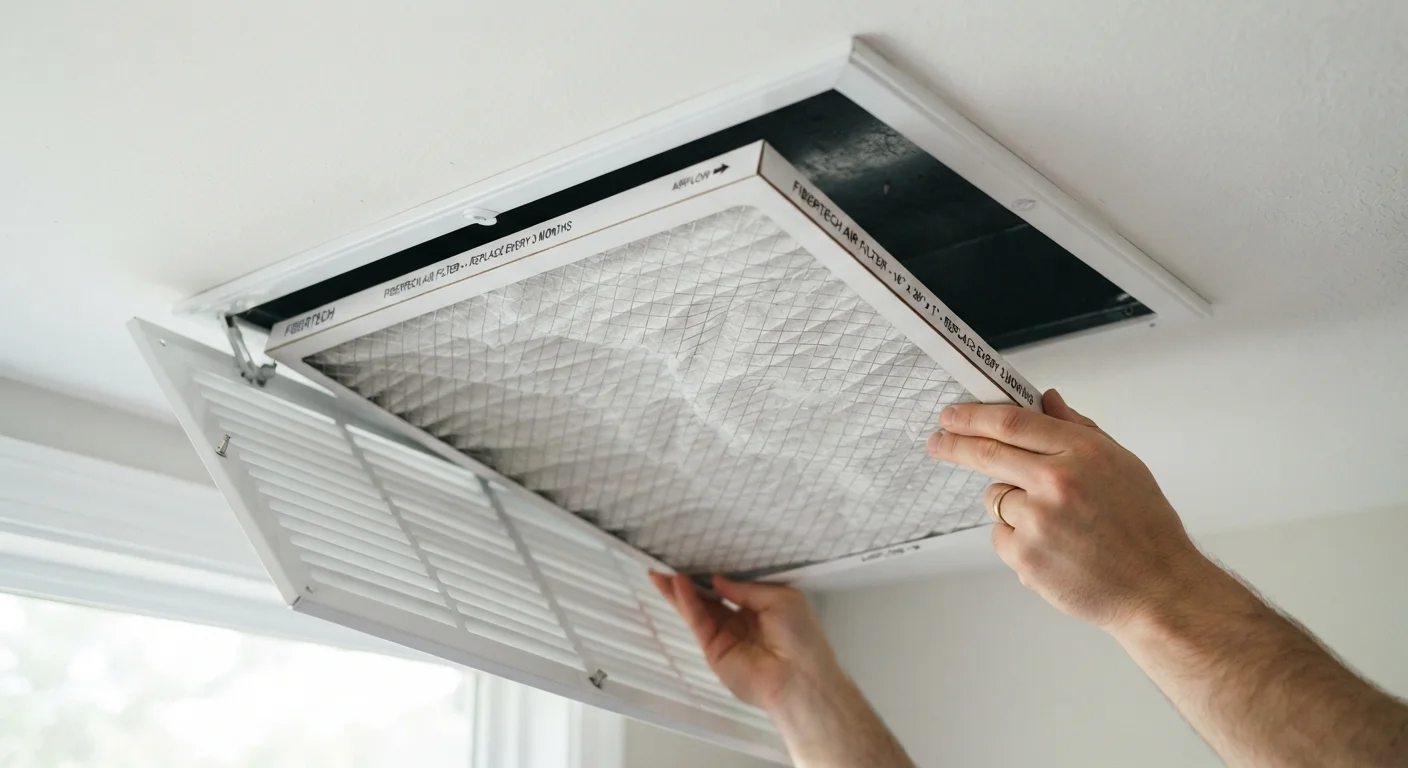
Why Filter Ratings Exist - and Why There Are Three of Them
Walk into any hardware store and you'll find air filters labeled with MERV, MPR, or FPR - sometimes all three on the same shelf. Each rating system measures filtration performance, but they were created by different organizations for different purposes, which is why comparing filters across brands can feel unnecessarily complicated.
MERV (Minimum Efficiency Reporting Value) is the only independent, industry-wide standard. It was developed by ASHRAE, the American Society of Heating, Refrigerating and Air-Conditioning Engineers, and is used across commercial and residential applications worldwide. MPR and FPR are proprietary scales created by individual manufacturers and retailers to differentiate their products - they are not interchangeable with MERV, though they can be roughly cross-referenced.
MERV
Minimum Efficiency Reporting Value - an industry-standard scale (1-16 for residential use) developed by ASHRAE that rates how effectively a filter captures particles of specific sizes. Higher MERV numbers indicate finer filtration.
MPR
Micro-Particle Performance Rating - a proprietary scale used by one major filter brand, measuring a filter's ability to capture particles smaller than 1 micron. Scores typically range from 300 to 2800.
FPR
Filter Performance Rating - a proprietary 4-10 scale used by a major home improvement retailer to simplify filter selection, color-coded by performance tier.
Micron
A unit of measurement equal to one millionth of a meter. Most household airborne particles - dust, pollen, mold spores, and pet dander - range from 0.3 to 100 microns in size.
HEPA
High-Efficiency Particulate Air - a filtration standard requiring capture of at least 99.97% of particles 0.3 microns or larger. True HEPA filters are rarely used in standard residential HVAC systems due to airflow restrictions.
Airflow restriction
The reduction in air movement caused by a denser filter medium. Filters with very high ratings capture more particles but can strain HVAC blower motors if the system isn't designed for them.
Understanding what each scale actually measures helps you choose a filter that genuinely fits your household's needs - whether that's managing pet dander, reducing dust, or supporting someone with respiratory sensitivities.
MERV, MPR, and FPR: What Each Rating Measures
MERV (1-16 residential): Tested against particles ranging from 0.3 to 10 microns, including dust, pollen, mold spores, pet dander, and some bacteria. A MERV 8 filter captures most household dust and pollen. MERV 11 adds fine particles like auto emissions and lead dust. MERV 13 approaches hospital-quality filtration, capturing smoke and fine droplets - but requires an HVAC system capable of handling reduced airflow.
| MERV residential range | 1-16 (most homes use 8-13) (ASHRAE Standard 52.2) |
| MPR scale range | 300 to 2800 (Proprietary manufacturer scale) |
| FPR scale range | 4 to 10 (Proprietary retailer scale) |
| Particle size captured at MERV 11 | Particles as small as 1 micron (ASHRAE Standard 52.2) |
| Recommended filter check frequency | Every 30-90 days depending on usage (U.S. Department of Energy guidance) |
| HEPA equivalent MERV | MERV 17-20 (not standard residential) (ASHRAE classification) |
MPR (300-2800): Focuses specifically on particles smaller than 1 micron, making it particularly sensitive to fine pollutants and smoke. An MPR 1000 is roughly comparable to MERV 11; MPR 1500-1900 approximates MERV 12-13. Because it emphasizes sub-micron performance, MPR scores can look dramatically different from MERV values even when filtration outcomes are similar.
FPR (4-10): A simplified color-coded scale: Good (4-5), Better (6-7), Best (8-9), and Premium (10). An FPR 7 is roughly equivalent to MERV 11-12. This scale is designed for ease of in-store decision-making rather than technical precision.
Check Your System's Manual Before Upgrading
Not every HVAC system can handle high-efficiency filters. A filter that is too dense for your blower motor can reduce airflow, strain components, and increase energy costs. Before moving to a significantly higher rating, consult your system's owner manual or an HVAC technician to confirm compatibility.
Choosing the Right Rating for Your Home
The right filter depends on your household profile, not just the highest number available. Use this as a general framework:
- Basic filtration (MERV 1-7 / FPR 4-5 / MPR 300-600): Captures large particles like lint and dust bunnies. Suitable for vacation homes or spaces with minimal occupancy and no pets.
- Standard residential (MERV 8-10 / FPR 6-7 / MPR 600-1200): The right range for most homes. Captures pollen, dust mite debris, and pet dander effectively without stressing typical HVAC equipment.
- Enhanced filtration (MERV 11-13 / FPR 8-9 / MPR 1500-1900): Recommended for homes with allergy or asthma sufferers, multiple pets, or occupants sensitive to air quality. Verify your system supports these filters before installing.
- High-efficiency (MERV 14-16): Generally reserved for medical or commercial environments. Rarely appropriate for standard residential HVAC without system modifications.
MERV 8-13
Ideal range for most residential HVAC systems
According to ASHRAE guidance, this range balances effective particle capture with manageable airflow restriction for typical home systems.
0.3 µm
Smallest particle size MERV ratings measure
ASHRAE's test protocol evaluates filter efficiency at this particle size, which covers fine dust, smoke, and many bacteria.
30-90 days
Recommended filter replacement interval
The U.S. Department of Energy recommends checking filters monthly and replacing them at least every three months under normal conditions.
Replacing filters on schedule matters as much as the rating you choose. A clogged MERV 13 filter performs worse than a clean MERV 8 - so regular maintenance is always part of the equation. Just as decoding labels takes practice in other areas - like learning what sunscreen ratings actually mean - understanding air filter ratings puts informed decision-making back in your hands.
The content on this site is for informational purposes only and is not a substitute for professional advice. Always consult a qualified professional for guidance specific to your situation.