

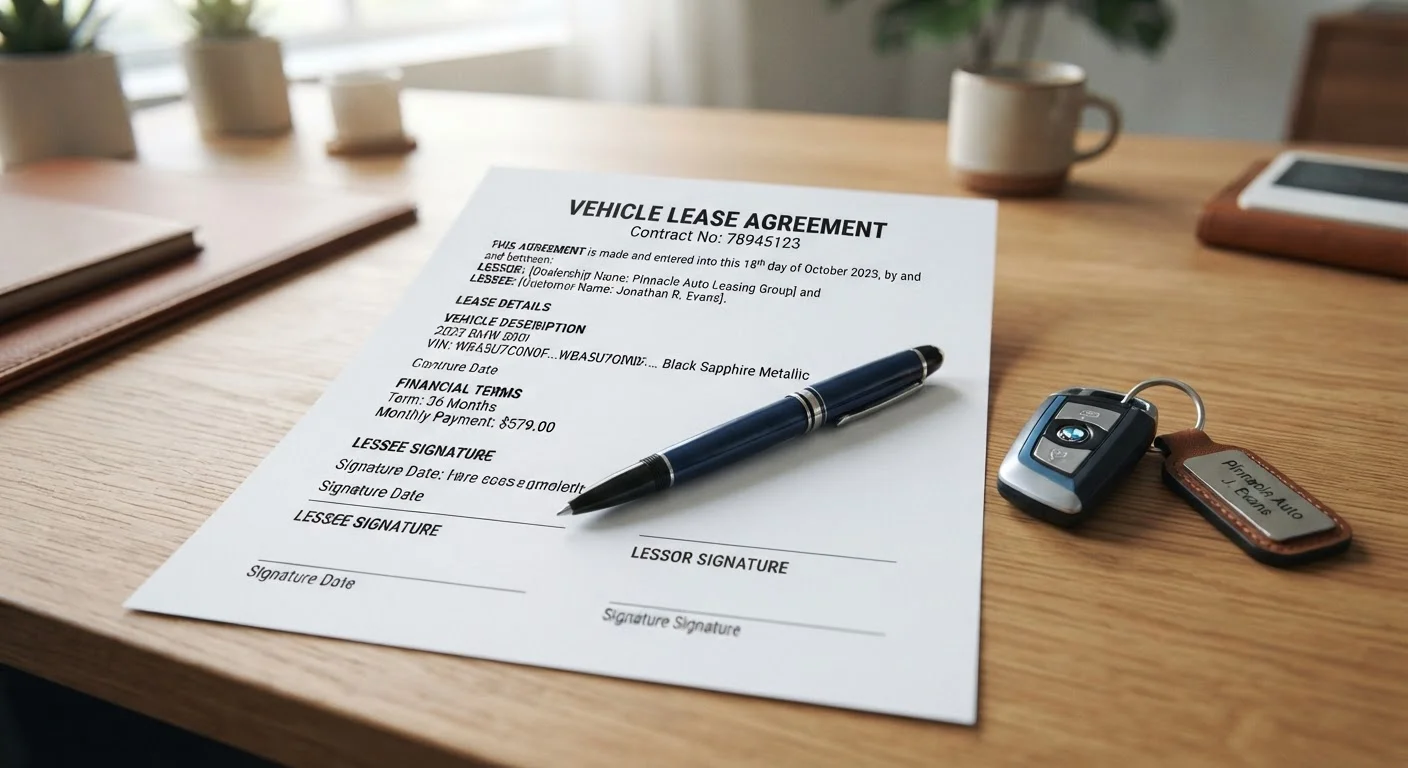
Why Lease Contracts Are Confusing by Design
A car lease agreement isn't structured to be easy reading. It's a dense legal document combining elements of a loan, a rental agreement, and a purchase option - all at once. Terms like capitalized cost, money factor, and residual value don't appear on the window sticker, and dealers aren't always eager to walk you through them line by line.
But these numbers are the actual levers that control what you pay. Understanding them puts you in a far stronger position - not just to spot a bad deal, but to know exactly what you're agreeing to before you hand over a signature. Just as borrowers benefit from knowing loan terminology, drivers benefit from decoding lease language before committing.
This Is General Information, Not Advice
This guide explains how lease contract terms generally work across the industry. Your actual lease document governs your specific obligations. Terms, fees, and standards vary significantly between manufacturers, captive finance arms, and third-party lenders. Read your contract in full and ask questions before you sign.
This guide is general educational information about how lease contracts work. It is not financial or legal advice. Your specific lease terms will vary by lender, manufacturer, and state. Always read your actual contract and consult a licensed professional if you have questions about your situation.
The Key Numbers That Determine Your Payment
Three figures drive nearly every lease payment calculation:
- Capitalized cost (cap cost): The negotiated selling price of the vehicle, which is the starting point for your lease. It can also include fees and add-ons rolled in. A lower cap cost means lower payments - and yes, it is negotiable on most leases.
- Residual value: The estimated value of the car at the end of the lease term, expressed as a dollar amount or percentage of MSRP. You only finance the depreciation between cap cost and residual, so a high residual is favorable. How depreciation works is central to understanding why two similar cars can have very different lease payments.
- Money factor: The lease equivalent of an interest rate. It's expressed as a tiny decimal (e.g., 0.00125). To convert it to an approximate APR, multiply by 2,400. A money factor of 0.00125 equals roughly 3% APR.
$0.15-$0.30
Typical per-mile overage fee at lease end
Per-mile excess mileage charges are defined in the lease contract and vary by lender and vehicle type.
2,400
Multiplier to convert money factor to approximate APR
Multiply the money factor (e.g., 0.00125) by 2,400 to get the equivalent annualized interest rate for comparison.
~30%
Typical new car depreciation in the first year
Industry data consistently shows new vehicles lose a significant portion of their value in the first 12 months, which directly affects residual value projections in lease contracts.
Your monthly payment is essentially the monthly depreciation (cap cost minus residual, divided by term) plus a monthly finance charge (cap cost plus residual, multiplied by the money factor). That's the core math - everything else is layered on top.
Mileage Caps and What Happens When You Exceed Them
Every lease contract specifies an annual mileage allowance - commonly 10,000, 12,000, or 15,000 miles per year. This limit exists because higher mileage reduces the car's residual value, which would undercut the lender's projection.
If you return the car over the mileage cap, you owe a per-mile overage fee - typically between $0.15 and $0.30 per mile, though this varies by lender and is stated in your contract. Driving 5,000 miles over at $0.25 per mile means a $1,250 charge at turn-in.
Underestimating Your Mileage Is a Common Mistake
Many drivers underestimate how much they drive annually, especially when life circumstances change mid-lease - a new job, a move, or a shift in family logistics. Mileage overage fees are non-negotiable once the contract is signed. Build in a realistic buffer when choosing your annual allowance rather than defaulting to the lowest-cost option.
Before signing, estimate your actual annual driving. If you commute long distances, travel frequently, or haul kids to activities across town, a standard 12,000-mile allowance may fall short. Some lessees negotiate a higher annual mileage allowance upfront - paying a slightly higher monthly payment - which is generally more cost-effective than paying overage fees at the end.
Fees You Should Read Before You Sign
Lease contracts typically include several fees that don't always get highlighted during negotiation:
- Acquisition fee
- Charged by the lender (not the dealer) to initiate the lease. It's often $600-$1,000 and is sometimes rolled into the cap cost.
- Disposition fee
- Due at lease end if you return the car and don't lease or buy another vehicle from the same brand. Typically $300-$500.
- Excess wear-and-tear charges
- The contract defines what's considered normal wear versus damage you'll be billed for. Scratches, tire condition, and interior stains are common points of dispute. Read the definitions closely.
- Early termination fee
- Breaking a lease before the term ends can be expensive - often equal to several remaining payments plus other costs. This is one of the most important clauses to understand before signing.
Always ask the finance officer to disclose the money factor in writing before you sign. Some dealers prefer to quote only the monthly payment, which obscures whether the financing terms are competitive.
Without knowing the money factor, you can't compare the financing cost of one lease offer against another or against a conventional auto loan.
Request a pre-return inspection through the leasing company, typically available 60-90 days before your lease ends. It gives you time to address legitimate wear items before they're assessed at a higher rate at turn-in.
Catching issues early allows you to make low-cost repairs rather than being charged the lender's assessed fee, which is often higher than an outside estimate.
Unlike an insurance policy - where you can learn to read key sections like exclusions and limits - a lease contract doesn't have a standardized layout. Ask the dealer or finance officer to walk through each fee line by line before you sign.
Your Options at the End of the Lease
When your lease term concludes, you generally have three paths:
- Return the vehicle. You hand back the keys, pay any applicable disposition fee, mileage overage, or wear-and-tear charges, and you're done. This is the simplest exit if the car's condition is good and you've stayed within your mileage limit.
- Buy out the vehicle. Your contract specifies a purchase option price - typically the residual value, sometimes plus a small purchase fee. If the car is worth more on the open market than its residual (or if you've grown attached to it), a buyout can make sense. Comparing financing versus paying cash applies here too - you can finance the buyout or pay it outright.
- Trade into a new lease. Many manufacturers offer loyalty incentives. If you're over your mileage or have wear-and-tear concerns, rolling into a new lease can sometimes absorb those costs - but read the new contract carefully so they aren't simply buried elsewhere.
Document the Car's Condition at Return
Take dated photos and video of the entire vehicle - exterior, interior, tires, and wheels - immediately before returning it. Give yourself a timestamped record that documents the car's condition at the moment you handed it back. This can be useful if wear-and-tear charges appear on your final invoice that you believe are inaccurate.
Questions to Ask Before Committing
Before signing any lease, get clear answers - in writing - on these points:
- What is the negotiated cap cost, and what's included in it?
- What is the money factor, and can I see it converted to an APR?
- What is the residual value, and is it set by the manufacturer or the dealer?
- What does the wear-and-tear standard cover, and how is it assessed at return?
- Is gap coverage included, or is it an add-on? (Gap coverage pays the difference between what you owe on the lease and the car's actual value if it's totaled or stolen - an important protection.)
- What is the exact early termination cost if my circumstances change?
A lease can be a practical vehicle arrangement for the right driver - but it's a financial contract with specific obligations, not a simple rental. Taking the time to understand what every clause means before you sign is the clearest way to avoid surprises at turn-in.
“A lease is a promise to pay for depreciation you haven't experienced yet. Understanding that promise - and its limits - is the entire job of reading the contract.”
— Home & Auto Editorial Team, Consumer vehicle education resource
This article provides general educational information about vehicle lease contracts and is not financial, legal, or consumer advice tailored to your individual situation. Lease terms, fees, and regulations vary by lender, manufacturer, and state. Always review your actual contract carefully and consult a qualified professional with questions about your specific circumstances.
The content on this site is for informational purposes only and is not a substitute for professional advice. Always consult a qualified professional for guidance specific to your situation.