

What Octane Rating Actually Means
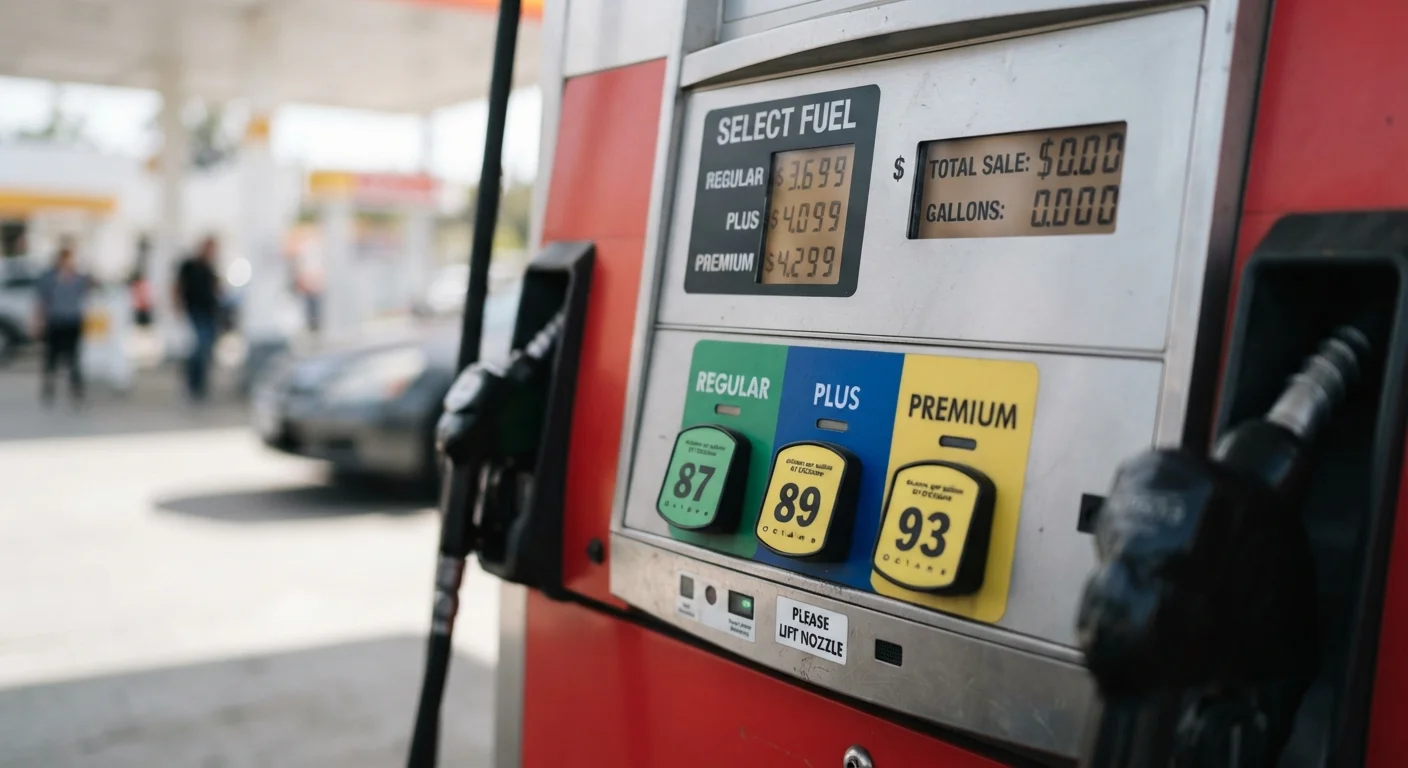
Walk up to any gas pump in America and you'll see three numbers: typically 87, 89, and 91 or 93. These are octane ratings - a measure of a fuel's ability to resist engine knock (also called pre-ignition or detonation), which is the uncontrolled ignition of the air-fuel mixture inside the cylinder before the spark plug fires.
Higher octane does not mean more energy, cleaner burning, or better fuel economy in most engines. It simply means the fuel is more stable under compression. Engines with high compression ratios or turbochargers generate more heat and pressure inside the cylinder, making them more prone to knock - and that's where premium fuel earns its place.
The U.S. uses the AKI (Anti-Knock Index) method, which averages two laboratory tests. That's the number displayed on the yellow sticker at the pump. European and other markets often use a different RON (Research Octane Number) scale, which runs slightly higher - so a European "95" isn't directly equivalent to a U.S. "95."
Myth
Premium fuel gives any car better performance and fuel economy.
Fact
Premium fuel only improves performance in engines specifically designed or tuned for higher octane.
Engines are engineered to a precise compression ratio and ignition map. An engine designed for 87-octane fuel extracts exactly the energy it needs from regular gasoline. Pouring in 93-octane does not unlock hidden power - the combustion chemistry simply has no additional advantage to offer that engine. Independent testing by organizations such as AAA has found no meaningful gain in fuel economy or horsepower for regular-grade engines run on premium.
Myth
Higher octane fuel is "cleaner" and better for your engine's long-term health.
Fact
Octane rating has nothing to do with fuel purity or detergent content; those are separate specifications.
All tiers of gasoline sold in the U.S. must meet EPA standards for detergent additives. Some fuel brands carry additional Top Tier detergent certification, but this applies across all their octane grades - not only premium. Choosing premium does not mean choosing cleaner fuel; it means choosing fuel with greater knock resistance. Engine cleanliness is governed by detergent quality, not octane level.
Myth
You can't put regular gas in a car that recommends premium without causing engine damage.
Fact
"Recommended" means the engine can safely operate on regular fuel, with a possible minor performance trade-off.
Modern knock-sensor technology allows an engine's ECU to detect and respond to early detonation by retarding ignition timing. This prevents harmful knock even when octane is slightly below the optimum level. The practical result is a small reduction in peak horsepower and, in some cases, slightly reduced fuel efficiency - but no physical damage. The only time using lower octane fuel is genuinely risky is when the manual states premium is required.
Myth
Midgrade (89 octane) is always a safe, sensible compromise between regular and premium.
Fact
Midgrade is rarely the optimal choice - most vehicles are tuned for either 87 or 91-plus, not 89.
Engine management systems are calibrated around specific octane targets. An engine that runs well on regular won't gain anything meaningful from midgrade. An engine that truly needs premium won't be fully protected by midgrade either. The middle-tier product exists for a narrow band of older engines with modest compression requirements, but for the vast majority of current vehicles, midgrade simply costs more than regular for no benefit - or falls short of what a premium-required engine needs.
Myth
Switching to premium will fix rough idling, hesitation, or other engine problems.
Fact
Fuel grade is rarely the cause of common engine performance issues; a mechanical inspection is the right first step.
Rough idling, hesitation, or loss of power are most often caused by worn spark plugs, clogged fuel injectors, failing sensors, or other mechanical and electrical issues - none of which are resolved by a higher octane rating. Spending extra on premium as a diagnostic guess is unlikely to help and may delay finding the actual problem. If your vehicle is running poorly, consult a qualified mechanic rather than changing fuel grade.
Required vs. Recommended: A Critical Distinction
Your owner's manual will use one of two phrases, and the difference matters financially:
- "Premium fuel required" - The engine's design demands it. Using regular can cause persistent knock, reduced performance, and potential long-term engine damage. Do not substitute.
- "Premium fuel recommended" - The engine is tuned to perform optimally on premium but is engineered to run safely on regular. You may see a modest drop in horsepower and fuel economy, but your engine will not be harmed.
Many drivers treat these phrases interchangeably. They are not. If your car says "recommended," using regular is a legitimate choice - especially if fuel costs are a concern. If it says "required," the cost savings at the pump are not worth the risk.
Never Ignore a "Required" Label
If your owner's manual states that premium fuel is required, that is an engineering specification - not a preference. Consistently using lower-octane fuel in a required-premium engine can cause persistent knock, reduced engine efficiency, and in severe or prolonged cases, internal engine damage. The cost savings at the pump are not worth the potential repair bills.
For a broader look at how vehicle-related costs connect to what you pay for coverage, see our piece on factors that shape your insurance premium.
When Premium Is Worth It - and When It Isn't
If you drive a high-performance vehicle, a turbocharged engine, or a luxury car with a high compression ratio, premium fuel is likely either required or genuinely beneficial. In these cases, the engine's ECU (Engine Control Unit) is calibrated to take full advantage of the fuel's knock resistance, delivering the horsepower and efficiency figures advertised.
For the majority of everyday commuter vehicles - sedans, crossovers, and minivans running standard naturally aspirated engines - regular 87-octane is exactly what engineers designed for. Filling those tanks with premium does not clean the engine faster, increase longevity, or deliver more miles per gallon. It simply costs more.
~16%
Price premium of 93-octane over 87-octane
Based on U.S. Energy Information Administration retail price tracking, premium gasoline consistently costs roughly 15-20 cents more per gallon than regular nationwide.
70%
New vehicles that operate normally on regular fuel
According to AAA research, approximately 70% of vehicles on U.S. roads are designed to run on regular 87-octane gasoline, making premium unnecessary for most drivers.
Modern engines equipped with knock sensors can detect pre-ignition and automatically retard ignition timing to compensate, which is why your engine won't knock audibly even on lower octane than ideal. However, this adaptive process does reduce power output slightly - a real tradeoff for performance vehicles, but largely imperceptible in everyday driving.
Understanding fuel choices is just one part of caring for your vehicle correctly. Oil selection is another area where myths run rampant - our guide on synthetic vs. conventional motor oil breaks down when each type makes sense for your engine.
This article is for general informational purposes only. For guidance specific to your vehicle, always consult your owner's manual or a qualified mechanic.
The content on this site is for informational purposes only and is not a substitute for professional advice. Always consult a qualified professional for guidance specific to your situation.