

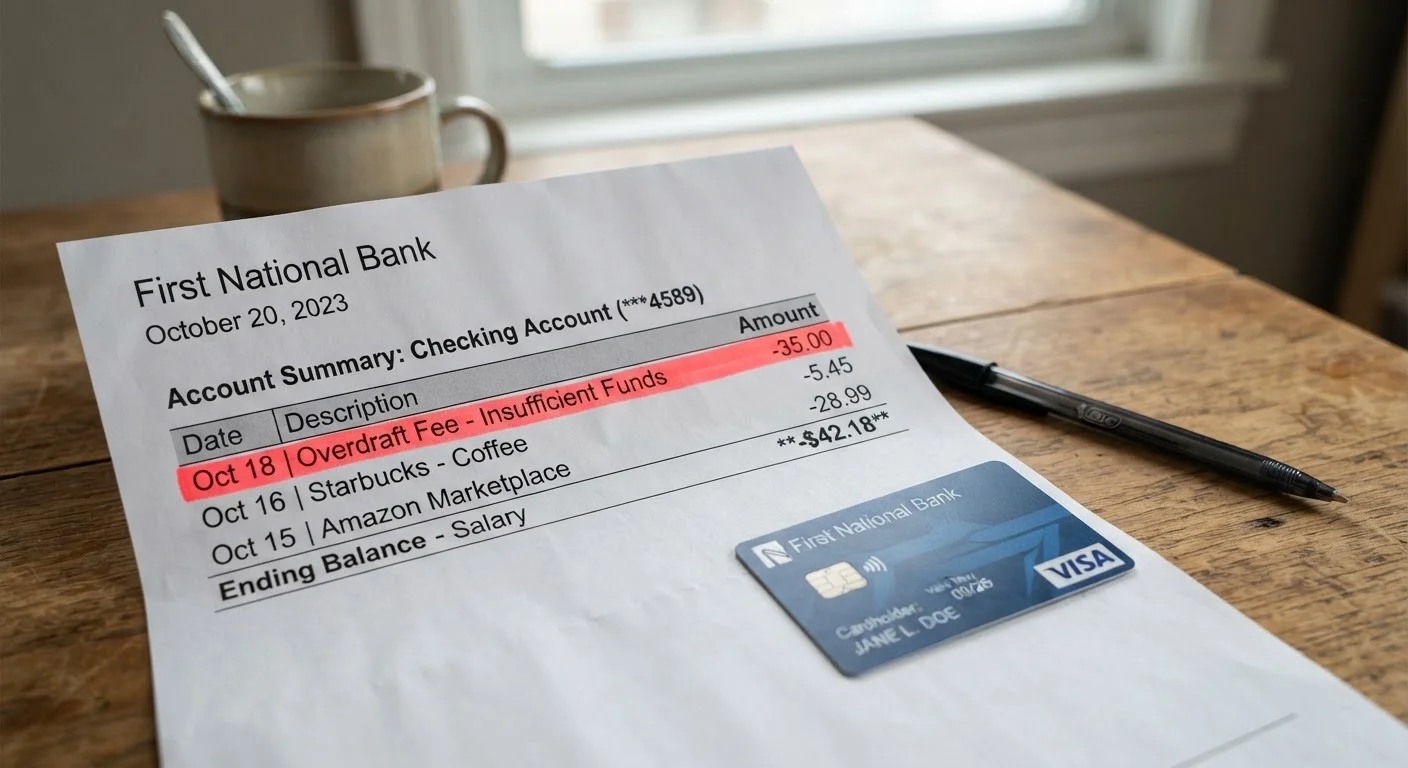
How Overdraft Programs Are Structured
When your checking account balance falls short of a transaction amount, your bank faces a binary choice: decline the transaction or cover it and charge you for doing so. Overdraft programs are the mechanism banks use to offer the latter. Understanding that structure is the starting point for managing these fees intelligently.
Most traditional overdraft programs work as a discretionary courtesy — meaning the bank is not obligated to cover any particular transaction, even if you are enrolled. Coverage is decided transaction by transaction. If the bank pays the shortfall, a flat fee is assessed regardless of whether the overdraft was $3 or $300. That asymmetry — identical fee for wildly different shortfall amounts — is one of the core reasons these programs attract criticism.
Banks also typically charge extended overdraft fees if your account remains negative beyond a defined window, often five business days. That compounds the cost of a single misstep. For a broader look at how checking account fees stack up, see our article on hidden checking account fee structures.
Non-Sufficient Funds (NSF) Fees Are Related but Different
An NSF fee is charged when the bank declines a transaction due to insufficient funds rather than covering it. Both overdraft fees and NSF fees can result from the same underlying shortfall — but the bank's response determines which type of charge applies. Some institutions charge NSF fees on returned checks or declined ACH items separately from their overdraft program. Reviewing your fee schedule for both line items is advisable.
Transaction Order and Why It Matters
One of the least visible mechanics in overdraft programs is transaction posting order. Banks have historically processed transactions in a sequence of their own choosing — and the order can dramatically affect how many overdraft fees are generated in a single day.
Consider a scenario where you have $100 in your account and five pending transactions: four small purchases of $10 each and one large purchase of $90. If the bank posts the large transaction first, your balance drops to $10, and the next four $10 purchases each clear without incident — one overdraft fee at most. But if the bank processes transactions largest-to-smallest, the $90 posts first, leaving $10, and then each of the remaining $10 transactions pushes the account negative — potentially generating multiple overdraft fees from the same spending pattern.
Regulatory pressure from the CFPB has reduced the most aggressive reordering practices at large banks, but policies vary by institution. Checking your bank's deposit account agreement for its stated posting order is worth the effort.
$35
Typical overdraft fee at large US banks
According to the Consumer Financial Protection Bureau, the median overdraft fee at the largest US banks has historically hovered around $35 per transaction.
~9%
Share of consumers paying most overdraft fees
CFPB research has indicated that a small segment of account holders — roughly 9% — account for the majority of overdraft fee revenue, often experiencing more than ten overdrafts per year.
$5.8B
Annual overdraft fee revenue at large US banks
The CFPB estimated that large banks collected billions annually in overdraft and NSF fees before a wave of industry reforms began reducing those figures in the early 2020s.
Opt-In Rules and What They Actually Cover
Federal rules changed significantly in 2010. Under Regulation E, banks are required to obtain your explicit consent — an opt-in — before covering everyday debit card and ATM transactions through a standard overdraft program. If you never opted in, those transactions are declined at the point of sale rather than covered and charged.
However, that opt-in protection does not extend to all transaction types. Checks and ACH (automated clearing house) payments — the electronic transfers that cover bill payments and direct debits — can still be processed and assessed overdraft fees even without your affirmative opt-in. This distinction matters: many automatic bill payments fall into the ACH category, making them a common source of unexpected overdraft charges.
If you are uncertain of your current enrollment status, your bank is required to tell you. Asking to review your overdraft election is a straightforward consumer right.
Check Your Opt-In Status Today
Log into your online banking portal or call your bank's customer service line to confirm whether you are currently enrolled in overdraft coverage for debit card and ATM transactions. If you prefer that transactions be declined rather than covered for a fee, you can request to opt out at any time — no penalty applies for doing so.
Alternatives Worth Understanding
Standard overdraft coverage is not the only option available, and for many account holders, the alternatives carry lower overall costs.
- Linked savings account: Many banks allow you to connect a savings account as a backup funding source. If a transaction would overdraw your checking account, funds are pulled from savings automatically. Banks may charge a transfer fee, but it is typically much lower than a standard overdraft fee.
- Overdraft line of credit: A formal credit product attached to your checking account. Interest accrues on the borrowed amount rather than a flat fee being charged. For larger shortfalls, this structure is usually less expensive — though it requires credit approval.
- Opting out entirely: If you opt out of standard overdraft coverage for debit and ATM transactions, those transactions are simply declined when funds run short. Declining a purchase is inconvenient, but it costs nothing. This is often the most protective option for people working on tighter budgets.
Persistent overdrafting is also worth examining as a signal. If fees appear regularly, it may point to a gap between income timing and spending patterns — something that budgeting fundamentals can help address. For those carrying debt alongside a thin checking buffer, our guide on balancing debt repayment and saving offers a structured approach.
This article is for general informational and educational purposes only and does not constitute personalized financial or legal advice. Fee structures, regulations, and account terms vary by institution and state. Consult your bank's deposit agreement and, where appropriate, a licensed financial professional for guidance specific to your situation.
Frequently Asked Questions
An overdraft fee is triggered when a transaction — such as a debit purchase, check, or automatic payment — exceeds your available account balance and the bank pays it anyway. The fee is charged per transaction covered, not per day. Some banks also charge an extended overdraft fee if your account stays negative for several consecutive days.
Yes. Opting out of standard overdraft coverage means debit card transactions will simply be declined when funds are insufficient, eliminating that type of fee entirely. Linking a savings account as a backup source or maintaining a personal buffer in your checking account are also effective strategies.
No. Standard overdraft protection is a discretionary bank service that covers transactions for a flat fee. An overdraft line of credit is a formal credit product with an interest rate applied to the borrowed amount. The line of credit often costs less for larger shortfalls, but it requires a credit application and approval.
No. Fee amounts and structures vary significantly between institutions. Credit unions and online banks have generally moved toward lower or eliminated overdraft fees in recent years. Reviewing your account's fee schedule — typically available in your deposit agreement — is the most reliable way to understand your specific exposure.
Under Federal Reserve Regulation E, banks must obtain your affirmative consent — your opt-in — before enrolling you in overdraft coverage for everyday debit card and ATM transactions. Without your opt-in, those transactions will be declined rather than covered. Coverage for checks and ACH payments operates under different rules.
The content on this site is for informational purposes only and is not a substitute for professional advice. Always consult a qualified professional for guidance specific to your situation.