

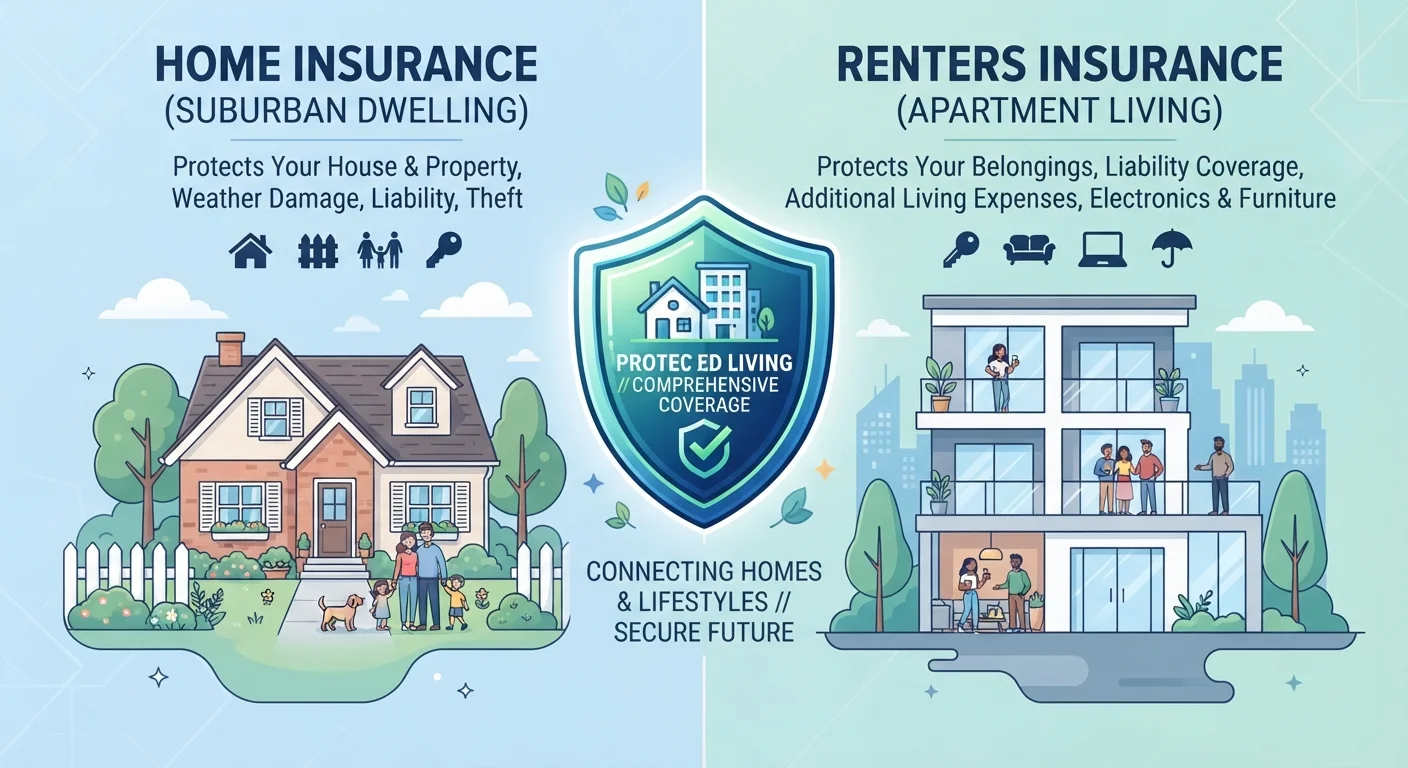
Option A
Homeowners Insurance
The comprehensive coverage for property owners.
Best for: People who own their home and need protection for both the structure itself and their personal belongings.
Option B
Renters Insurance
The affordable protection layer for tenants.
Best for: People who rent an apartment or house and want coverage for their personal belongings and personal liability.
The Core Distinction: What Each Policy Actually Protects
The single most important difference between these two policy types comes down to one question: do you own the building you live in?
Homeowners insurance is built around the assumption that you do. It covers the dwelling structure itself - walls, roof, attached structures like a garage - as well as your personal belongings inside and your personal liability. If a fire damages your roof or a windstorm breaks windows, your homeowners policy is what pays for repairs to the building.
Renters insurance has a narrower scope by design. Because tenants don't own the building, the policy skips structural coverage entirely and focuses on what the tenant actually controls: their personal property and their legal liability. If that same fire destroys your furniture and clothing inside a rented apartment, your renters policy covers those losses - not your landlord's policy.
This is one of the most common misunderstandings in residential insurance. Many renters assume the building owner's policy extends some protection to them. It does not. The landlord's coverage protects the landlord's property. Tenants need their own separate policy to protect theirs. For a broader look at how common insurance misconceptions can cost people money, see what people often misunderstand about insurance coverage.
| Criterion | Homeowners Insurance | Renters Insurance |
|---|---|---|
| Who it's for | Home and condo owners | Renters and tenants |
| Covers the building structure | Yes | No |
| Covers personal belongings | Yes | Yes |
| Personal liability coverage | Yes | Yes |
| Additional living expenses | Yes | Yes |
| Covers detached structures | Yes | No |
| Flood damage (standard policy) | Not included | Not included |
| Typical annual premium range | Higher - varies widely by home value and location | Lower - generally more affordable |
| Often required by | Mortgage lenders | Some landlords |
Coverage Components Side by Side
Both policy types share some structural similarities. Each is typically organized around a few standard coverage categories:
- Personal property coverage - Present in both policies. Reimburses you for belongings damaged or stolen due to covered perils (fire, theft, vandalism, certain water damage, etc.).
- Personal liability coverage - Present in both policies. Covers you if someone is injured on your property or if you accidentally cause damage to someone else's property.
- Additional living expenses (ALE) - Present in both policies. Pays for temporary housing and related costs if a covered loss makes your home uninhabitable.
- Dwelling coverage - Present only in homeowners insurance. Covers the structure of the home, attached garages, and built-in appliances.
- Other structures coverage - Present only in homeowners insurance. Covers detached structures on your property like a fence or shed.
~55%
Renters who carry renters insurance
According to the Insurance Information Institute, roughly 55% of U.S. renters had renters insurance as of recent surveys, leaving nearly half unprotected.
$1,000+
Typical annual homeowners premium (national average)
The National Association of Insurance Commissioners has reported average homeowners insurance premiums exceeding $1,000 annually, though this varies significantly by state and property.
$150-$300
Typical annual renters insurance premium
Renters insurance is widely cited as one of the more affordable insurance products available, with many policies falling in the $150-$300 per year range depending on coverage limits and location.
It's worth noting that personal property coverage under either policy type can be written as actual cash value (what your item is worth today, accounting for depreciation) or replacement cost value (what it would cost to buy a comparable new item). Replacement cost coverage typically comes with higher premiums but provides more complete reimbursement.
Cost Differences and What Drives Premiums
Homeowners insurance premiums are substantially higher than renters insurance premiums, and the reason is straightforward: the policy covers far more. Insuring a building's structure adds significant risk for the insurer, which translates into higher cost for the policyholder.
Several factors affect the premium for either policy type:
- Location - Proximity to fire stations, crime rates, and regional weather risks all influence pricing.
- Coverage limits - Higher limits on personal property or liability mean higher premiums.
- Deductible amount - Choosing a higher deductible (the amount you pay out-of-pocket before insurance kicks in) typically lowers your premium.
- Claims history - A history of prior claims can raise your rates.
- Credit history - In most states, insurers use credit-based insurance scores as one rating factor.
For homeowners, additional factors include the age and condition of the home, the replacement cost of the structure, and the type of construction. Understanding how these variables affect what you pay fits into the broader picture of how insurance coverage and costs work.
Mortgage Lenders and Insurance Requirements
If you finance a home with a mortgage, your lender will almost certainly require you to carry homeowners insurance as a condition of the loan. This protects the lender's financial interest in the property. Renters insurance is generally not legally required, but some landlords include it as a condition of the lease. Even when optional, renters insurance is typically worth considering given the relatively low cost compared to the potential financial impact of an uninsured loss.
Important Gaps in Both Policies
Neither homeowners nor renters insurance is all-inclusive. Some of the most commonly misunderstood gaps include:
- Flood damage - Standard versions of both policies exclude flooding from external water sources. Separate flood insurance, often through the National Flood Insurance Program (NFIP) or a private insurer, is required.
- Earthquake damage - Also excluded from standard policies in most states. A separate endorsement or standalone earthquake policy is needed.
- High-value items - Jewelry, art, collectibles, and certain electronics may have sub-limits under standard personal property coverage. A scheduled personal property endorsement can provide fuller protection for specific valuables.
- Business equipment used at home - Home-based business property may not be fully covered under a standard personal policy.
- Intentional acts and general wear and tear - No standard insurance policy covers damage you cause deliberately or the slow deterioration of your home over time.
Knowing these gaps is essential before a loss occurs. A thorough review of your coverage fits naturally into a broader household insurance audit - see the household insurance coverage checkup framework for a structured approach. You can also explore how different types of insurance work together to understand how each policy fits into your overall protection picture.
This article is for general informational purposes only and does not constitute personalized insurance, financial, or legal advice. Coverage terms, exclusions, limits, and premiums vary by insurer and by state. Always read your actual policy documents carefully and consult a licensed insurance agent or adviser for guidance specific to your situation.
The content on this site is for informational purposes only and is not a substitute for professional advice. Always consult a qualified professional for guidance specific to your situation.