

Our Verdict
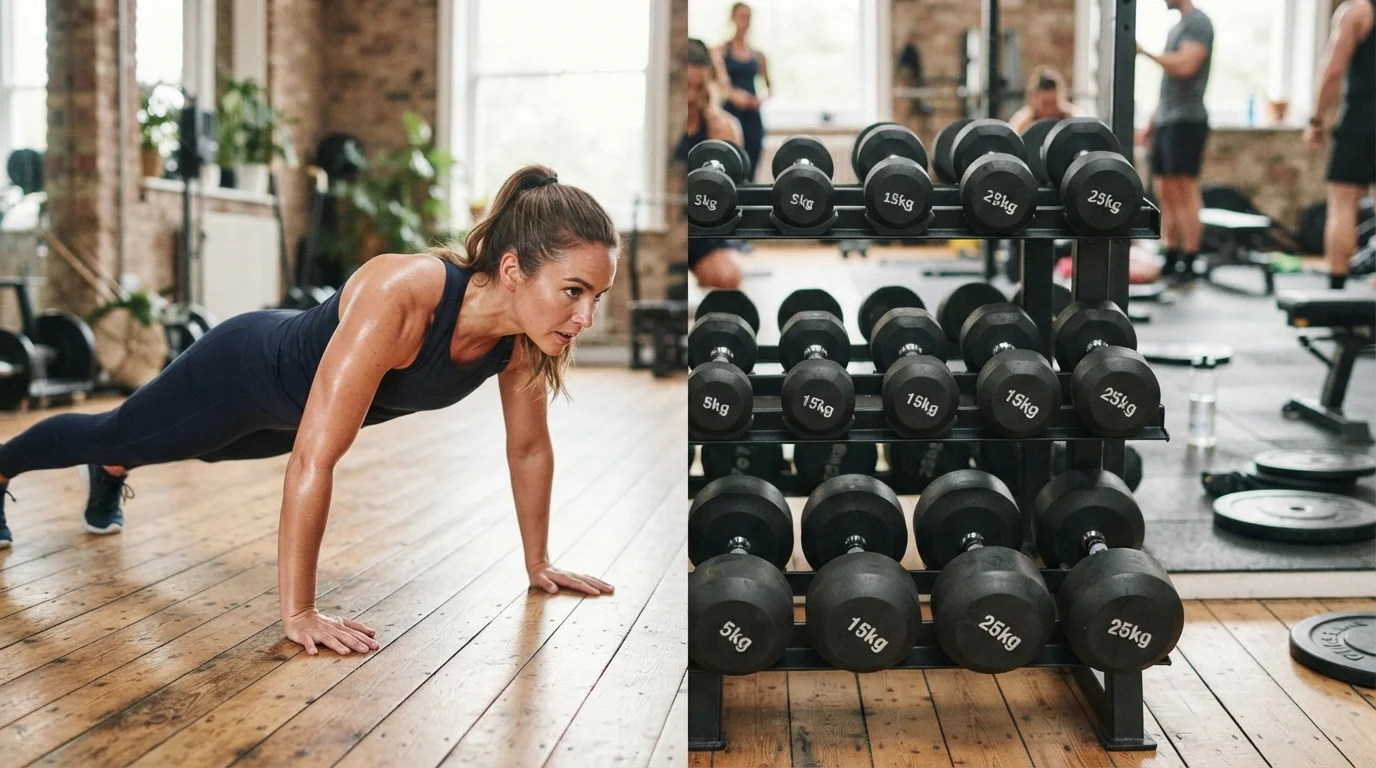
Bodyweight training and free weights are complementary tools, not competing philosophies. Bodyweight methods offer accessibility, functional movement patterns, and joint-friendly progressions, while free weights provide measurable load increases and greater stimulus for hypertrophy over time. Most people benefit from understanding both rather than choosing one permanently.
| Best for | Recommended |
|---|---|
| Those with no gym access or minimal equipment | Bodyweight Training |
| Those prioritizing maximal strength or muscle hypertrophy | Free Weights |
| Beginners building movement competency and body awareness | Bodyweight Training |
| Adults over 40 managing muscle loss with structured progression | Free Weights |
How Each Method Challenges the Body
Resistance training - whether using your own body or external loads - creates mechanical tension in muscle tissue. That tension, over time, drives adaptation. The two methods differ primarily in how that tension is generated and controlled.
Bodyweight training uses the trainee's own mass as resistance. Exercises like push-ups, pull-ups, lunges, and planks require the body to stabilize through multiple planes of motion simultaneously. This places high demand on proprioception (the body's sense of position) and co-contraction of stabilizing muscles. Load is adjusted by changing leverage - elevating feet, slowing tempo, or progressing to single-limb variations.
Free weights - including dumbbells, barbells, and kettlebells - add an external, quantifiable load. This makes progressive overload (gradually increasing resistance) straightforward to track and apply. The trainee can also isolate movement patterns more selectively and fine-tune the stimulus to target specific muscle groups or movement demands.
Understanding how aerobic and anaerobic exercise differ provides useful context here - both bodyweight circuits and free-weight training primarily tap anaerobic pathways, though intensity and rest periods shape the metabolic demand considerably.
Comparing the Two Approaches
The table below summarizes how bodyweight training and free weights compare across the criteria most relevant to everyday fitness decisions.
| Bodyweight Training | Free Weights | |
|---|---|---|
| Equipment required | None (or minimal) | Dumbbells, barbells, or kettlebells |
| Load progression | Indirect (leverage, tempo, variation) | Direct (add weight incrementally) |
| Learning curve | Relatively low for basic movements | Moderate to high for compound lifts |
| Joint stability demand | High - stabilizers always engaged | Variable by exercise and technique |
| Hypertrophy potential | Moderate, especially at beginner level | High with consistent progressive overload |
| Portability | Fully portable, no gym needed | Requires gym or home equipment |
| Injury risk (with poor form) | Lower for most movements | Higher for loaded compound lifts |
One nuance the table doesn't fully capture: free weights require access to equipment and, for compound lifts like the deadlift or overhead press, a degree of technical coaching that bodyweight movements typically don't. Performing barbell work with poor form carries a meaningful injury risk - a point worth taking seriously if you're training independently.
Technique Matters Before Load Does
Adding weight to a compromised movement pattern amplifies the risk of injury rather than the training benefit. If you're new to barbell or dumbbell work, working with a certified strength and conditioning coach or personal trainer - even for a few sessions - can help establish safe mechanics. Don't assume technique will self-correct as you get stronger.
Matching the Method to Your Goal
The most useful framework isn't "which is better" but "which fits this goal right now."
- Building foundational movement patterns: Bodyweight training tends to teach joint awareness and coordination before external load is introduced. This is especially relevant for people building an exercise habit without an athletic background.
- Progressive hypertrophy (muscle growth): Research consistently shows that progressive overload - adding load over time - is a primary driver of hypertrophy. Free weights make this progression more precise and sustainable past the beginner stage.
- Older adults managing muscle preservation: Muscle mass declines with age, a process called sarcopenia. Strength training after 40 benefits from structured load progression, making free weights a valuable tool - though bodyweight work remains effective when access is limited.
- Training with joint pain or limited mobility: Bodyweight exercises can often be modified to reduce compressive joint load, though this depends on the individual and the movement. A physical therapist or certified trainer can help identify what's appropriate.
Start With Movement Quality
Regardless of which tool you choose, movement quality matters more than load at the outset. A controlled bodyweight squat or hinge pattern should feel stable and pain-free before adding external weight. Rushing this step is one of the most common contributors to early training setbacks.
It's also worth noting what fitness research clarifies about common training beliefs: neither method has a monopoly on results. The best training tool is one you use consistently, with sufficient effort, over enough time.
Can You Use Both? When Combining Makes Sense
Many evidence-based training programs integrate both modalities. A practical example: bodyweight warm-up movements to prepare joints, followed by barbell or dumbbell compound lifts, then bodyweight accessory work for stabilizers. This hybrid approach captures the joint-preparation benefits of bodyweight training alongside the load-progression benefits of free weights.
For those managing weight as part of a broader health strategy, evidence-based principles for sustainable weight management place resistance training - of either type - as a meaningful contributor to metabolic health and lean mass retention.
The practical bottom line: if you have access only to your own body, you can build and maintain significant strength and fitness. If you have access to free weights and the foundational knowledge to use them safely, they offer more precise control over progression. Neither choice is wrong - what matters most is that the approach is sustainable, safe, and aligned with what you're actually trying to accomplish.
This article is for general informational purposes only and does not constitute medical or professional fitness advice. Consult a qualified healthcare provider or certified fitness professional before beginning any new exercise program, particularly if you have existing health conditions or prior injuries.
The content on this site is for informational purposes only and is not a substitute for professional advice. Always consult a qualified professional for guidance specific to your situation.