

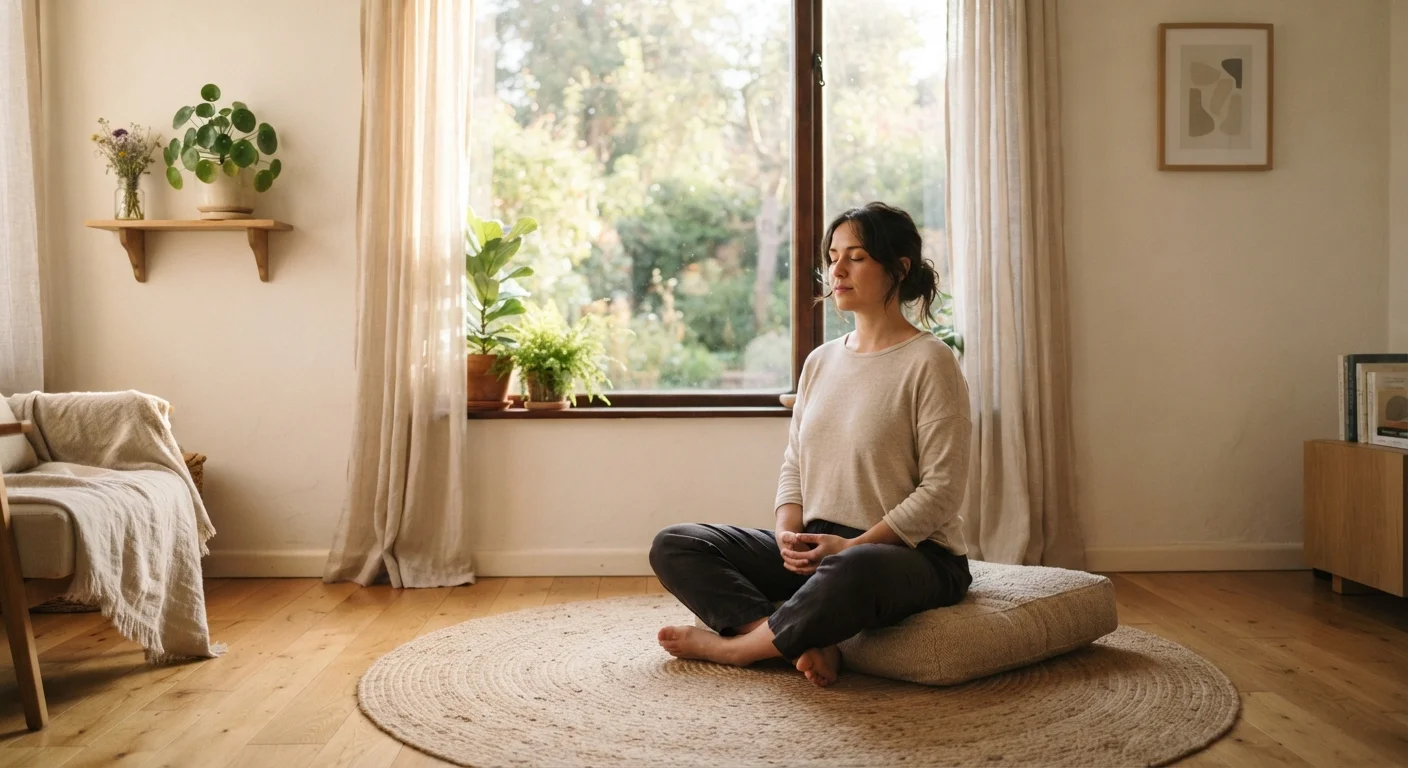
Option A
Mindfulness
The always-available quality of conscious awareness.
Best for: Anyone who wants to reduce reactive thinking and stay more grounded throughout daily life - no dedicated time or setting required.
Option B
Meditation
The structured practice that trains the mind.
Best for: People who want a deliberate, repeatable mental exercise to deepen focus, reduce stress, or build emotional resilience over time.
Two Terms, One Relationship
Mindfulness and meditation appear constantly in wellness conversations, often used as if they mean the same thing. They don't - but they are deeply interconnected. Understanding the distinction helps you make more intentional choices about your own mental wellness practice.
Mindfulness is a quality of attention: a deliberate, non-judgmental awareness of what's happening in the present moment - your thoughts, sensations, emotions, and surroundings. It's something you can bring to any activity. Meditation, by contrast, is a formal practice - a set of intentional exercises done in a dedicated time and space, most of which are specifically designed to cultivate mindfulness (or other mental qualities like compassion or focus).
A useful analogy: mindfulness is to meditation what fitness is to exercise. You build fitness through exercise, but fitness itself shows up in how you move through daily life. For broader context on how these ideas fit into the mental wellness landscape, see what mental wellness means and how it differs from mental health.
| Criterion | Mindfulness | Meditation |
|---|---|---|
| What it is | A quality of awareness | A structured practice or exercise |
| When it happens | Anytime, during any activity | During a dedicated session |
| Time required | No set time; momentary | Typically 5-45 minutes per session |
| Setting | Any environment | Usually quiet, comfortable space |
| Primary goal | Sustained present-moment awareness | Train attention, focus, or emotional skill |
| Learning curve | Immediate to try; deepens with practice | Accessible to beginners; technique refines over time |
| Relationship to the other | Can exist without formal meditation | Almost always develops mindfulness as a byproduct |
What Mindfulness Actually Looks Like in Practice
Because mindfulness is a quality rather than a technique, it doesn't require sitting still or closing your eyes. Washing dishes with full attention to the water temperature, sounds, and sensations - without mentally rehearsing tomorrow's to-do list - is a genuine mindfulness practice. So is noticing the urge to check your phone without immediately acting on it.
Key characteristics of a mindful moment include:
- Present-moment focus: Attention anchored in what's happening now, not replaying the past or rehearsing the future.
- Non-judgmental observation: Noticing thoughts and feelings as passing events rather than fixed truths or commands.
- Intentionality: Choosing to pay attention, rather than operating on autopilot.
Research has associated regular mindfulness practice with reductions in rumination, improved emotional regulation, and lower perceived stress - though it's worth noting that study designs vary, and effects differ by individual. For a grounded look at what the evidence does and doesn't support, explore common mental wellness myths that can shape unrealistic expectations.
47%
Time minds are wandering on average
A Harvard study using experience-sampling found people's minds were not focused on their current activity nearly half the time - and were less happy when wandering.
8 weeks
MBSR program duration with measurable outcomes
Research on the standard Mindfulness-Based Stress Reduction program shows measurable reductions in self-reported stress and anxiety after eight weeks of practice.
~10 min
Minimum effective daily meditation in some studies
Several controlled studies suggest that brief daily sessions of around ten minutes can produce detectable improvements in attention and mood over weeks.
What Meditation Is - and the Main Types
Meditation is any structured mental exercise practiced with intention over a defined period. Sessions can range from five minutes to an hour or more. Most forms share a common architecture: you choose an anchor of attention (breath, a word, a body scan), notice when the mind wanders, and redirect attention back - repeatedly.
Common meditation approaches include:
- Focused attention (concentration) meditation: Sustaining attention on a single object, such as the breath or a repeated phrase.
- Open monitoring meditation: Observing the flow of thoughts, sounds, and sensations without latching on to any one of them - this approach most directly trains mindfulness.
- Loving-kindness (metta) meditation: Cultivating feelings of warmth and goodwill toward oneself and others.
- Body scan: Systematically moving awareness through different regions of the body to notice sensations without judgment.
Structured programs like Mindfulness-Based Stress Reduction (MBSR) and Mindfulness-Based Cognitive Therapy (MBCT) combine formal meditation with mindfulness principles; both have a substantial body of clinical research supporting their use for stress, anxiety, and depressive relapse prevention. That said, meditation is not a substitute for professional mental health care - see when self-care is enough and when professional support is the right call.
This article is for general informational and educational purposes only and is not a substitute for professional medical or mental health advice. Always consult a qualified healthcare provider for guidance specific to your circumstances.
The content on this site is for informational purposes only and is not a substitute for professional advice. Always consult a qualified professional for guidance specific to your situation.